
Quick answer
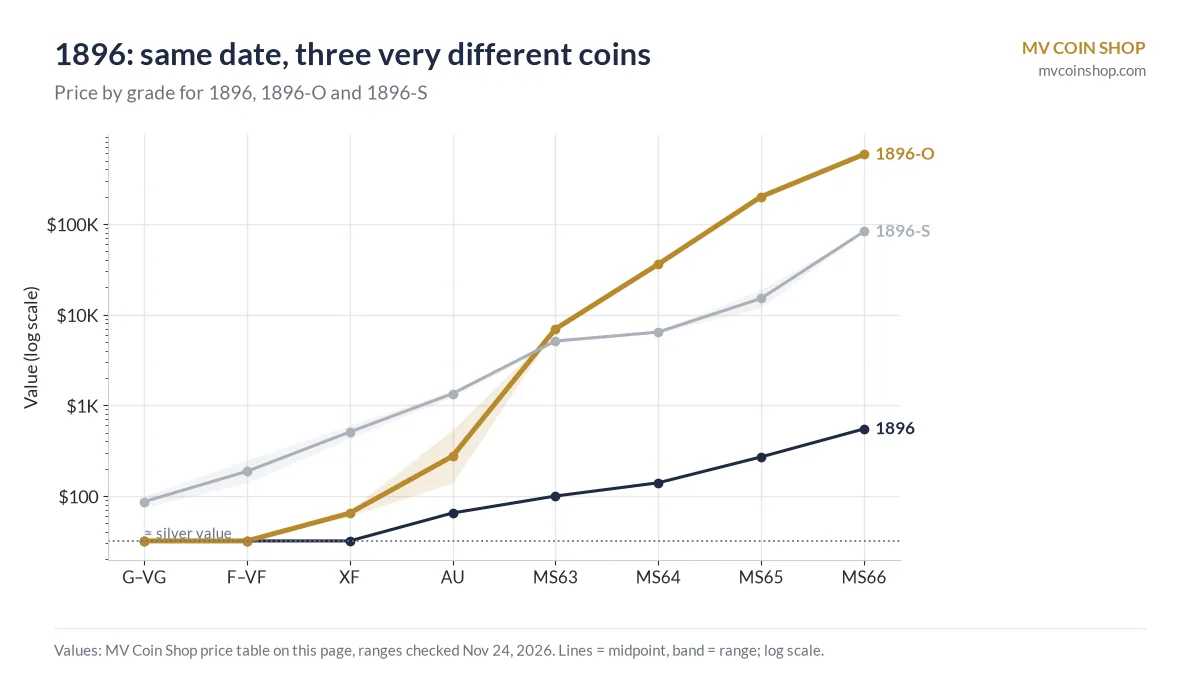
The 1896 (no mint mark) is very common: worn ones trade near silver value (about $32) and uncirculated ones run about $100 in MS63 and about $270 in MS65. The branch-mint coins are a different story. The 1896-O is about $60–$70 in XF but about $6,900–$7,000 in MS63. The 1896-S is valuable in every grade: about $140–$250 in Fine to Very Fine, $1,250–$1,450 in AU and $4,900–$5,350 in MS63.
1896 Morgan dollar values by mint and grade
| Grade | 1896 (no mint mark) | 1896-O | 1896-S |
|---|---|---|---|
| Good–Very Good | near silver value | near silver value | $75–$100 |
| Fine–Very Fine | near silver value | near silver value | $140–$250 |
| Extremely Fine | near silver value | $60–$70 | $430–$600 |
| About Uncirculated | about $65 | $140–$540 | $1,250–$1,450 |
| MS63 | about $100 | $6,900–$7,000 | $4,900–$5,350 |
| MS64 | about $140 | about $36,000 | $6,250–$6,600 |
| MS65 | about $270 | about $200,000 | $12,000–$19,000 |
| MS66 | about $550 | about $585,000 | about $82,500 |
1896 Morgan dollar value finder
Market notes (Nov 2026)
- Worn 1896: near melt (melt is $32.30 at $41.76 silver, COMEX, Nov 24).
- Silver is down about 39% in 2026 (Corgano), so worn 1896 prices fell with it.
- Biggest single grade step: 1896-O from About Uncirculated ($140–$540) to MS63 ($6,900–$7,000), about ×25.3.
- Top of the table: 1896-O in MS65 at $200,000; its silver is 0.016% of that.
Sources: COMEX silver futures, 4:25 a.m. Central, Nov 24, 2026; Corgano 2026 silver price history.
Identify your 1896 Morgan dollar
- Mint marks below the wreath: none = Philadelphia (9,976,000), O (4,900,000), S (5,000,000).
- 1896-O strike: New Orleans coins of this date are often flat on the hair above Liberty’s ear and have dull, baggy surfaces. A truly lustrous, well-struck 1896-O is a rarity.
- Altered mint marks: because the 1896-S is worth far more than the 1896, fakes with an S added to a Philadelphia coin exist. Compare the S to a known genuine San Francisco coin and look for a seam.
How to tell what you have, step by step
If you have just found or inherited an 1896 dollar, work through these in order. You need a kitchen scale that reads to a hundredth of a gram, a ruler or caliper, a fridge magnet and a 5x or 10x loupe.
- Make sure it is real. A genuine Morgan dollar weighs 26.73 grams and measures 38.1 mm across (PCGS specifications). Wear can take a little weight off an old coin, but a coin that is clearly light, thick, too small or pulled by a magnet is not silver and needs a second look before anything else.
- Find the mint mark. Turn the coin over and look just under the wreath bow. No letter means Philadelphia, O means New Orleans, S means San Francisco. That single letter can change the value by a factor of ten or more.
- Decide whether it is worn. Tilt it under one lamp. On an uncirculated coin a band of light sweeps around the fields like spokes on a wheel. On a worn coin the cheek, the hair above the eye and the eagle’s breast look flat and gray, and the shine breaks up.
- Look at the fields. If the flat areas behind the portrait reflect print like a mirror, it may be prooflike, which adds money (see the table below). If the surface looks scrubbed, has fine parallel lines or an unnatural bright white color, it has probably been cleaned, which lowers it.
- Check the variety. Use the quick check further down this page to see whether your coin has one of the dies collectors pay more for.
- Decide whether grading is worth it. For a worn Philadelphia coin it usually is not. For any 1896-O or 1896-S that still has its luster, any prooflike coin and any coin that passes a variety check, a PCGS or NGC grade is what buyers pay for.
A note on the 1896-O: because uncirculated examples are worth thousands, coins that are really About Uncirculated are often offered as “uncirculated.” Rub on the cheek and on the eagle’s breast is the giveaway. An honest AU58 1896-O lists at $675 in the PCGS Price Guide, while a PCGS MS62 lists at $3,150.
Problems that change the value
A cleaned 1896 is worth silver value. Cleaned or damaged 1896-O and 1896-S coins lose a large part of their premium, especially at AU and above, where buyers expect original luster.
Inherited 1896 Morgan dollars?
Check each coin’s mint mark before anything else. An 1896-S in a jar of worn dollars is easy to overlook and can be worth more than everything around it. For taxes, probate and the rest of the collection, see our heir’s guide or what to do with inherited coins.
1896: the year of free silver
1896 was the year of William Jennings Bryan’s “Cross of Gold” campaign for unlimited silver coinage, and silver dollars were at the center of national politics. The Mint’s report for fiscal 1896 shows what was actually happening inside the mints. After the 1893 repeal of the Sherman Act’s purchase clause, the government still held a large stock of silver it had already bought. Coinage of silver dollars from that bullion was resumed on February 1, 1896, and continued for the rest of the fiscal year at a rate of $1,500,000 per month.
Demand for the coins remained weak. The same report records that the assistant treasurer at Chicago shipped 1,000,000 silver dollars to the mint just for storage, and the number of standard dollars in actual circulation barely moved between July 1895 and July 1896. Most 1896 Philadelphia dollars went into bags in vaults, which is why they are common in uncirculated grades today. New Orleans and San Francisco coins were more often paid out, and far fewer survive unworn.
The Director’s report also shows how little the silver in these coins was worth at the time. The average London price for the fiscal year was 67.6 cents an ounce, so the silver in one dollar was worth about 52 cents ($0.52262 in the report), and silver traded against gold at a ratio of 1 to 30.58. Coinage kept running after the fiscal year closed: from July 1 to November 1, 1896, the mints struck 8,702,100 more silver dollars, booking a profit of $2,723,810 on the difference between face value and the cost of the metal. The report counts 52,116,904 standard silver dollars in actual circulation on July 1, 1896, only 136,861 more than a year earlier, even though millions more had been struck.
We check coins like this for free, no obligation, at our office in Mountain View (by appointment): book here or call (415) 952-6467. If you would rather sell, we buy Morgan dollars.
1896 Morgan dollar varieties (VAMs)
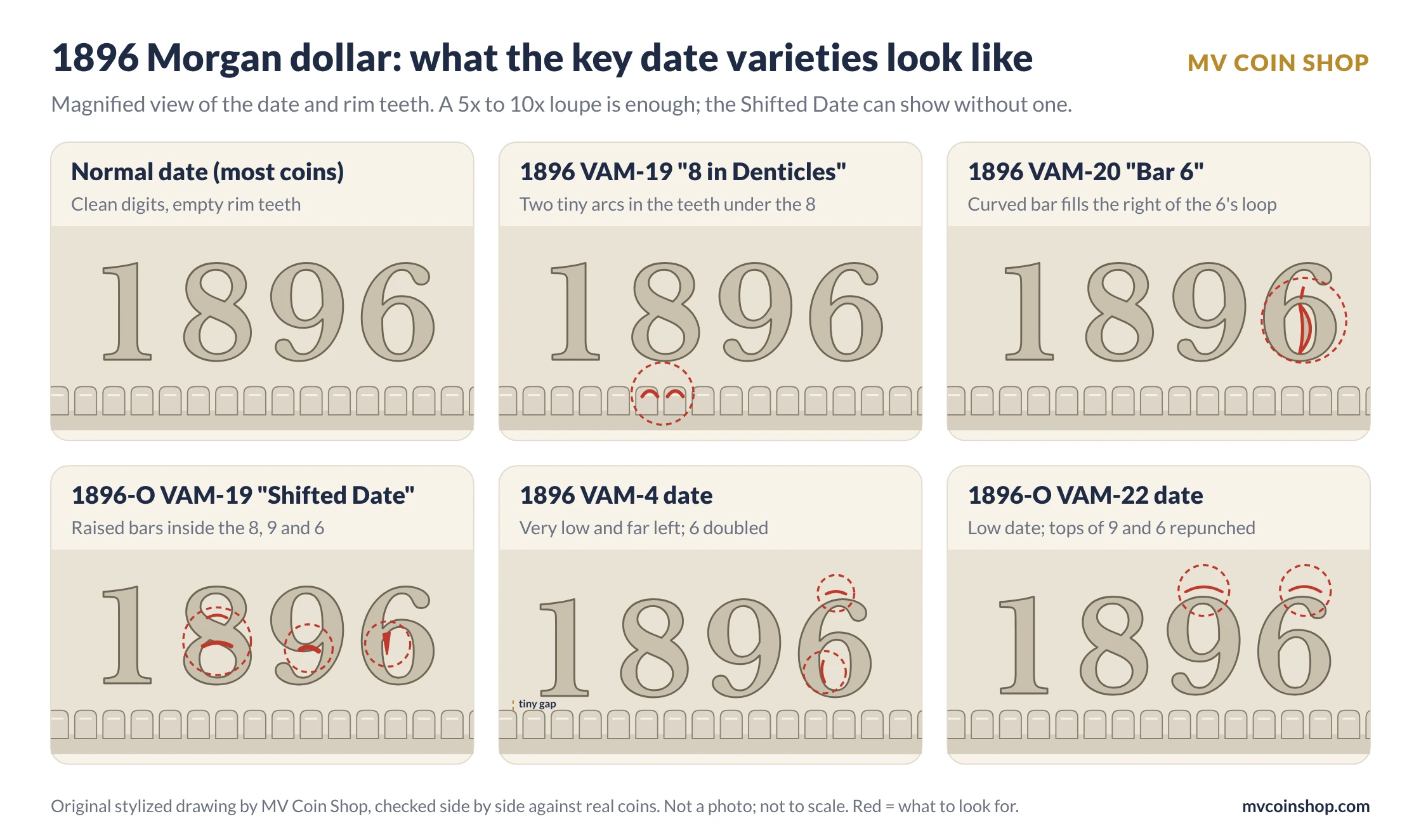
Collectors recognize 104 die varieties, or VAMs, for 1896: 56 from Philadelphia, 37 from New Orleans and 11 from San Francisco. Most sell for the same as a regular coin. The few that pay more are the 1896 VAM-4 Doubled Stars, VAM-19 “8 in Denticles” and VAM-20 “Bar 6”, the 1896-O VAM-19 Shifted Date and the 1896-S VAM-5 S over S. One famous name, the 1896-O “Micro O”, is a period counterfeit. A different 1896-O die, VAM-22 (low date, slightly repunched 96, O tilted right), was long listed as privately made. In March 2026, VAMWorld revised it to a genuine Mint product, consistent with a 2015 NGC study that had argued the variety was wrongly condemned. It is not the Micro O. Our 1896 Morgan dollar VAM guide lists all 104 with values and a finder.
Quick check: is my 1896 Morgan dollar a valuable VAM?
Answer up to four questions. Easy naked-eye checks come first, loupe checks last.
For all 104 VAMs, use the full 1896 VAM finder.
See all 104 1896 VAMs, with diagrams and a value for each: 1896 Morgan dollar VAM varieties.
Full guides to the 1896 varieties that pay more
- 1896 VAM-4 Doubled Stars
- 1896 VAM-19 “8 in Denticles”
- 1896 VAM-20 “Bar 6” (the so-called 1896/4)
- 1896-O VAM-19 Shifted Date
- 1896-O VAM-4 Micro O (period counterfeit)
- 1896-O VAM-18A Clashed G and t
- 1896-O VAM-22 low date (now judged genuine)
- 1896-S VAM-5 S over S
Each guide has a close-up drawing, step-by-step checks, the die markers, PCGS prices and population by grade, recent sales and our rarity rating.
How many 1896 Morgan dollars survive?
Mintage tells you how many were made. What sets the price today is how many are left, and in what grade. The table puts PCGS’s survival estimates next to the number of coins each grading service has actually certified.
| Coin | Struck | PCGS estimate, all grades | Estimate, MS60 and up | Estimate, MS65 and up | PCGS has graded | NGC has graded (MS) |
|---|---|---|---|---|---|---|
| 1896 | 9,976,000 | 1,000,000 | 230,000 | 15,000 | 67,867 | 79,371 |
| 1896-O | 4,900,000 | 490,000 | 23,000 | 8 | 10,105 | 9,272 |
| 1896-S | 5,000,000 | 500,000 | 28,000 | 156 | 5,165 | 3,170 |
Two numbers jump out. PCGS thinks only about 8 gem (MS65 or better) 1896-O dollars exist, which ranks it among the four rarest Morgan dollars in gem condition (PCGS lists its rarity in that grade range as R-9.6). The 1896-S is less extreme, with about 156 gems, but it is the only one of the three that is scarce even worn: in the PCGS Price Guide, an F15 1896-S lists at $140 while the 1896 and 1896-O list at $92, close to silver value.
Why so few? Most of the loss happened long before collectors cared. Under the 1918 Pittman Act the Treasury melted hundreds of millions of silver dollars, and Q. David Bowers estimates that 2 to 3 million 1896-S dollars went into that melt; he describes the 1896-O losses as “millions,” mint-state coins included. Many worn Philadelphia dollars were melted again when silver spiked in the 1970s. The coins that did survive in bags were paid out by the Treasury in the 1950s and early 1960s: many hundreds of bags of 1896 Philadelphia dollars (well over a million coins), several 1,000-coin bags of 1896-O, and some 1896-S bags in the 1950s that have long since been spread out among collectors (Bowers, as quoted on PCGS CoinFacts). That is why a roll of mint-state 1896 dollars is easy to find and a single gem 1896-O is not.
For the 1896-O, Bowers puts the population at roughly 2,000 to 4,000 coins in MS60 to MS62, then only 200 to 350 in MS63 and 75 to 150 in MS64. The price ladder below follows those numbers almost exactly.
Strike and luster by mint
| Mint | How they are usually struck | Luster | What it means for you |
|---|---|---|---|
| 1896 (Philadelphia) | Usually well struck | Varies from frosty to dull or “greasy” | Lots of choice, so pay up only for frosty, well-struck coins |
| 1896-O (New Orleans) | Nearly always flat, especially on the hair above the ear | Often dull and heavily bag-marked | A sharp, lustrous 1896-O deserves a premium over its grade |
| 1896-S (San Francisco) | Below average to average, some weak in the centers | Usually excellent | Even a softly struck 1896-S can be attractive; judge the luster |
NGC’s own notes say most 1896-O coins are abraded with poor strike and luster and that the typical survivor sits in the high AU range, and that most 1896-S dollars went into circulation and show many abrasions. In plain terms: for the branch mints, an uncirculated coin with a clean cheek is the exception, and graders and buyers price it that way.
Prooflike and deep mirror prooflike 1896 dollars
Some business-strike coins were made from freshly polished dies and have mirror-like fields. Graders call a coin prooflike (PL) when the mirror reflects clearly at a short distance, and deep mirror prooflike (DMPL, or DPL at NGC) when it reflects at a longer distance with frosted design against black-looking fields. The label adds real money, but it is rare on the branch mints.
| Coin | PCGS PL | PCGS DMPL | NGC PL | NGC DPL | PCGS Price Guide |
|---|---|---|---|---|---|
| 1896 | 1,364 | 919 | 954 | 409 | MS63PL $185, MS65PL $650; MS63DMPL $450, MS65DMPL $1,500, MS66DMPL $5,500 |
| 1896-O | — | — | 49 | 10 | Record: $13,200 for a PCGS MS62PL (Stack’s Bowers, April 2024) |
| 1896-S | — | — | 9 | 2 | No PCGS auction record for a DMPL |
PCGS estimates about 3,000 prooflike and 2,100 deep mirror 1896 Philadelphia dollars survive. Compare a regular MS65 at $225 in the PCGS Price Guide with an MS65DMPL at $1,500: if your common 1896 has mirror fields, it is worth having it graded. The auction record for an 1896 PL is $19,200 for a PCGS MS67+PL (Heritage, June 2024). Bowers notes that the few 1896-O prooflikes are mostly low-contrast and heavily bag-marked, which is why even an MS62PL brought five figures.
1896 proof Morgan dollars
The Philadelphia Mint also struck 762 proofs for collectors in 1896 (PCGS). Proofs were struck twice or more from polished dies on polished blanks, so they have needle-sharp detail, squared-off rims and deep mirror fields. A prooflike business strike, by contrast, has a rounded rim, softer detail and usually some bag marks. All proofs were made at Philadelphia, so a proof 1896 never has a mint mark. Three dies were used only for proofs (VAM-18, 40 and 41); see the 1896 VAM list.
| Grade | Proof | Cameo | Deep Cameo |
|---|---|---|---|
| PR63 | $4,000 | $4,400 | $5,500 |
| PR65 | $6,500 | $7,250 | $10,500 |
| PR67 | $17,500 | $27,000 | $32,500 |
| PR68 | $30,000 | $52,500 | $65,000 |
| PR69 | — | $115,000 | — |
PCGS has graded 246 as plain proofs, 85 as Cameo and 38 as Deep Cameo (Nov 24, 2026), some of them more than once. The auction records are $66,700 for a PR68 (Bowers and Merena, October 2005), $84,000 for a PR68+ Cameo (Heritage, January 2022) and $126,500 for a PR69 Deep Cameo (Heritage, April 2006).
Auction records and price history
| Coin | Grade (PCGS) | Price | Sale |
|---|---|---|---|
| 1896-S | MS69 | $720,000 | Stack’s Bowers, Nov 18, 2020 |
| 1896-O | MS66 | $528,000 | Stack’s Bowers, Nov 18, 2020 |
| 1896 proof | PR69 Deep Cameo | $126,500 | Heritage, Apr 6, 2006 |
| 1896 | MS68 | $30,550 | Legend Rare Coin Auctions, Oct 8, 2020 |
| 1896 prooflike | MS67+PL | $19,200 | Heritage, Jun 16, 2024 |
| 1896-O prooflike | MS62PL | $13,200 | Stack’s Bowers, Apr 3, 2024 |
The same top coins tell the price story. The 1896-S MS69, the only one PCGS lists in that grade, sold for $402,500 at Heritage in November 2005 before its $720,000 sale in 2020. An 1896-O in MS66 brought $345,000 in that same 2005 sale (the Jack Lee collection) against $528,000 in 2020. Lower down, prices are less steady. PCGS records an 1896-O MS65 at $149,500 in April 2002, then $94,000 in April 2013 and $96,000 in June 2024. An 1896-S MS67 went from $132,000 in December 2020 to $158,600 in September 2026.
PCGS price ladder by grade
The table near the top of this page gives our rounded ranges. Here are the PCGS Price Guide values for the same three coins grade by grade, so you can see exactly where each one jumps.
| Grade | 1896 | 1896-O | 1896-S |
|---|---|---|---|
| VF20 | $92 | $92 | $200 |
| XF40 | $92 | $92 | $500 |
| XF45 | $92 | $125 | $800 |
| AU50 | $94 | $160 | $1,475 |
| AU55 | $94 | $300 | $2,100 |
| AU58 | $94 | $675 | $2,250 |
| MS60 | $95 | $2,100 | $3,100 |
| MS62 | $95 | $3,150 | $4,300 |
| MS63 | $100 | $7,500 | $5,000 |
| MS64 | $140 | $36,000 | $6,500 |
| MS65 | $225 | $200,000 | $12,000 |
| MS66 | $450 | $585,000 | $82,500 |
| MS67 | $1,650 | none graded | $150,000 |
What PCGS coins actually sold for recently
| Coin and grade | Price | Sale |
|---|---|---|
| 1896 MS65 | $288 | Stack’s Bowers, Jan and Mar 2026 |
| 1896 MS66 | $500 | Heritage, Aug 2026 |
| 1896 MS67 | $2,440 | Heritage, Sep 2026 |
| 1896-O AU58 | $528 | Stack’s Bowers, Mar 2026 |
| 1896-O MS62 | $2,928 | Heritage, Jul 2026 |
| 1896-O MS63 | $7,015 | Stack’s Bowers, Sep 2026 |
| 1896-O MS64 | $43,920 | Stack’s Bowers, Sep 2026 |
| 1896-S XF40 | $415 | Stack’s Bowers, Oct 2026 |
| 1896-S AU55 | $1,830 | Heritage, Jan 2026 |
| 1896-S MS63 | $3,904 | Heritage, Jul 2026 |
| 1896-S MS64 | $5,124 | Stack’s Bowers and Heritage, Sep 2026 |
| 1896-S MS66 | $56,120 | Heritage, Sep 2026 |
What drives the market for 1896 dollars
- Silver sets the floor. Worn Philadelphia and New Orleans coins trade within a few dollars of melt, so they move with the silver price (see the market notes above).
- Guide prices are a ceiling more often than a floor. Many recent sales came in under the PCGS Price Guide: an 1896-S MS64 at $5,124 against a $6,500 guide, an 1896-O AU58 at $528 against $675. Use the guide to see the shape of the market and recent sales to set a price.
- The 1896-O is the most grade-sensitive. One grade step from MS63 to MS64 is the difference between about $7,500 and $36,000 in the guide. That is why these coins are often regraded and why a sale in one grade can swing widely.
- Plus grades and eye appeal pay. PCGS lists an 1896 MS65+ at $285 against $225 for MS65, and an 1896-O AU58+ at $875 against $675.
- Registry collectors chase the top. The records above came from famous Morgan sets, such as the Jack Lee collection, that competed in the PCGS Set Registry.
Toning on 1896 Morgan dollars
Silver tones over time. Dollars that sat for decades in canvas bags or paper rolls sometimes picked up bands of blue, green, gold and violet, especially on the side that touched the cloth. Collectors pay a lot for natural, vivid color. In August 2020 a PCGS MS66+ 1896 with bright rainbow bag toning sold for $18,212.50 at a Legend auction, while the next lot, another MS66+ with duller color, brought $587.50 (Coin World, Aug 10, 2020). Plain gray or brown toning usually adds nothing.
Because the premium is so large, artificial toning is common. Warning signs are colors that are too even, too bright for the age, or that cover worn spots and scratches as well as the fields. PCGS and NGC will not give a regular grade to a coin they judge artificially toned. If an ungraded “rainbow” 1896 is priced like a monster, assume it is not one until a grader says so.
Counterfeits and altered mint marks
The 1896 has three kinds of trouble:
- Period counterfeits. The 1896-O “Micro O” was made outside the Mint, apparently not long after 1896. PCGS found that the 1896-O, 1900-O and 1902-O Micro O coins share die markers, and in April 2005 it declared all three contemporary counterfeits. They are silver and look old, so they fool people. See our Micro O guide.
- Modern fakes. Cast or struck copies of Morgan dollars, many of them base metal, are sold online and at flea markets. Weight (26.73 g), diameter (38.1 mm), a magnet test and the sharpness of the edge reeding catch most of them. Mushy letters, a grainy or bubbly surface and a coin that rings dull are other signs.
- Added mint marks. An 1896-S is worth far more than an 1896 in every grade, so some Philadelphia coins have had an S glued or soldered on. Look under a loupe for a seam, a glue line or a letter that sits on top of the field instead of rising out of it. Collectors also use the VAM book: if your “S” coin was struck by a die pair that is only known on Philadelphia coins, the mint mark was added.
If the coin is valuable, the safest test is a PCGS or NGC holder. Check the certification number on the grader’s website, since fake holders exist too.
Frequently asked questions
How much is an 1896 Morgan silver dollar worth?
A worn 1896 (no mint mark) is worth about silver value, around $32. Uncirculated, it is about $100 in MS63.
How much is an 1896-O Morgan dollar worth?
About $60–$70 in XF and $140–$540 in AU, but about $6,900–$7,000 in MS63. It is a classic condition rarity.
How much is an 1896-S Morgan dollar worth?
About $75–$100 in Good to Very Good, $430–$600 in XF and $4,900–$5,350 in MS63.
Where is the mint mark on an 1896 silver dollar?
On the reverse, below the wreath and above the letters DO in DOLLAR.
How many 1896 proof Morgan dollars were made?
762, all at Philadelphia. PCGS estimates a few hundred survive, and a PR65 lists at about $6,500 in the PCGS Price Guide (Nov 2026).
What is the most valuable 1896 Morgan dollar?
The 1896-S graded PCGS MS69, which sold for $720,000 at Stack’s Bowers in November 2020. The 1896-O record is $528,000 for a PCGS MS66 at the same sale.
Why is the 1896-O so expensive in mint state?
Most 1896-O dollars were weakly struck, circulated or melted. PCGS estimates only about 8 survive in MS65 or better, so a gem lists at about $200,000 even though worn ones are worth little over silver value.
Related pages
- 1893-S Morgan dollar value
- 1898 Morgan dollar value
- 1921 Morgan dollar value
- Morgan dollar values (all dates)
- All 104 1896 Morgan dollar VAMs
Sources
- Values: APMEX coin-value pages and CoinsWorth auction estimates, checked Nov 24, 2026, rounded by us.
- Mintages: Morgan dollar mintage table (Wikipedia, citing Red Book/CoinFacts).
- History: Annual Report of the Director of the Mint, fiscal year ended June 30, 1896.
- Survival estimates, population, Price Guide, auction records and Bowers commentary: PCGS CoinFacts 1896, 1896-O, 1896-S, PL #7241, DMPL #97241 and proofs #7331, #87331, #97331, checked Nov 24, 2026.
- NGC Census and notes: NGC Coin Explorer 1896-O and 1896-S, checked Nov 24, 2026.
- Toning sale: Steve Roach, “Market Analysis: All colors of the rainbow on 1896 Morgan dollar,” Coin World, Aug 10, 2020.
- Micro O: PCGS announcement, April 2005. Altered mint marks and die pairs: CoinCommunity forum thread 332377.
- Mint figures (bullion value, ratio, July to November 1896 coinage, dollars in circulation): Annual Report of the Director of the Mint for fiscal 1896, pages on silver and coinage.
By David, owner of Mountain View US and Foreign Coins, ANA member and PCGS and NGC submitter.