
By David · Updated November 26, 2026
I’m David. I buy sterling flatware, hollowware, and estate silver at our office in Mountain View, by appointment, and I work with sellers in other states through photo reviews and insured mail-in. I’m a member of the American Numismatic Association and a PCGS and NGC submitter, so if a silver chest comes with a box of coins, I can handle both at one appointment. This page explains how I price silverware, step by step.
How selling your silverware works
- Send a count or a few photos. Text or email a picture of the set and a close-up of the marks on the back of two or three handles, or use the appraisal request form. Tell me roughly how many pieces there are and whether the knives have stuffed handles. The photo review is free.
- Choose where we meet. Most sellers come to our office in Mountain View, by appointment. For a large estate set or a heavy chest, a house call is usually easier. If you are out of state, we can arrange insured mail-in once we agree on how the lot will be priced.
- We weigh and test in front of you. Solid pieces go on a calibrated scale in grams. Hollow-handle knives and weighted pieces are set aside and counted on their own line. Anything with worn or unclear marks is tested before it is priced.
- You get a written offer. It lists each group (forks, spoons, serving pieces, knives) with its weight and the silver spot price used. You can accept all of it, part of it, or none of it, with no fee for the evaluation.
- You get paid. Cash, check, or bank transfer, whichever we agree on before we meet. The number on the paper is the amount you receive.
Sterling or silver plate? Read the marks first
Sterling silver is 92.5% pure silver; the remaining 7.5% is usually copper, added for strength. Silver plate is a thin coat of silver over a base metal such as brass or nickel silver, and as metal it is worth very little. Turning a fork over and reading the back of the handle settles most questions in a few seconds.
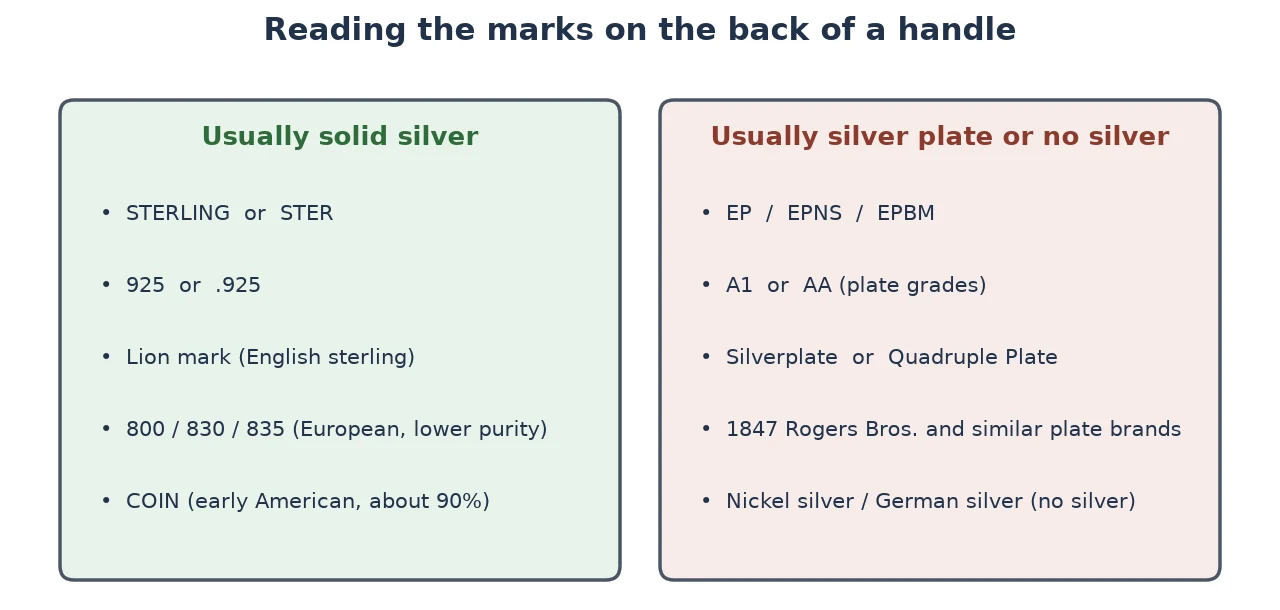
- American sterling is normally stamped STERLING, often next to the maker’s name or trademark. Some later and imported pieces read simply 925.
- English sterling carries a group of hallmarks: a walking lion for sterling, a town mark, and a letter that dates the piece.
- Continental European silver is often 800 or 835 fine. It holds less silver than sterling, and I price it on its own silver content.
- Early American coin silver is about 90% silver and may be marked COIN, PURE COIN, or with only a maker’s name.
- Plate marks include EP, EPNS, A1, Silverplate, and Quadruple Plate, plus brand names such as 1847 Rogers Bros. Nickel silver and German silver contain no silver at all.
A magnet makes a quick first screen, because sterling does not stick to one. Passing that test does not prove a piece is sterling, though: brass and nickel silver are not magnetic either. When the marks are missing, I test the metal.
How the .925 math turns weight into silver value
For solid sterling, the starting point is the silver inside it. Weigh the pieces in grams, multiply by 0.925 to get the pure silver, divide by 31.1035 to convert to troy ounces, and multiply by the silver spot price. The result is melt value.
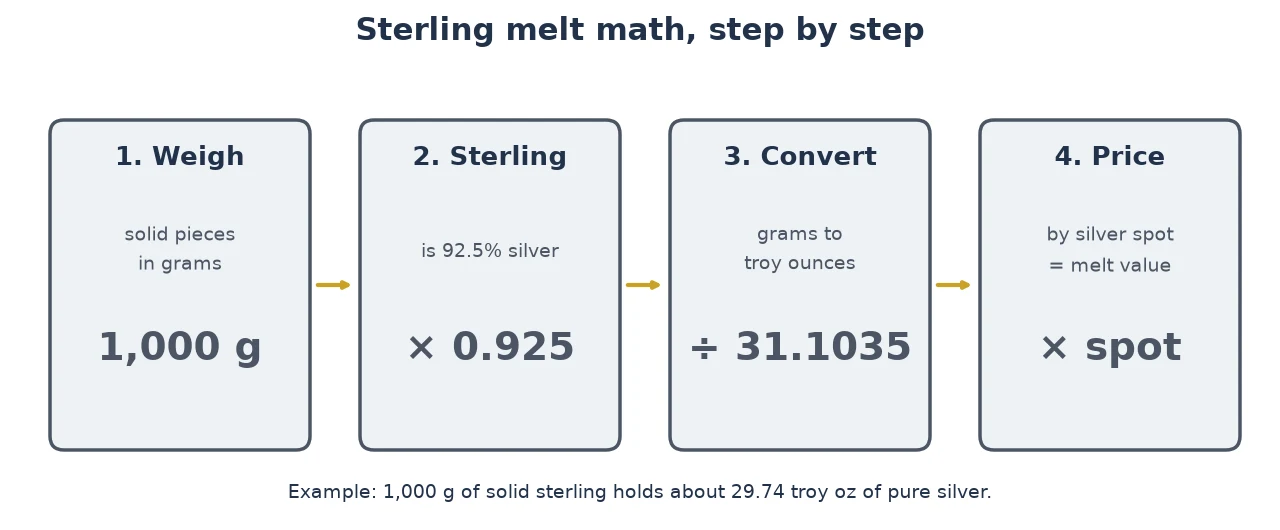
At a reference spot price of $41.10 per troy ounce (November 26, 2026), each gram of sterling holds about $1.22 of silver, and a troy ounce of sterling, as weighed, holds about $38.02. A kitchen scale is fine for a rough idea. Set it to grams: the kitchen ounce (28.35 g) is lighter than the troy ounce silver is priced in, and mixing the two up is one of the most common errors I see in sellers’ own math.
An offer for sterling is a percentage of melt rather than melt itself, because the silver still has to be refined. I don’t publish a single percentage, since it depends on the size of the lot and the market that day. What I do is write the weight, the spot price, and the offer down side by side, so you can see exactly how the number was reached. If the lot also includes bars or rounds, the same approach is explained on selling silver and gold bullion, and pre-1965 coins are covered on selling silver coins.
Hollow-handle knives: what counts and what doesn’t
Most sterling dinner knives made in the last century have a stainless steel blade set into a hollow sterling handle. The handle is two thin silver shells soldered together and packed with a filler, usually pitch or a cement compound, that holds the blade in place. Blade and filler both add weight on the scale. Neither contains silver.
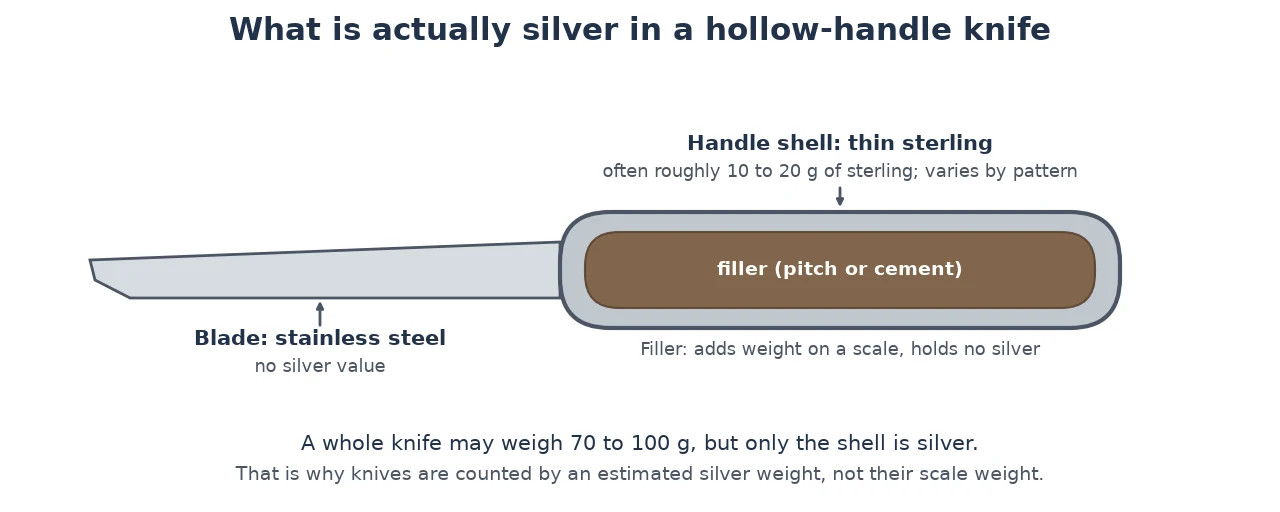
A whole knife can weigh 70 to 100 grams, while the silver in its handle is often closer to 10 to 20 grams, depending on the pattern and the maker. A buyer who prices knives at their full weight is overpaying on paper and has to make it back elsewhere in the offer. A buyer who pays nothing for them is underpaying. I count knives by an estimated silver weight per handle and show that as its own line. The same applies to weighted candlesticks, compotes, and other hollowware with a cement-filled base.
Please don’t take a knife apart to prove anything. Opening a handle ruins it as usable flatware and doesn’t change how it is priced.
Makers, patterns, and sets worth more than their silver
Most everyday place settings sell on their silver weight. A smaller group of patterns and serving pieces can bring more than melt from people completing a set, especially when the pieces are unmonogrammed and in good condition. Makers I see often include:
- Gorham, one of the oldest American silver makers, with patterns such as Chantilly and Strasbourg.
- Reed & Barton, founded in 1824, with Francis I, French Renaissance, and Florentine Lace.
- Wallace, founded in 1835, with Grande Baroque, Rose Point, and Sir Christopher.
- Towle, International, Kirk Stieff, and Tiffany, along with many smaller American and European makers.
If the maker on your set isn’t on this list, that’s fine. The weight, the marks, and the condition tell most of the story, and if a pattern deserves a closer look before it is sold for metal, I’ll say so.

Example: how an inherited sterling chest breaks down
Illustrative example only. This is not a real customer, not a quote, and not a price list. It shows how a common twelve-place-setting chest with a few serving pieces adds up, using typical weight ranges for each type of piece.
Swipe the table sideways to see all five columns.
| Group | Pieces | Sterling weight counted | Pure silver (troy oz) | Melt at $41.10 spot |
|---|---|---|---|---|
| Dinner or place forks | 12 | 540–660 g | 16.1–19.6 | $660–$810 |
| Salad forks | 12 | 384–480 g | 11.4–14.3 | $470–$590 |
| Place or soup spoons | 12 | 480–600 g | 14.3–17.8 | $590–$730 |
| Teaspoons | 24 | 576–768 g | 17.1–22.8 | $700–$940 |
| Solid serving pieces | 6 | 360–660 g | 10.7–19.6 | $440–$810 |
| Hollow-handle knives (silver in the handles only) | 12 | 120–240 g | 3.6–7.1 | $150–$290 |
| Total | 78 | 2,460–3,408 g | 73.2–101.4 | $3,010–$4,170 |
Weights are typical ranges for American sterling patterns; your set may be lighter or heavier. Melt is metal value at a reference silver spot price of $41.10 per troy ounce on November 26, 2026. It is not an offer: an offer is a percentage of melt, and a sought-after pattern can be priced above it.
Two lines move the total more than any other: the knives and the serving pieces. A chest with heavy serving pieces can hold more silver than another set with twice as many teaspoons. The wooden chest itself usually adds little, and monograms rarely matter for melt, although they do lower a set’s appeal to pattern buyers.
Before you sell silverware
- Don’t polish. Tarnish doesn’t change a weight-based offer, and polishing removes a little silver.
- Keep sets together, chest included. If plate and stainless are mixed in, bring it all; sorting is part of the appointment.
- Check every piece for marks. Mixed drawers often hide a few sterling pieces among the plate.
- Bring the rest of the lot. Gold rings and chains are priced the same way, by content and spot; see selling gold jewelry.
Silverware in an estate
Sterling often turns up alongside coins and jewelry when a family is clearing out a parent’s home. You can bring everything to one appointment and get a single written offer, itemized by category, so the estate’s records stay simple. If coins are part of it, start with my guide to an inherited coin collection, which covers what to keep together and what not to clean. When you’re ready, the appraisal request form is the fastest way to send photos and a rough inventory. If the coins are most of the lot, selling a coin collection explains how we price them, and for a written value for the estate without selling, see coin appraisals.
Frequently asked questions
What is the best way to sell sterling silver flatware?
Separate the sterling from any plate, then get a written offer that shows the weight in grams, the silver spot price used, and how the knives were counted. Those three numbers show exactly how the price was reached. Selling a whole set to one buyer is fastest; selling desirable pattern pieces one at a time online can bring more, but it takes longer and comes with fees.
How much can I sell my sterling flatware set for?
Start from the silver it holds: weight in grams times 0.925, divided by 31.1035, times the silver spot price. That is melt value, and an offer is a percentage of it. A twelve-place set with a few serving pieces often holds somewhere around 70 to 100 troy ounces of pure silver, so the spot price on the day matters a great deal.
Who pays the most for sterling silver flatware?
Usually the buyer who weighs in front of you, counts hollow-handle knives by their silver rather than their total weight, and writes down the spot price and the percentage. For a sought-after pattern in good condition, a buyer who resells to people completing sets may pay more than a metal buyer, and I will tell you when a set looks like one of those.
Do you buy partial sets, single pieces, or mixed drawers?
Yes. A partial set, a few serving pieces, a single sterling bowl, or a drawer where sterling is mixed in with plate and stainless are all fine. I sort it with you and only price the pieces that contain silver.
How do I know if my silverware is sterling or silver plate?
Turn a piece over and read the back of the handle. STERLING, 925 or .925, and English hallmarks with a walking lion indicate solid silver. EP, EPNS, A1, Silverplate, Quadruple Plate, and names like 1847 Rogers Bros. indicate plate. Nickel silver and German silver contain no silver. When the marks are worn, I test the metal.
How are hollow-handle knives priced?
By an estimated silver weight per handle, not by what the whole knife weighs. The blade is stainless steel and the handle is packed with filler, so only the thin sterling shell counts. That is often around 10 to 20 grams per knife, depending on the pattern.
Should I polish my silver before selling it?
No. Polishing takes off a little silver and does not raise a weight-based offer. Tarnish has no effect on the price, and leaving pieces as they are also keeps maker marks easy to read.
Do I need an appointment, and can you come to me?
Yes, we work by appointment at our office in Mountain View. For a large estate set or a heavy silver chest, a house call is often easier. If you live out of state, start with photos, and we can arrange insured mail-in once we agree on how the lot will be priced.
How will I be paid?
By cash, check, or bank transfer, whichever we agree on before we meet. There is no fee for the evaluation and no deduction after the fact: the amount on the written offer is the amount you receive.