
Quick answer
The 1896 VAM-19 shows the top of a stray 8 as two small curved bars in the rim teeth just below the 8 of the date. It is a Top 100 variety. Worn and lower mint state coins bring a modest premium ($50–$150 circulated, $75–$200 MS60–63), but gems are where it pays: a PCGS MS67 sold for $1,769 and an MS67+ for $7,320 at Heritage in September 2026.
In the 1890s each digit of the date was punched into the working die by hand. On this die the engraver first set the 8 too close to the rim, then punched it again in the right place. Polishing removed most of the first try, but the very top of that 8 survived where it had cut into the border, and it now shows as two curved slivers sitting in the spaces between the rim teeth.
Chris Pilliod reported the variety in October 1990. VAMWorld counts it among several Morgan “misplaced date” dies, notes that it is not hard to find in lower grades, and says it turns scarce in MS64 and above. That pattern is exactly what the price record shows.
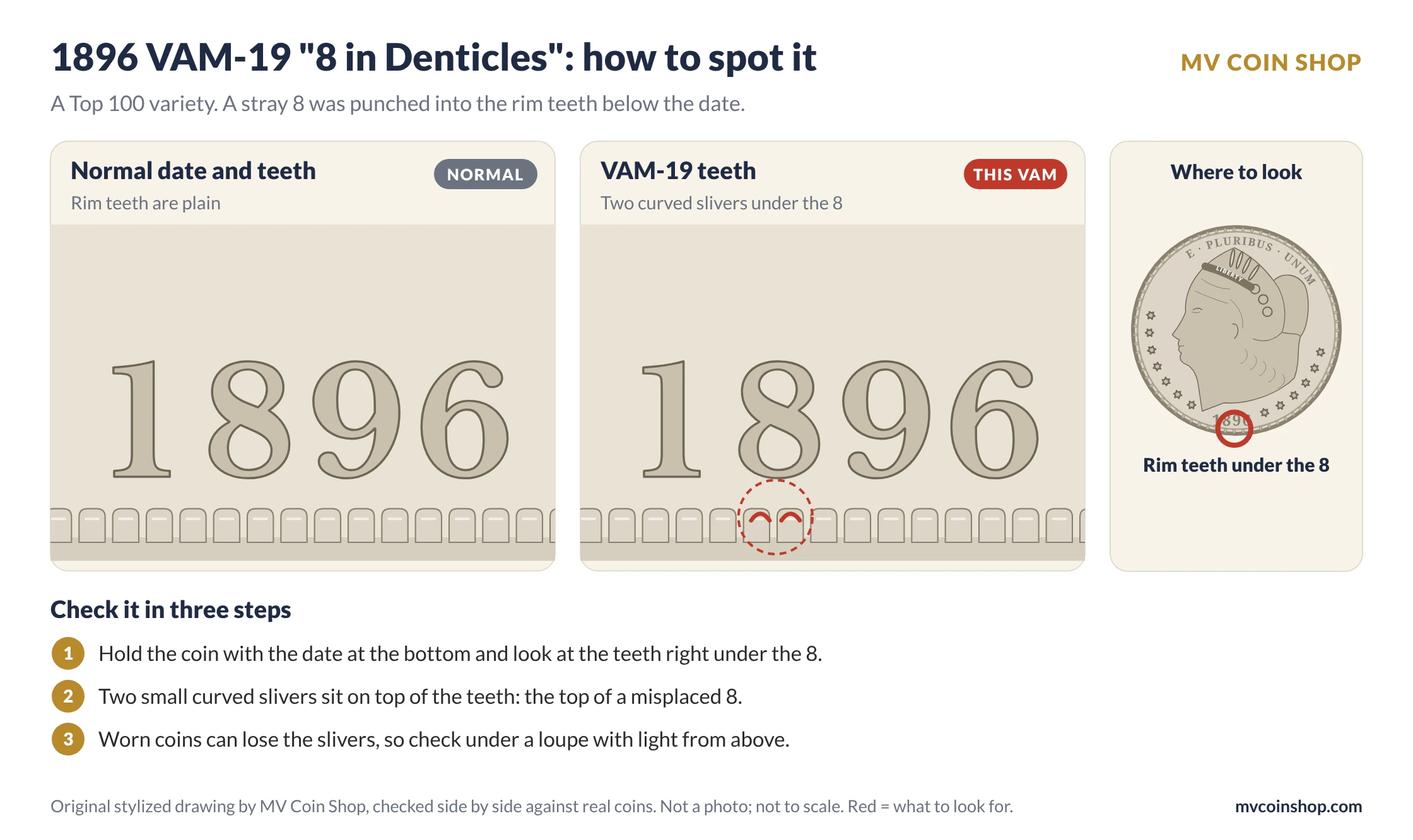
How to identify the 1896 VAM-19
- Confirm there is no mint mark on the back. This is a Philadelphia die.
- Turn the coin so the date is at the bottom and look straight down at the rim teeth under the 8.
- Look for two small raised curved bars, each one sitting in a gap between teeth, slightly left of the center of the 8.
- Check that the date slants a little: it rises to the right, so the 1 is closest to the rim.
- On late die states the smaller of the two bars, the one on the right, can fade away from die wear. One clear bar in the right spot still points to VAM-19.
Die markers to confirm it
- Top of a misplaced 8 in two tooth spaces below the 8, shown as two raised, curved bars.
- Date slightly slanted, with the 1 nearest the rim.
- Other digits show no stray marks.
- Early die states show doubling on the inside of the wreath bow and on the branch to its left; the branch doubling fades on later states.
Die details summarized in our own words from the VAMWorld listing and the Van Allen–Mallis reference.
What the 1896 VAM-19 is worth
| Grade | PCGS Price Guide, 1896 VAM-19 | PCGS Price Guide, regular 1896 |
|---|---|---|
| AU58 | $125 | $94 |
| MS62 | $150 | $95 |
| MS63 | $175 | $100 |
| MS64 | $260 | $140 |
| MS65 | $425 | $225 |
| MS66 | $1,100 | $450 |
| MS67 | $3,400 | $1,650 |
| Grade band | What it sells for | Regular coin, same band |
|---|---|---|
| Circulated (Good to AU) | $50–$150 | $32–$65 |
| MS60 to MS63 | $75–$200 | $70–$110 |
| MS64 and up | $160–$650 | $140–$550 |
| Date | Grade (PCGS) | Price | Venue |
|---|---|---|---|
| 09/2026 | MS67+ | $7,320 | Heritage |
| 09/2026 | MS67 | $1,891 | Heritage |
| 09/2026 | MS67 | $1,769 | Heritage |
| 09/2026 | MS65+ | $390 | Heritage |
| 09/2026 | MS65 | $451 | Heritage |
| 09/2026 | MS64 | $165 | Heritage |
| 05/2026 | MS67 | $3,050 | Heritage |
| 12/2023 | MS64 | $192 | Heritage |
How rare is the 1896 VAM-19?
Our rating runs from 1 (easy to find) to 5 (very rare). It is our judgment from the PCGS population, how often the variety appears at auction and how often we see it, not an official scale.
| Grade | 15 | 50 | 53 | 55 | 58 | 61 | 62 | 63 | 63+ | 64 | 64+ | 65 | 65+ | 66 | 66+ | 67 | 67+ |
|---|---|---|---|---|---|---|---|---|---|---|---|---|---|---|---|---|---|
| PCGS population | 1 | 1 | 2 | 4 | 8 | 12 | 22 | 48 | 2 | 43 | 3 | 28 | 4 | 8 | 1 | 13 | 1 |
Look-alikes and common mistakes
Rim teeth on many Morgans carry small die chips or bag-mark dents. A chip is usually a shapeless lump; a dent is sunken. The VAM-19 bars are raised, smooth and curved like the top of a loop, and they sit in the gaps rather than on the teeth themselves. Compare with 1896 VAM-1F, which has collar marks in the rim below the date that can look like the top of a digit; that one sells for no premium.
What collectors say
NGC labels a late die state of VAM-19, though VAMWorld does not recognize it as a separate number. On the forums the coin is a favorite first find for new VAM hunters because the marks are visible without a loupe once you know where to look.
Think you have one? Send us clear photos or book a free look. We will tell you which die it is and what it would bring, with no obligation. If you decide to sell, we also buy Morgan dollars.
Frequently asked questions
Where is the 8 on an 1896 VAM-19?
In the rim teeth directly below the 8 of the date. Two small curved raised bars sit in the gaps between the teeth. They are the top of an 8 that was first punched too low.
How much is an 1896 VAM-19 Morgan dollar worth?
About $50 to $150 circulated and $75 to $200 in MS60 to MS63. The PCGS Price Guide lists $260 in MS64, $425 in MS65 and $3,400 in MS67 (Nov 24, 2026).
Can I see VAM-19 without a magnifier?
Often yes, on an uncirculated coin under a good light. A 5x loupe makes it certain, and you need one on worn coins.
Other 1896 varieties and related pages
- All 104 1896 Morgan dollar VAMs, with the VAM finder
- 1896 Morgan dollar value by mint and grade
- Morgan dollar values (all dates)
- 1896 VAM-4 Doubled Stars Morgan Dollar
- 1896 VAM-20 "Bar 6" Morgan Dollar
- 1896-O VAM-19 Shifted Date Morgan Dollar
- 1896-O Micro O Morgan Dollar (VAM-4)
- 1896-O VAM-18A Clashed G and t Morgan Dollar
- 1896-O VAM-22 Morgan Dollar
- 1896-S VAM-5 S over S Morgan Dollar
Sources
- Die description: VAMWorld 1896 VAM-19 page (checked Nov 24, 2026), summarized in our own words; Van Allen and Mallis, Comprehensive Catalog and Encyclopedia of Morgan and Peace Dollars.
- Price guide, population and auction records: PCGS CoinFacts #133945 and regular-coin #7240, checked Nov 24, 2026.
- Sales: PCGS Auction Prices (#133945); PriceCharting 1896 VAM-19 sold list (Nov 24, 2026).
By David, owner of MV Coin Shop, ANA member and PCGS and NGC submitter. Diagrams are original stylized drawings by MV Coin Shop, not photos. Updated November 24, 2026.