
Quick answer
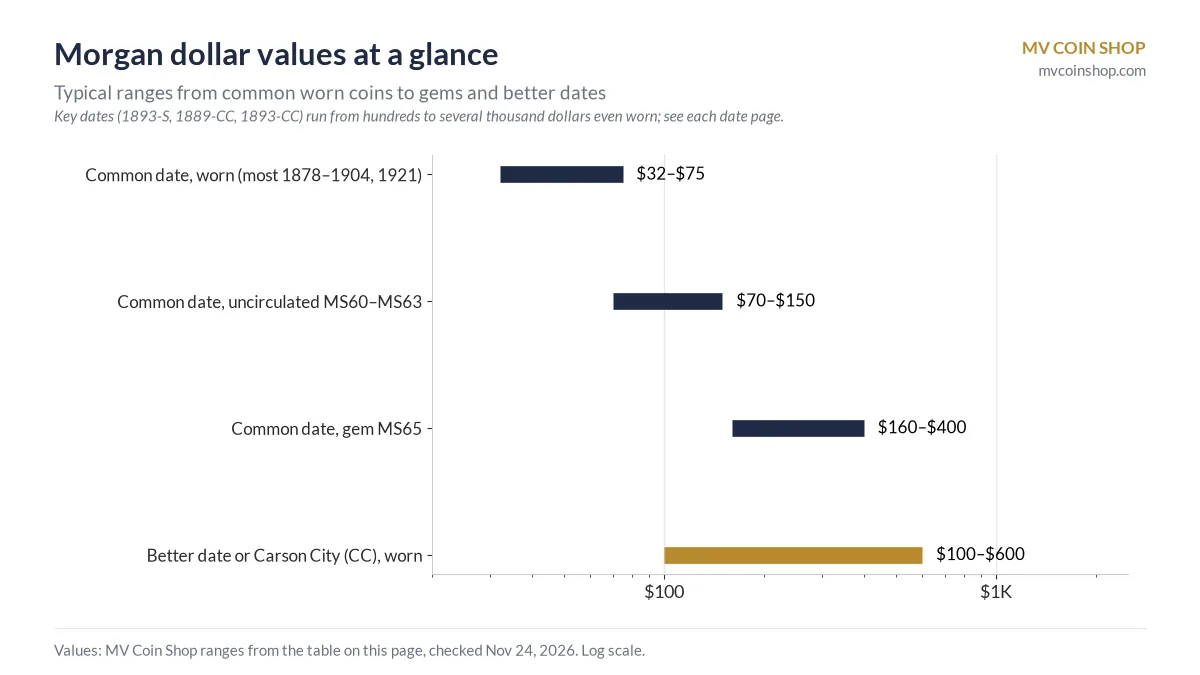
Most Morgan silver dollars (1878–1904 and 1921) are common dates worth about their silver, roughly $32 to $75 in worn condition and $70 to $150 in lower uncirculated grades (MS60–MS63). What changes the number is the date and mint mark (a short list of scarce dates bring three or four figures even with heavy wear) and the condition (gem uncirculated coins can be worth many times a worn one). Find your date and mint mark in the table below, then read the grade section.
Morgan dollar values at a glance
| What you have | Typical value range |
|---|---|
| Common date, worn (most 1878–1904, 1921) | melt (about $32) to $75 |
| Common date, uncirculated MS60–MS63 | $70–$150 |
| Common date, gem MS65 | $160–$400 |
| Better date or Carson City (CC), worn | $100–$600 |
| Key date, worn (e.g. 1893-S, 1889-CC, 1893-CC) | hundreds to several thousand dollars |
| Proof-like or deep mirror proof-like (PL/DMPL) | premium over the same grade |
Silver dollar melt value calculator
Morgan and Peace dollars hold 0.77344 troy oz of silver. Default spot: $41.76 (Nov 24, 2026, COMEX silver futures). Type today’s price to update.
Melt is the floor, not an offer: dealers usually pay a little under it for worn common dates, and better dates or unworn coins are worth more.
What’s my silver dollar worth?
Ranges from our date pages, checked Nov 24, 2026, for problem-free coins.
Dates without their own page yet: most worn common dates trade near melt; check the series table or ask us.
Market notes (Nov 2026)
- At the Nov 24 spot price of $41.76, the silver in one of these dollars is worth $32.30; that is well off January’s record ($115.08 an ounce), and silver lost about 15% in November alone.
- Common worn Morgans: our range is melt to about $75. In late November the cheapest online dealers asked about 6% over melt for random worn dates (FindBullionPrices, Nov 21), and buy prices sit a little under melt, so the spread on these coins is thin.
- Key dates are priced on scarcity, not metal: Heritage sold PCGS F12 1893-S dollars for $5,500 and $6,893 this year, and PCGS AU50 1889-CC coins brought $7,930–$8,100.
Sources: COMEX silver futures, 4:25 a.m. Central, Nov 24, 2026; Corgano 2026 silver price history; FindBullionPrices, Morgan random-year premiums, Nov 21, 2026; Heritage FUN sale 1390, lot 4352 (NumisBids); Heritage auction 1397, lot 3175 (Sixbid); PCGS Auction Prices, Stack’s Bowers Mar 2026; PCGS Auction Prices, Heritage Jul 2026.
How to read a Morgan dollar: date, mint mark, condition
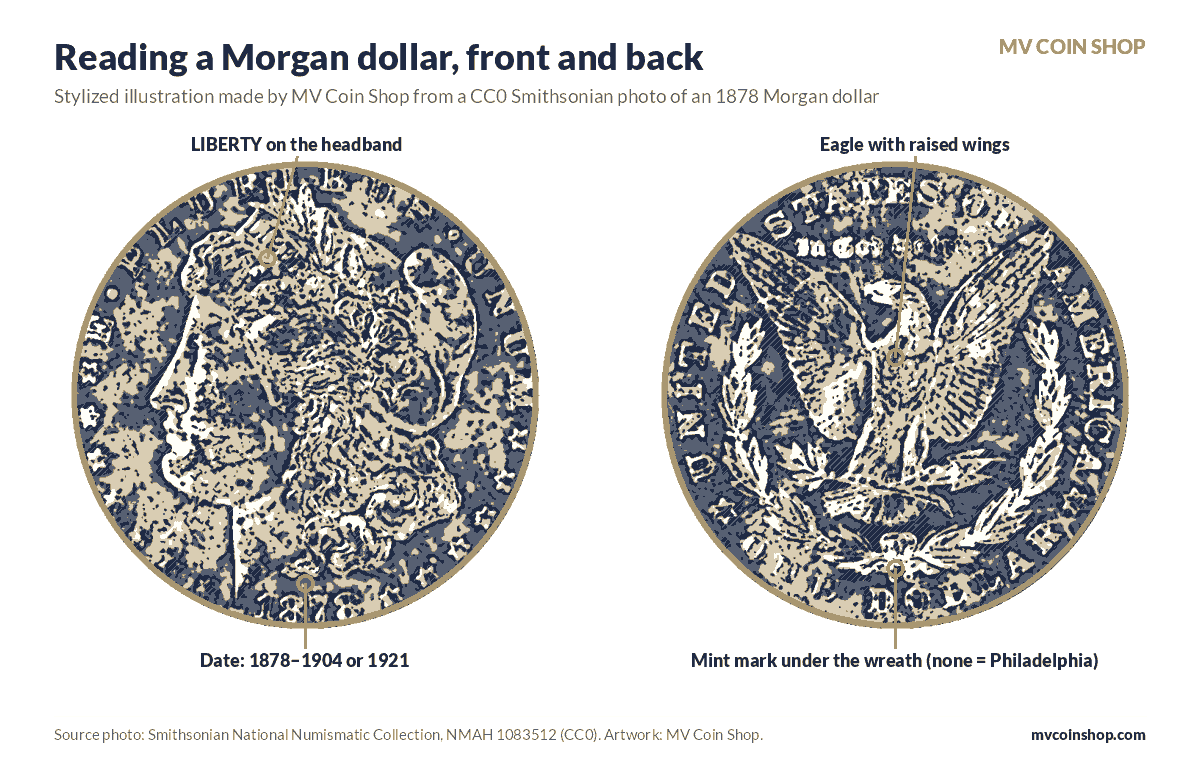
- Date: at the bottom of the front, under Liberty’s head. Morgans were struck 1878–1904 and again in 1921 (and as modern collector coins from 2021, which are a different product).
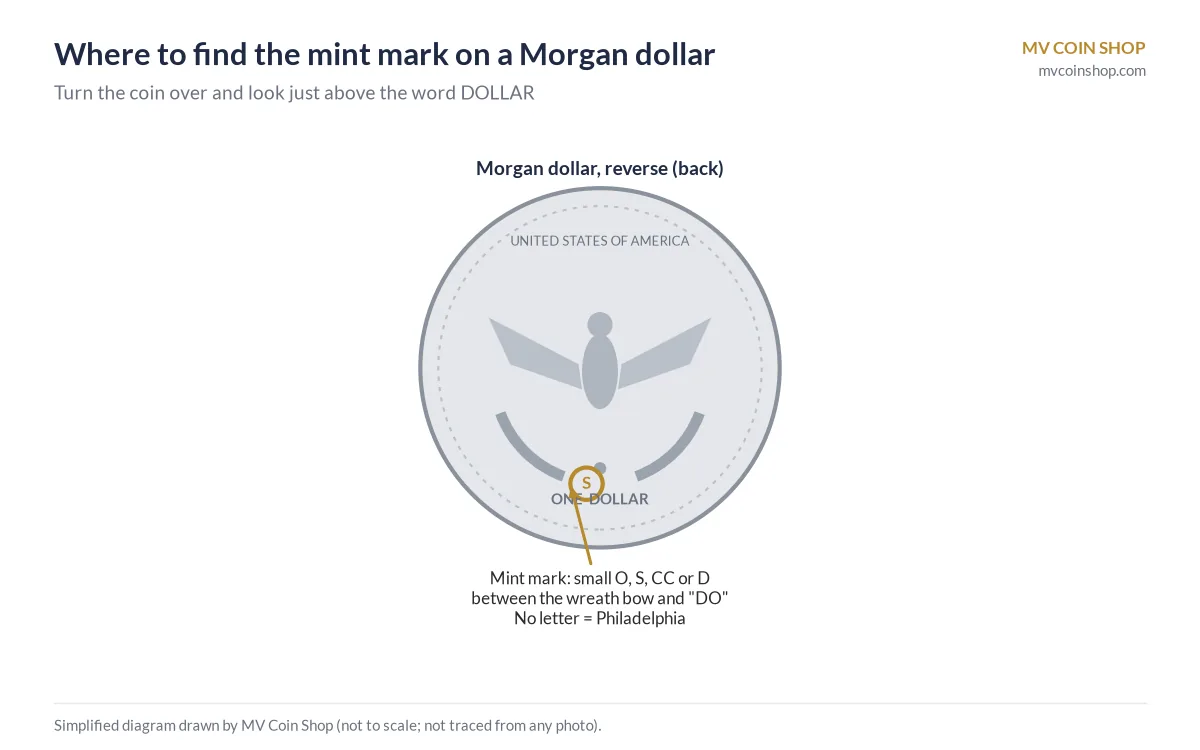
- Mint mark: a small letter on the reverse, between the wreath’s bow and the word DOLLAR. No letter = Philadelphia. O = New Orleans, S = San Francisco, CC = Carson City, D = Denver (1921 only).
- Condition: look at the highest points: Liberty’s hair above the ear and the eagle’s breast. Flat, smooth spots mean wear. Frosty, unbroken luster that “cartwheels” under a lamp suggests uncirculated.
- Varieties: 1878 has 8 and 7 tail-feather versions, plus 7-over-8 tail feathers. Several dates have overdates or doubled dies (catalogued by VAM number). The 1921 has its own flatter design.
Every Morgan dollar date and mintage
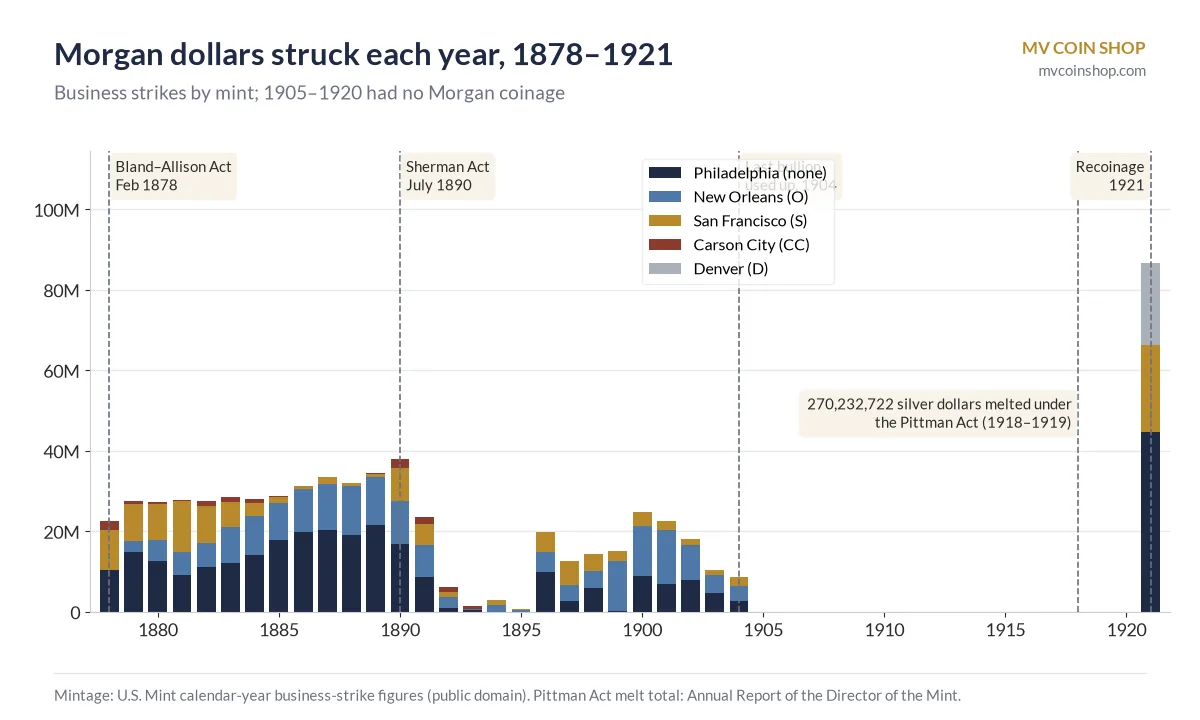
Business-strike mintages by year and mint. Low mintage does not always mean high value: hundreds of millions of Morgans sat in Treasury vaults for decades and were released in the 1950s–60s, so some low-mintage dates are common in uncirculated condition, while some high-mintage dates are rare because they were melted.
| Year | P (none) | O | S | CC | D |
|---|---|---|---|---|---|
| 1878 | 10,508,800 (all varieties) | — | 9,774,000 | 2,212,000 (semi-key) | — |
| 1879 | 14,806,000 | 2,887,000 (semi-key) | 9,110,000 | 756,000 (key) | — |
| 1880 | 12,600,000 | 5,305,000 (semi-key) | 8,900,000 | 495,000 (semi-key) | — |
| 1881 | 9,163,000 | 5,708,000 (semi-key) | 12,760,000 | 296,000 (semi-key) | — |
| 1882 | 11,100,000 | 6,090,000 | 9,250,000 | 1,133,000 (semi-key) | — |
| 1883 | 12,290,000 | 8,725,000 | 6,250,000 (semi-key) | 1,204,000 (semi-key) | — |
| 1884 | 14,070,000 | 9,730,000 | 3,200,000 (key) | 1,136,000 (semi-key) | — |
| 1885 | 17,787,000 | 9,185,000 | 1,497,000 (semi-key) | 228,000 (semi-key) | — |
| 1886 | 19,963,000 | 10,710,000 (semi-key) | 750,000 (semi-key) | — | — |
| 1887 | 20,290,000 | 11,550,000 | 1,771,000 (semi-key) | — | — |
| 1888 | 19,183,000 | 12,150,000 (semi-key) | 657,000 (semi-key) | — | — |
| 1889 | 21,726,000 | 11,875,000 (semi-key) | 700,000 (semi-key) | 350,000 (key) | — |
| 1890 | 16,802,000 | 10,701,100 (semi-key) | 8,230,373 (semi-key) | 2,309,041 (semi-key) | — |
| 1891 | 8,693,556 | 7,954,529 (semi-key) | 5,296,000 (semi-key) | 1,618,000 (semi-key) | — |
| 1892 | 1,036,000 (semi-key) | 2,744,000 (semi-key) | 1,200,000 (key) | 1,352,000 (semi-key) | — |
| 1893 | 378,000 (key) | 300,000 (key) | 100,000 (key) | 677,000 (key) | — |
| 1894 | 110,000 (key) | 1,723,000 (semi-key) | 1,260,000 (semi-key) | — | — |
| 1895 | 880 (proofs only) | 450,000 (key) | 400,000 (key) | — | — |
| 1896 | 9,976,000 | 4,900,000 (semi-key) | 5,000,000 (semi-key) | — | — |
| 1897 | 2,822,000 | 4,004,000 (semi-key) | 5,825,000 | — | — |
| 1898 | 5,884,000 | 4,400,000 | 4,102,000 (semi-key) | — | — |
| 1899 | 330,000 (semi-key) | 12,290,000 | 2,562,000 (semi-key) | — | — |
| 1900 | 8,830,000 | 12,590,000 | 3,540,000 (semi-key) | — | — |
| 1901 | 6,962,000 (key) | 13,320,000 | 2,284,000 (semi-key) | — | — |
| 1902 | 7,994,000 | 8,636,000 | 1,530,000 (semi-key) | — | — |
| 1903 | 4,652,000 (semi-key) | 4,450,000 (semi-key) | 1,241,000 (key) | — | — |
| 1904 | 2,788,000 (semi-key) | 3,720,000 | 2,304,000 (semi-key) | — | — |
| 1921 | 44,690,000 | — | 21,695,000 (semi-key) | — | 20,345,000 (semi-key) |
Key dates to look for first
If you are sorting a pile, pull these out before anything else: 1879-CC, 1884-S, 1889-CC, 1892-S, 1893, 1893-O, 1893-S, 1893-CC, 1894, 1895-O, 1895-S, 1901, 1903-S. Many other dates, especially New Orleans, San Francisco and Carson City coins from the 1880s and 1890s, carry premiums in better grades and are marked semi-key in the table.
Cleaned, damaged and altered coins
- Cleaning has the biggest effect on uncirculated and key-date coins. A cleaned common date in circulated grade usually still sells near melt.
- Holes, solder marks, heavy scratches and bent coins are generally treated as silver.
- Key dates are counterfeited and altered, for example by adding or removing a mint mark (a common fake 1893-S or 1895 starts as another date). Have any key date authenticated before buying or selling.
- Do not clean, polish or dip coins. Original surfaces are what collectors pay for.
If you inherited Morgan dollars
Morgan dollars are the single most common “valuable” coin in family collections, often in rolls, bank bags or cigar boxes. Start by sorting by mint mark and pulling out any CC coins and any of the key dates above. Set aside anything that looks bright and unworn. A fair offer on the worn common dates will be close to silver value (about $32 each today). On the rest, an in-person look is worth more than any chart. Our inherited coin collection guide covers sorting, taxes and selling.
Inside the San Francisco Mint: what the old letters show
Most Morgan dollar histories are written from Philadelphia. The Mint’s own correspondence, now scanned from the National Archives, shows the West Coast side, which matters because San Francisco struck many of the coins Bay Area families still hold.
- January 5, 1893: the San Francisco superintendent shipped five boxes of cancelled obverse and reverse dies from 1892, silver dollar dies among them, back to Philadelphia by Wells Fargo express. Dies were made only in Philadelphia, and every used die went back to be destroyed. This is how the Mint made sure an 1892 die could not strike coins in 1893.
- 1893: San Francisco struck only 100,000 Morgan dollars. Today that is the series’ most famous key date, and the vaults there already held tens of millions of earlier dollars that nobody needed.
- January 17, 1894: Engraver Charles E. Barber reported to Philadelphia’s superintendent that, under instructions of November 2, 1893, he had prepared the 1894 dies for San Francisco. These included five pairs of standard silver dollar dies (obverses numbered 13–17, reverses 14–18), alongside gold and minor-silver dies. Five pairs for a full year shows how little dollar coinage the West Coast was expected to do.
- May 23, 1921: the Director of the Mint asked Philadelphia to send San Francisco twenty pairs of dollar dies for the Pittman Act coinage, four times the 1894 order. San Francisco went on to strike more than 21 million 1921-S dollars. Read the full 1921 story.
The pattern is the reason Morgan values are so uneven. Mintage was set by politics, not by demand. The 1878 Bland-Allison Act and the 1890 Sherman Act forced huge purchases, and the coins piled up in vaults. Then the 1918 Pittman Act melted more than 270 million of them, according to the Mint’s 1921 report. Which dates survived, and in what condition, is largely an accident of which vault bags were melted and which were saved.
Bring yours, unsorted and uncleaned, to our office in Mountain View (appointment only), or call (415) 952-6467. Free evaluation.
Morgan dollar VAM variety guides
Some Morgan dollars are worth more because of the die that struck them. Collectors identify these die varieties by VAM number, after the Van Allen and Mallis catalog. We have built full identifiers, with diagrams, finders and values by grade, for these dates:
- 1896 Morgan dollar VAM varieties: 104 dies, including the 8 in Denticles, Bar 6 and the 1896-O Micro O
- 1921 Morgan dollar VAM varieties: the Thorn Head, TRU_T, Capped R, Unicorn, pitted reverse, wide reed and the Zerbe and Chapman proofs
Frequently asked questions
How much is a Morgan silver dollar worth?
Most common-date Morgans are worth roughly $32 to $75 in circulated condition and $70 to $150 in lower uncirculated grades (MS60–MS63). The money is in the scarce dates and in coins that never circulated; those start at a few hundred dollars and the best reach five or six figures.
Which Morgan dollars are the most valuable?
The best-known keys are the 1893-S, the 1889-CC, the 1893-CC and the proof-only 1895. Many dates are also condition rarities, cheap when worn but expensive in gem uncirculated, such as the 1901, 1904-S and 1884-S.
Where is the mint mark on a Morgan dollar?
On the reverse, under the wreath, just above the letters DO in DOLLAR. No mint mark means Philadelphia.
Are all Morgan dollars silver?
Yes. Every circulating Morgan dollar (1878–1904, 1921) is 90% silver with about 0.7734 troy ounce of pure silver.
Should I get my Morgan dollars graded?
Only coins that are uncirculated, key dates, or possibly valuable varieties. For worn common dates, grading fees usually exceed any gain.
Why are some low-mintage Morgans cheap?
Because many were stored in Treasury vaults and released in original bags decades later, so uncirculated examples survive in quantity. Survival matters as much as mintage.
Related pages
- 1921 Morgan dollar value
- Peace dollar values
- Silver dollar values (all types)
- Inherited a coin collection?
- How much silver is in a Morgan dollar
- Peace vs Morgan dollars
Sources
- Melt: 0.77344 troy oz × $41.76 (COMEX silver futures, 4:25 a.m. Central on Nov 24, 2026).
- Tier ranges: our own rounding of public references checked Nov 24, 2026 (APMEX coin-value pages; CoinsWorth estimates from certified-coin auction sales).
- Mintages: Morgan dollar mintage table (Wikipedia, citing Red Book/CoinFacts).
- History: San Francisco Mint superintendent to Philadelphia, January 5, 1893 (NARA RG 104); Engraver Charles E. Barber to Superintendent O.C. Bosbyshell, January 17, 1894 (NARA RG 104); “Letters Sent to Philadelphia & San Francisco Mints,” 1921 (National Archives RG 104, via the Newman Numismatic Portal on Internet Archive); Annual Report of the Director of the Mint, fiscal year ended June 30, 1921.
By David, owner of Mountain View US and Foreign Coins, ANA member and PCGS and NGC submitter.