
Quick answer
1878 was the first year of the Morgan dollar, and Philadelphia made it in three versions: 8 tail feathers (the first design), 7 tail feathers (the revised design), and 7-over-8 tail feathers (old dies re-hubbed). San Francisco (S) and Carson City (CC) also struck 1878 dollars. Worn 7-feather coins trade close to silver. The 8-feather and 7/8 coins carry a premium, uncirculated 8TF coins run about $200 in MS63, and the 1878-CC is worth about $180–$200 even in Fine to Very Fine.
1878 Morgan dollar values by variety and grade
| Grade | 8 tail feathers | 7TF, reverse of 1879 | 7/8 tail feathers | 1878-S | 1878-CC |
|---|---|---|---|---|---|
| Fine–Very Fine | — | near silver value | — | near silver value | $180–$200 |
| Extremely Fine | about $85 | near silver value | — | near silver value | $230–$240 |
| About Uncirculated | $85–$110 | about $120 | about $150 | $70–$75 | $300–$400 |
| MS63 | about $200 | about $350 | about $420 | about $150 | $580–$750 |
| MS64 | $270–$700 | $660–$750 | $630–$680 | about $180 | $890–$920 |
| MS65 | $900–$2,200 | $1,900–$2,100 | $2,350–$2,400 | about $400 | $2,150–$2,250 |
| MS66 | $3,550–$5,050 | $6,000–$8,050 | about $10,000 | $1,000–$1,050 | $5,500–$6,500 |
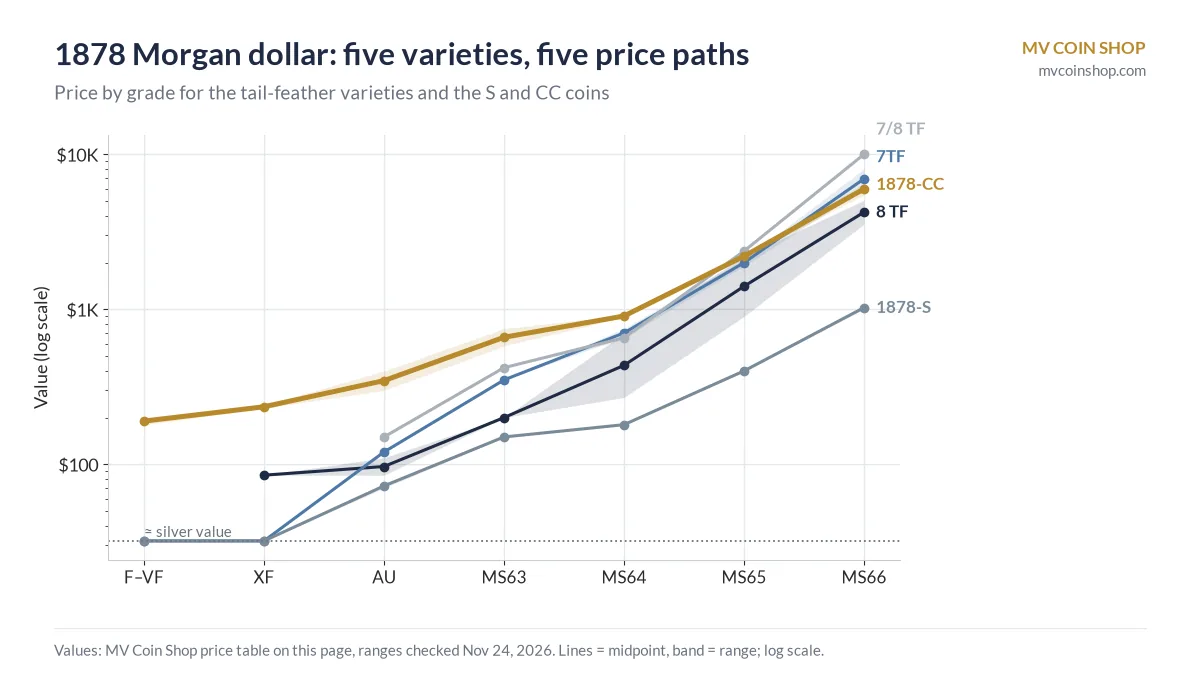
1878 Morgan dollar value finder
Market notes (Nov 2026)
- Worn 1878 7TF: near melt (melt is $32.30 at $41.76 silver, COMEX, Nov 24).
- Silver is down about 39% in 2026 (Corgano), so worn 1878 7TF prices fell with it.
- Biggest single grade step: 1878 7/8 tail feathers from MS65 ($2,350–$2,400) to MS66 ($10,000), about ×4.2.
- Top of the table: 1878 7/8 tail feathers in MS65 at $2,350–$2,400; its silver is 1.3% of that.
Sources: COMEX silver futures, 4:25 a.m. Central, Nov 24, 2026; Corgano 2026 silver price history.
How to count tail feathers
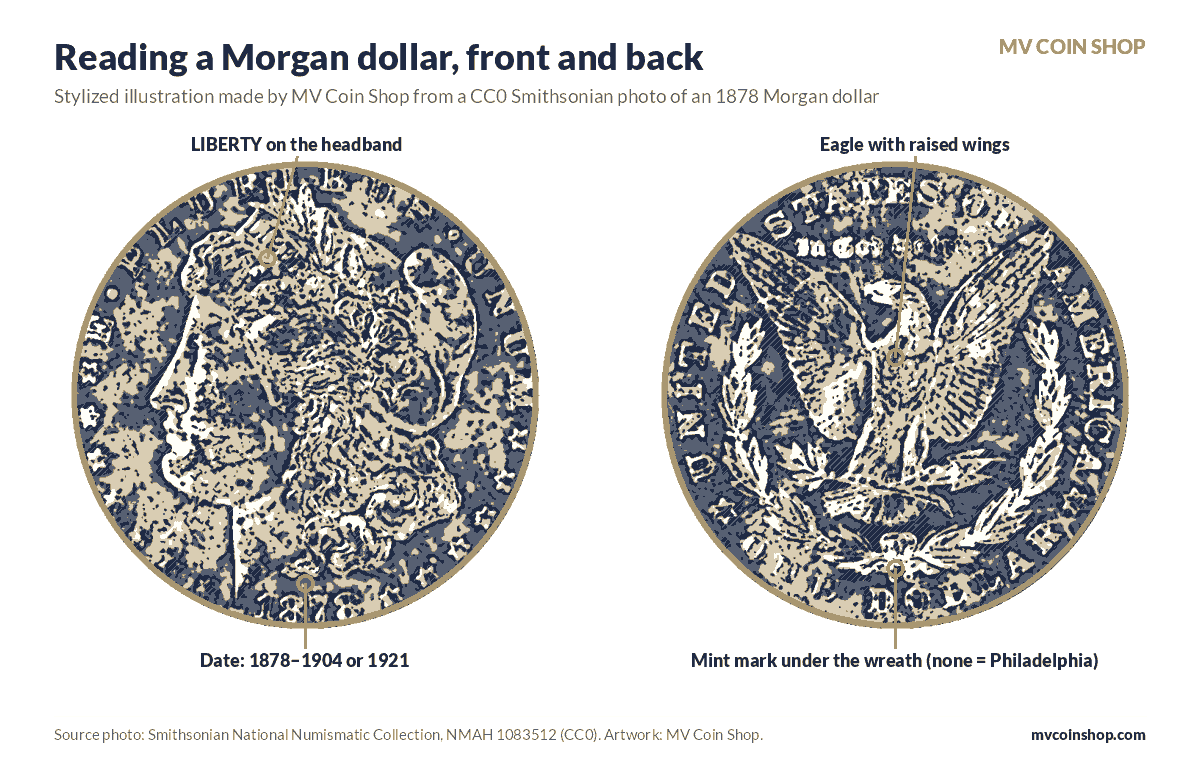
- Look at the eagle’s tail on the back, below the wreath bow. Count the long feathers. Eight = the first 1878 design. Seven = the revised design.
- 7 over 8 (doubled tail feathers): you will see seven clear feathers with the tips of extra feathers poking out underneath. These came from dies that were first made with eight feathers and then re-hubbed with the seven-feather design.
- Reverse of 1878 vs reverse of 1879: on 7-feather coins, check the top arrow feather. If it is parallel to the arrow shafts, it is the reverse of 1878; if it slants, it is the reverse of 1879. The eagle’s breast is also flatter on the 1878 reverse.
- Mint marks: under the wreath. 1878 has no New Orleans coins; that mint reopened for coinage in February 1879.
Condition problems
First-year Morgans were saved as novelties, so many were handled, carried as pocket pieces, or mounted. Cleaned or holed 7TF coins are worth silver value. The 8TF and 7/8TF varieties and the 1878-CC keep some premium even with problems, because collectors need them for date-and-variety sets.
If you have a box of old dollars
Sort out every 1878 and count the tail feathers before doing anything else. It takes seconds and is the one check that separates a melt-value coin from a premium one. Then look for CC under the wreath. For taxes, probate and the rest of the collection, see our heir’s guide or what to do with inherited coins.
How the Morgan dollar began in 1878
The Morgan dollar exists because of a single law: the Bland-Allison Act of February 28, 1878, which ordered the Treasury to buy silver every month and coin it into standard dollars. The Treasury had a new design ready from engraver George T. Morgan, and Philadelphia began striking it within weeks. Soon after the first strikes, the Mint revised the reverse to show seven tail feathers instead of eight. Dies already in use were re-hubbed with the new design, which created the 7-over-8 coins.
The law’s demands outran the Mint. Within a year the Director of the Mint was reporting where coinage could and could not keep up. In fiscal 1879 the San Francisco Mint’s silver-dollar coinage was larger than at any other mint. At Carson City, owners of silver bullion were demanding a higher price for delivery at Carson than the government paid at Philadelphia or San Francisco, so the Carson mint was idle for months. New Orleans reopened for coinage on February 20, 1879, which is why there is no 1878-O.
Many 1878-CC dollars stayed in Treasury vaults for almost a century and were sold to the public by the government in the 1970s, which is why uncirculated 1878-CC coins in original government holders still appear in estates.
We check coins like this for free, no obligation, at our office in Mountain View (by appointment): book here or call (415) 952-6467.
Frequently asked questions
How much is an 1878 Morgan silver dollar worth?
It depends on the variety. Worn 7-tail-feather coins trade near silver value. 8-tail-feather coins bring about $85–$110 in About Uncirculated and about $200 in MS63. The 1878-CC is worth about $180–$200 even in Fine to Very Fine.
How do I tell if my 1878 dollar has 8 or 7 tail feathers?
Count the long feathers in the eagle’s tail on the back. Eight is the first design; seven is the revised one. Extra feather tips under seven feathers means a 7/8 tail feathers coin.
Is an 1878 8 tail feather dollar rare?
About 749,500 were struck, so it is scarcer than the 7-feather coins and carries a premium in every grade, but it is not a great rarity.
Is there an 1878-O Morgan dollar?
No. The New Orleans Mint did not resume coinage until February 1879. Any 1878-O is altered or fake.
Related pages
- 1879 Morgan dollar value
- 1893-S Morgan dollar value
- 1880 Morgan dollar value
- Morgan dollar values (all dates)
Sources
- Values: APMEX coin-value pages and CoinsWorth auction estimates, checked Nov 24, 2026, rounded by us.
- Mintages: Morgan dollar mintage table (Wikipedia, citing Red Book/CoinFacts).
- History: Annual Report of the Director of the Mint, fiscal year ended June 30, 1879 (Carson City bullion prices, San Francisco output, New Orleans reopening February 20, 1879).
By David, owner of Mountain View US and Foreign Coins, ANA member and PCGS and NGC submitter.