
Quick answer
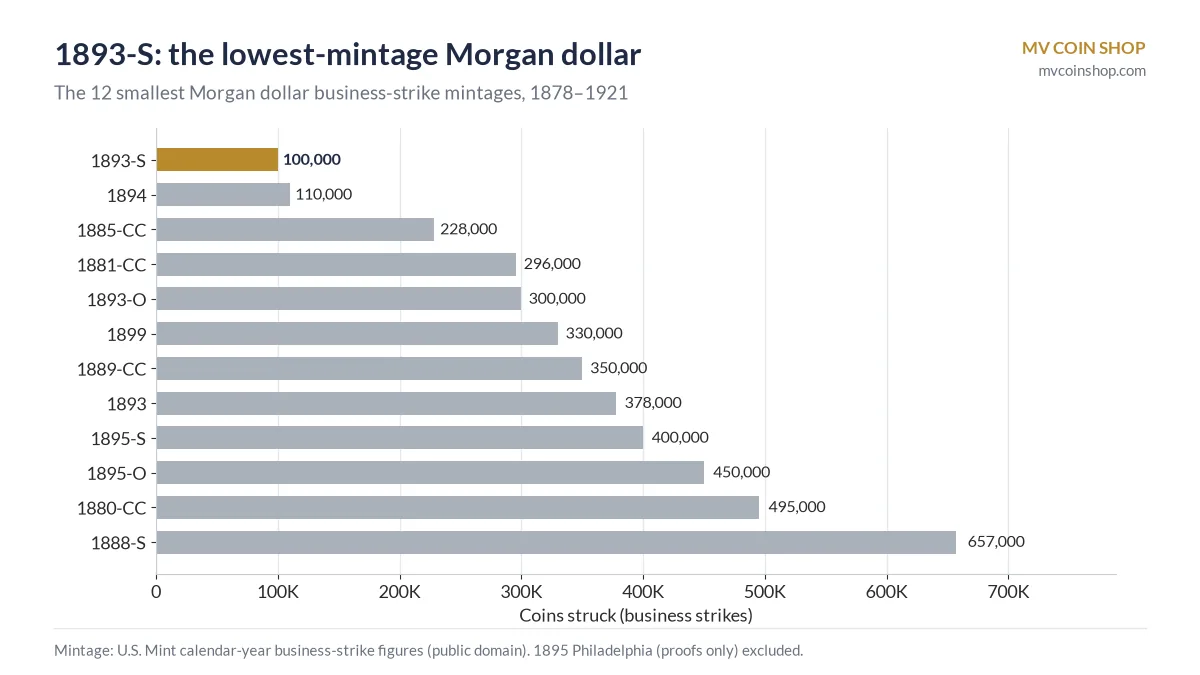
The 1893-S is the most valuable regular-issue Morgan dollar. Only 100,000 were struck, and even a heavily worn genuine example is worth about $2,800 to $6,250. Fine to Very Fine coins run roughly $6,450 to $10,500, Extremely Fine about $14,500 to $19,000, and About Uncirculated $33,000 and up. Because it is so valuable, it is also one of the most faked US coins. Have any 1893-S authenticated before you buy or sell.
1893-S Morgan dollar value by grade
| Grade | 1893-S |
|---|---|
| Good–Very Good | $2,800–$6,250 |
| Fine–Very Fine | $6,450–$10,500 |
| Extremely Fine | $14,500–$19,000 |
| About Uncirculated | $33,000–$42,500 |
| MS63 | about $450,000 |
| MS64 | about $500,000 |
| MS65 | about $1,200,000 |
1893 Morgan dollar value finder
Market notes (Nov 2026)
- Lowest price in our table: a worn 1893-S at $2,800–$6,250 retail, 86.7× the $32.30 melt (silver $41.76, COMEX, Nov 24).
- Metal is under 2% of that price; a $5 silver move (about $3.87 a coin) is small next to the 1893-S premium.
- Biggest single grade step: 1893-S from About Uncirculated ($33,000–$42,500) to MS63 ($450,000), about ×12.0.
- Top of the table: 1893-S in MS65 at $1,200,000; its silver is 0.0027% of that.
- Recent public results line up with our table: Heritage sold PCGS F12 examples for $5,500 (January 2026) and $6,893 (October 2026), and a PCGS VF20 for $6,500 (March 2026), at or just below the low end of our Fine–Very Fine range.
- At the top, GreatCollections sold the Clapp–Eliasberg PCGS MS65 CAC coin for $1,181,250 in its Aug 9, 2026 sale, a record for the grade and close to the “about $1,200,000” MS65 figure in our table.
Sources: COMEX silver futures, 4:25 a.m. Central, Nov 24, 2026; Corgano 2026 silver price history; Heritage FUN sale 1390, lot 4352 (NumisBids); Heritage Dallas sale 1391, lot 3588 (NumisBids); Heritage auction 1397, lot 3175 (Sixbid); GreatCollections, Sept 3, 2026.
Uncirculated 1893-S dollars are rarities that trade a few times a year, usually at major auctions, for six-figure prices. If you think you have one, do not clean it, do not ship it to an unknown buyer, and get it certified by PCGS or NGC.
How to tell if your 1893-S is real
Most “1893-S” dollars offered outside the trade are fakes or altered coins. The common tricks, and what to check:
- Added S mint mark: someone takes a real 1893 Philadelphia dollar (378,000 minted, worth far less) and glues or solders on an S. Look at the S under 10× magnification for a seam, glue line or a slightly different color.
- Altered date: a common 1898-S or 1883-S has its date tooled to read 1893. Compare the shape of the last 3 with the other digits; tooled digits look thin or uneven.
- Cast and struck counterfeits: made from scratch, often in China. They may weigh wrong (a genuine coin weighs 26.73 g), be magnetic, or show mushy details, bubbles or a seam on the edge.
- Known die markers: genuine 1893-S dollars show specific die markers that experts check, the best known being a fine diagonal die line inside the T of LIBERTY. Certification is the standard for this date.
- Mint mark location: a small S on the reverse, tucked between the wreath’s bow and the word DOLLAR.
Problem coins
Because the date is so scarce, collectors buy 1893-S dollars with problems that would make a common date worth only its silver. A cleaned, scratched or even holed genuine 1893-S still sells for thousands of dollars. Grading services label these coins “details” (for example, “VF details, cleaned”), and they usually sell for well under a problem-free coin of the same sharpness. They still sell, though. Never try to “improve” one.
If you think you inherited one
Every week someone finds an “1893-S” in a family box. Most turn out to be altered or counterfeit, but some are real, and a real one can be the most valuable coin in an estate. Put it in a paper envelope by itself, write down where it was found, and have it examined in person. If it looks genuine, the next step is certification. We can submit it for you. Settling an estate? Start with our heir’s guide (date-of-death values, sorting) and these first steps.
Why so few: what the 1893 Mint records show
The 1893-S was not planned as a rarity. It was a side effect of a silver-dollar glut. By July 1, 1892, the San Francisco Mint alone held more than 36 million silver dollars in its vaults, and the country did not need more. The Director of the Mint’s report for fiscal year 1893 is blunt: all silver dollars coined that year came from bullion bought under the Sherman Act of July 14, 1890, totaling just $5,343,715 at all mints. “There being no special demand for silver dollars,” the report says, “the coinage was limited.”
The Mint’s letters from those months show the routine that made the 1893-S possible. On January 5, 1893, the San Francisco superintendent shipped five boxes of cancelled 1892 dies, silver dollar dies included, back to Philadelphia by Wells Fargo express. Every die was made in Philadelphia, and every used one had to go back to be destroyed. San Francisco worked through 1893 with the new year’s dies and struck only 100,000 dollars before turning to other work. When the Sherman Act’s silver purchases ended on November 1, 1893, the bullion supply dried up too.
The next year’s order shows how little dollar coinage San Francisco expected. On January 17, 1894, engraver Charles E. Barber reported that, under instructions of November 2, 1893, he had prepared the 1894 dies for San Francisco. These included just five pairs of standard silver dollar dies. Compare that with the twenty pairs sent west for the 1921 coinage.
Why are 1893-S dollars so scarce today even though 100,000 were made? Unlike many San Francisco dates, the 1893-S apparently went into circulation instead of sitting in vault bags, so most survivors are worn. Many more were likely melted under the 1918 Pittman Act, which destroyed more than 270 million silver dollars, according to the Mint’s 1921 report. Uncirculated examples are rare for that reason.
A Bay Area note
The 1893-S is a San Francisco coin through and through. It was struck at the old Mint at Fifth and Mission. Bay Area families who held silver dollars for generations have a better chance than most of turning up a genuine example.
Second opinion before you sell? We look for free at our office in Mountain View (by appointment): (415) 952-6467 or book online.
Frequently asked questions
How much is an 1893-S Morgan dollar worth?
A genuine 1893-S is worth roughly $2,800 to $6,250 in Good to Very Good condition, about $6,450 to $10,500 in Fine to Very Fine, and $33,000 and up in About Uncirculated. Uncirculated examples sell for six figures.
How many 1893-S Morgan dollars were made?
100,000, the lowest mintage of any regular-issue Morgan dollar struck for circulation.
How can I tell if my 1893-S is fake?
Check the weight (26.73 g), look for a glued or soldered S and a tooled date, and compare against known die markers. Because fakes are common, professional authentication by PCGS or NGC is the standard.
Where is the mint mark on an 1893-S dollar?
On the back, under the wreath, just above the letters DO in DOLLAR.
Is a cleaned 1893-S still valuable?
Yes. A genuine 1893-S with cleaning or other problems still typically sells for thousands of dollars, though less than a problem-free coin.
Related pages
- 1890 Morgan dollar value
- 1896 Morgan dollar value
- 1889-CC Morgan dollar value
- Morgan dollar values (all dates)
Sources
- Values: APMEX coin-value pages and CoinsWorth auction estimates, checked Nov 24, 2026, rounded by us.
- Mintage: Morgan dollar mintage table (Wikipedia, citing Red Book/CoinFacts).
- History: Annual Report of the Director of the Mint, fiscal year ended June 30, 1893; San Francisco Mint superintendent to Philadelphia, January 5, 1893 (NARA RG 104); Engraver Charles E. Barber to Superintendent O.C. Bosbyshell, January 17, 1894 (NARA RG 104); Annual Report of the Director of the Mint, fiscal year ended June 30, 1921.
By David, owner of Mountain View US and Foreign Coins, ANA member and PCGS and NGC submitter.