
Quick answer
The 1896-O “Micro O” (VAM-4) is not a Mint coin. It is a period counterfeit with a tiny O set high and tipped far right. In April 2005 PCGS declared the 1896-O, 1900-O and 1902-O Micro O dollars contemporary counterfeits and stopped certifying them. Today collectors of old fakes pay about $40–$200. Before 2005 the same coins sold for $1,000–$5,000.
For four decades the Micro O was a prize. Francis Klaes reported it in June 1963, it made the Top 100, and every major grading service attributed it. Then researchers noticed the same small marks repeating from coin to coin in a way that real dies do not produce. The coins had been made by copying a genuine coin, not by the Mint.
The economics explain why someone bothered. In fiscal 1896 the Mint Director reported that silver averaged about 67.6 cents an ounce, so the silver in a dollar was worth only about 52 cents. A counterfeiter who struck full-weight, good-silver dollars could pocket the difference, and nobody would ever find a lead slug in the batch. An NGC forum contributor who tested examples with XRF found a sterling-type alloy and argued the dies were made by electrotyping a real coin.
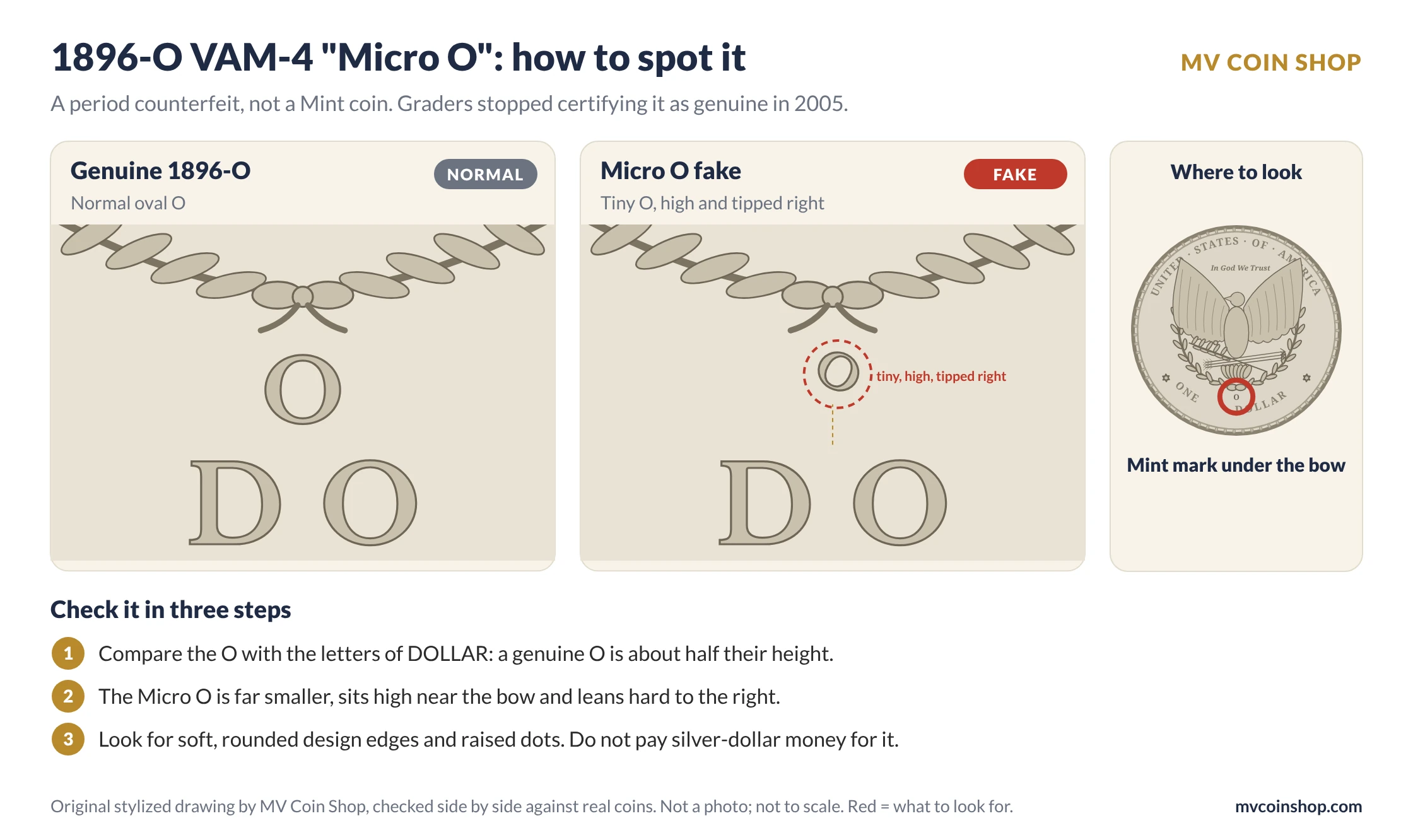
How to identify the 1896-O VAM-4
- Compare the O mint mark with the letters of DOLLAR. A genuine 1896-O mint mark is a medium oval about half their height. The Micro O is much smaller.
- Check its position and tilt. The Micro O sits slightly high, centered, and leans far to the right.
- Look at the edges of the design where they meet the field, especially the wing and tail feathers. On these fakes they are rounded rather than crisp.
- Under 10x, look for raised dots around the letters LLAR of DOLLAR. The three known reverse dies each have their own dot pattern.
- On the front, the copied die is otherwise normal, with a slightly low date and a single line at the base of the top cotton leaf.
Die markers to confirm it
- Reverse copied from an 1899-O VAM-6 coin, with the same Micro O position.
- Two faint short diagonal polish lines on the sixth and seventh feathers from the bottom of the eagle’s left wing, and a small raised dot on the fifth tail feather, both inherited from that 1899-O coin.
- Three reverse dies: very fine dots around LLAR; small dots around LLAR in another pattern; or dots around LAR, the right star and nearby wreath leaves.
- All three reverse dies share small dents left of the mint mark and right of the N in ONE, copied from bag marks on the original coin.
- Rounded design edges on both sides.
Die details summarized in our own words from the VAMWorld listing and the Van Allen–Mallis reference.
What the 1896-O VAM-4 is worth
| Grade band | What it sells for | Regular coin, same band |
|---|---|---|
| Circulated (Good to AU) | $40–$200 (outliers to $565) | $35–$540 |
| MS60 to MS63 | rarely offered | $1,500–$7,000 |
| MS64 and up | rarely offered | $21,000–$44,000 |
Recent sales: Not genuine: PCGS stopped certifying Micro O 1896-O, 1900-O and 1902-O in 2005 after finding repeating marks. Collectors of contemporary fakes still pay $50–$200 raw or in ANACS/ICG "counterfeit" holders (GreatCollections ANACS VG8 $197, Feb 2025; ANACS EF45 $565, May 2025). Before 2005 they brought $1,000–$5,000.
How rare is the 1896-O VAM-4?
Our rating runs from 1 (easy to find) to 5 (very rare). It is our judgment from the PCGS population, how often the variety appears at auction and how often we see it, not an official scale.
Look-alikes and common mistakes
Two genuine varieties are easy to confuse with it. Several real 1896-O dies have an O that is tilted or set high (VAM-2, 3, 13 and 18), but those are a normal medium size. And 1896-O VAM-22, long listed as privately made, was reclassified as genuine in March 2026; it is not a Micro O. Six other 1896-O numbers are also period fakes: VAM-21, 25, 26, 27, 30 and 34.
What collectors say
Where the coins came from is still argued. In a 2007 SSDC VAM-e newsletter, ANACS’s John Roberts floated the idea that they were struck for 1950s Havana casinos; forum members pushed back, and Treasury letters cited on the NGC boards suggest fakes of this kind were already being caught around 1896 in the Mississippi Valley and the South. The operation was large. VAMWorld’s privately made listings had grown to about 30 die pairs by May 2016, including 16 front and 11 back dies.
Think you have one? Send us clear photos or book a free look. We will tell you which die it is and what it would bring, with no obligation. If you decide to sell, we also buy Morgan dollars.
Frequently asked questions
Is the 1896-O Micro O real?
No. It is a period counterfeit. PCGS declared the 1896-O, 1900-O and 1902-O Micro O dollars contemporary counterfeits in April 2005 and stopped certifying them.
What is an 1896-O Micro O worth today?
About $40 to $200 to collectors of contemporary counterfeits, raw or in a holder marked counterfeit. GreatCollections sold an ANACS VG8 for $197 in February 2025 and an EF45 brought $565 in May 2025, an outlier.
Does the Micro O contain silver?
Tests reported on the NGC forums found a sterling-type silver alloy, close to real coin silver. That is what made the fakes profitable when a dollar held only about 52 cents of silver.
My old PCGS holder says Micro O. Is it genuine?
Coins certified before 2005 still exist in old holders. The current view of PCGS and the variety community is that they are counterfeit. Value it as a collectible fake.
Other 1896 varieties and related pages
- All 104 1896 Morgan dollar VAMs, with the VAM finder
- 1896 Morgan dollar value by mint and grade
- Morgan dollar values (all dates)
- 1896 VAM-4 Doubled Stars Morgan Dollar
- 1896 VAM-19 "8 in Denticles" Morgan Dollar
- 1896 VAM-20 "Bar 6" Morgan Dollar
- 1896-O VAM-19 Shifted Date Morgan Dollar
- 1896-O VAM-18A Clashed G and t Morgan Dollar
- 1896-O VAM-22 Morgan Dollar
- 1896-S VAM-5 S over S Morgan Dollar
Sources
- Die description: VAMWorld 1896-O VAM-4 page (checked Nov 24, 2026), summarized in our own words; Van Allen and Mallis, Comprehensive Catalog and Encyclopedia of Morgan and Peace Dollars.
- Regular-coin price guide: PCGS CoinFacts #7242, checked Nov 24, 2026.
- Sales: PCGS CoinFacts 1896-O (Ron Guth note); Proxiblog, "Meet the Micro O Counterfeit Family!" (Feb 2025); GreatCollections archive; PriceCharting.
By David, owner of MV Coin Shop, ANA member and PCGS and NGC submitter. Diagrams are original stylized drawings by MV Coin Shop, not photos. Updated November 24, 2026.