
Collectors know the San Francisco Mint by a single letter: the S mint mark on a coin’s reverse, or, in later years, on its obverse. The building behind that letter has a paper trail that is older, and more precise, than most of the stories told about it. Congress authorized a California branch mint in 1852; the first coins were struck in 1854; a second building—the “Granite Lady”—opened in 1874 and then stood through the earthquake and fire of 1906. The figures below come from the Mint’s own reports and from a later official compilation of those tables, read alongside a 1906 newspaper extra and the superintendent’s account of the disaster.
This is a history of the institution, not a price guide. For current values of the dates collectors hunt most often, see our U.S. coin values hubs, including the Morgan dollar and Peace dollar pages.
The Gold Rush and the 1854 Branch Mint
After the 1848 discovery of gold, California’s new production had a long way to travel before it could become United States coin. The official history of the San Francisco facility, published by the United States Mint, puts the problem plainly: bullion was shipped to the Philadelphia Mint, “a long and dangerous journey,” while thousands of people were already pouring into the state. On July 3, 1852, Congress approved legislation for a branch mint in California, and the Secretary of the Treasury chose San Francisco as the site.
The first plant opened on April 3, 1854, on Commercial Street, to accept deposits from miners. It was a practical answer to a local problem—turning raw gold into coin and bars close to the diggings—rather than a ceremonial outpost of the Philadelphia Mint. The S mint mark that came with that branch is, according to the Mint’s own facility history, the oldest mint mark still in use.
First-Year Coinage in the Official Tables
The Mint’s later official compilation of calendar-year production, Domestic and Foreign Coins Manufactured by Mints of the United States, 1793–1970 (Bureau of the Mint, U.S. Government Printing Office, 1972), Table XXXIII, records the San Francisco gold coinage for calendar year 1854 as follows: 141,468 double eagles ($20), 123,826 eagles ($10), 268 half eagles ($5), 246 quarter eagles ($2.50), and 14,632 gold dollars. Those 282,712 pieces have a stated denomination of $4,084,207, which is the first-year gold-coin figure given on the Mint’s San Francisco facility page. The half eagles and quarter eagles of that first year are especially scarce as a matter of the official count, not of later reputation alone.
The compilation reports domestic coinage “by United States Mint, class, denomination, and year of manufacture,” and it is careful to use the calendar year. That distinction matters throughout this essay. Many nineteenth- and early-twentieth-century Annual Report[s] of the Director of the Mint are organized around the fiscal year ending June 30. A fiscal-year total can mix two calendar dates and two mint-mark years. The mintages in the table later in this article are calendar-year figures, each tied to a named official source.
The Granite Lady at Fifth and Mission
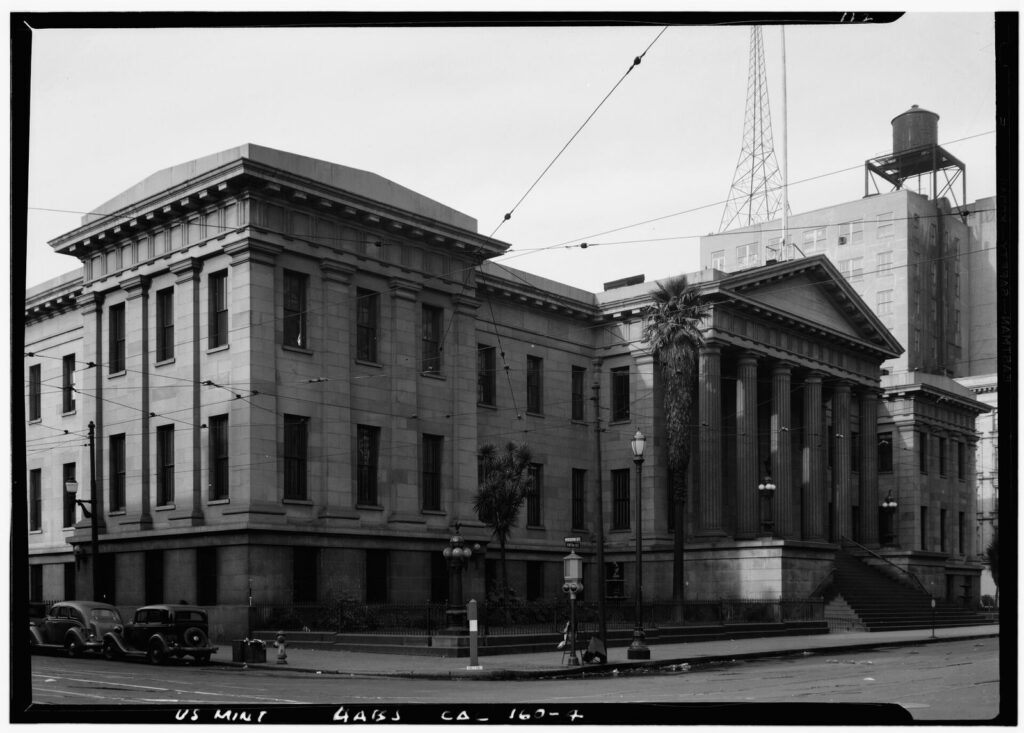
Within fifteen years the Commercial Street plant had been outgrown. A November 1, 1976, press release by Mint Director Mary Brooks, announcing the completed restoration of the Old Mint, gives the construction record in official summary form. The Treasury acquired the lot at Fifth and Mission Streets in 1867 for $100,000 in gold coin. Construction began on April 1, 1869. The cornerstone was laid on May 25, 1870, and the building was finished in November 1874. The same release states the construction cost as $2,130,512. A slightly larger figure appears in a contemporary official comment: in 1875, William A. Potter, who succeeded Alfred B. Mullett as Supervising Architect, wrote that the cost “including construction, furnishing, and machinery” came to $2,201,198.32, a total later quoted in the Treasury’s historical account of the building. The two numbers are not a contradiction once furnishings and machinery are included; they should not be averaged or treated as a single “official” cost.
Mullett, Supervising Architect of the Treasury, designed a two-story brick structure with a lofty basement and attic, sandstone facing, a Doric hexastyle portico, and granite stairs and corridor floors—the classical “temple” form described in both the 1976 Mint release and the later Treasury essay. He was designing after the city’s 1868 earthquake, and he wrote about the work in the language of permanence. The Treasury account quotes his judgment that the work had been done “in a substantial manner, and is undoubtedly a cheap as well as a permanent structure,” and that a branch mint ought to be “convenient, durable, and creditable to the government.” Those were not empty ornaments of style. In April 1906 they became a test of the walls themselves.
The second mint opened in November 1874. Collectors still call the building the Granite Lady. It was designated a National Historic Landmark in 1961, a fact recorded on the Mint’s facility timeline, and it remains one of the best surviving examples of federal classical revival architecture in the West.
April 1906: Earthquake, Fire, and the Only Bank Left Standing
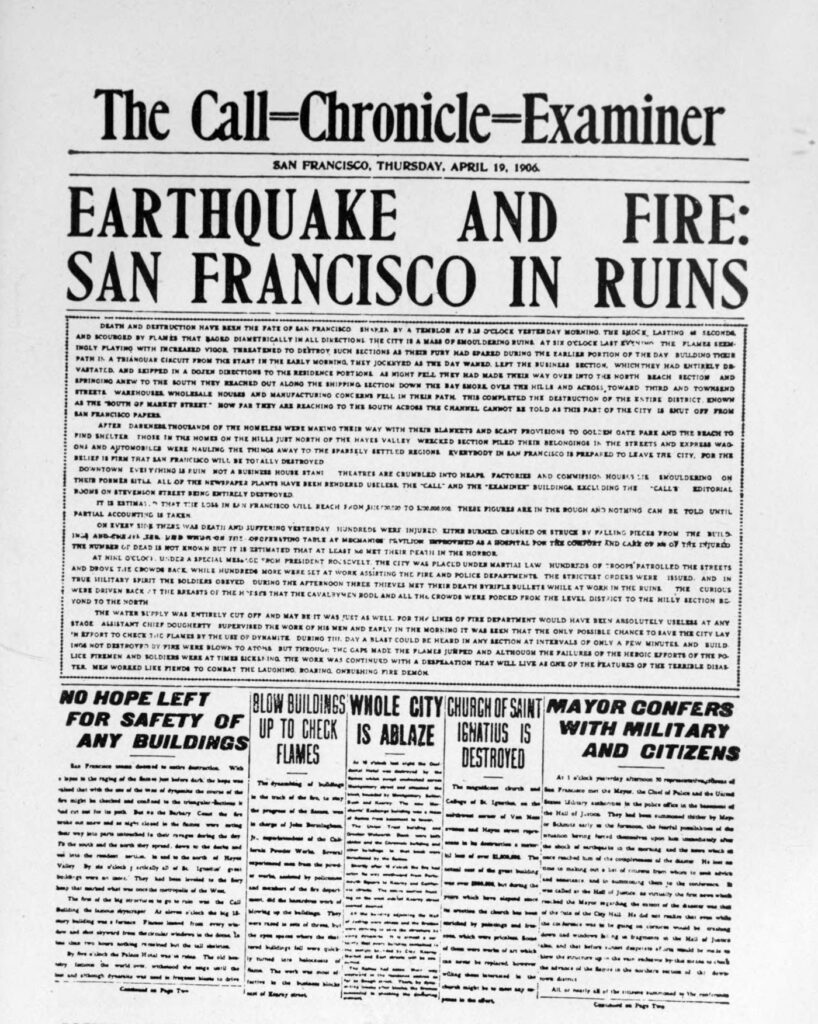
On the morning of April 18, 1906, a severe earthquake struck San Francisco; fire followed and burned for days. The city’s major newspapers could not print in their own plants. On April 19 they issued a joint extra, The Call-Chronicle-Examiner, under the headline “Earthquake and Fire: San Francisco in Ruins.” The front page, now in the public domain and preserved by the Library of Congress’s Chronicling America program, told readers that downtown was ruin, that “not a business house stands,” and that the loss might reach $150,000,000 to $200,000,000 in the rough estimates of the first day. It is a contemporary witness to the scale of the disaster, not a Mint document, and it is useful for that reason: it shows the city in which the mint building suddenly became almost the only financial institution still able to function.
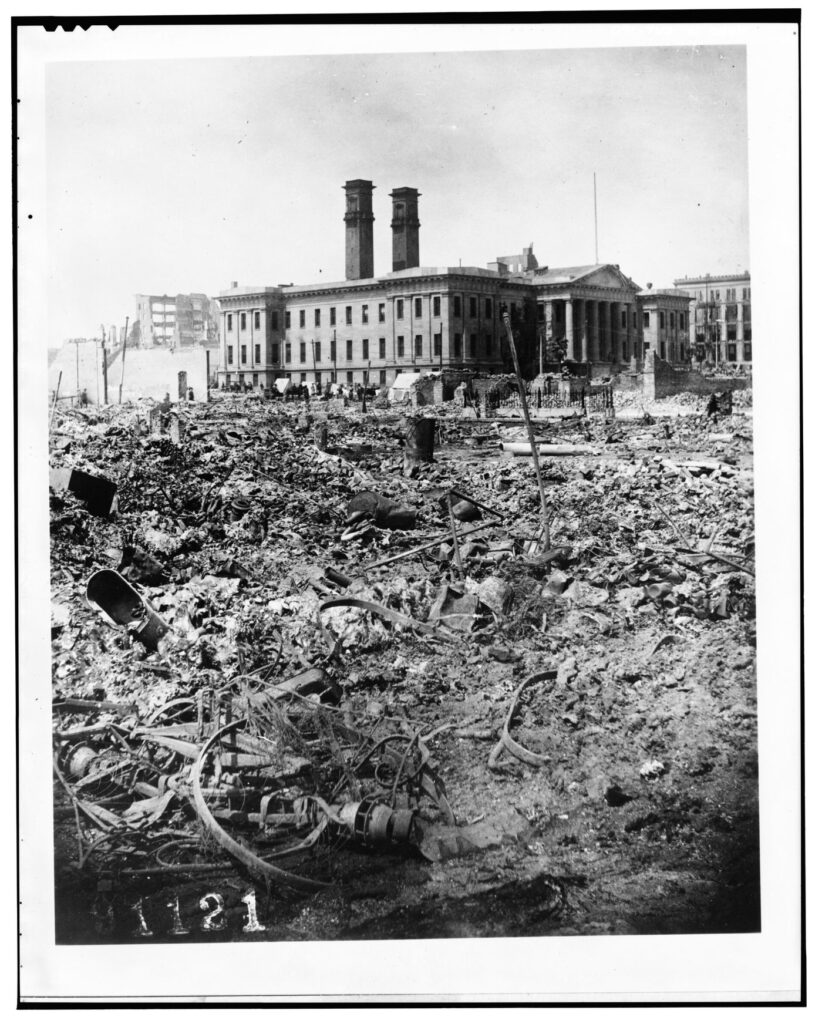
The official account is in the Annual Report of the Director of the Mint to the Secretary of the Treasury for the Fiscal Year Ended June 30, 1906 (Washington: Government Printing Office, 1906), pages 42–43. The United States Mint’s Office of the Historian has published a transcription of that excerpt. The report states that the mint escaped destruction or serious structural damage and was “the only structure, but one, left standing within many blocks in every direction.” The superintendent’s own narrative, printed there, is more specific than later summaries. The building, he wrote, had been constructed shortly after the 1868 earthquake “against damage by future seismic disturbances.” The 1906 shock, he reported, left almost no mark except a few hundred dollars’ damage to the chimneys: “There is not a fracture or a crack to be found anywhere in the massive walls.”
The fire was another matter. Plate glass on the south end was lost; on the west, sash and window frames were destroyed as well; on the north, where “the flames having driven directly against the whole side of the structure,” the stone was “badly flaked for the entire face of the wall.” A section of roof about 30 by 40 feet burned. In the days afterward, dynamite used to bring down dangerous nearby walls wrecked remaining plate glass at the front. The superintendent’s repair estimates were precise: $5,000 for windows, sash, and frames; $8,000 for the roof and stacks, including the decision to lower the tall smokestacks about 20 feet; $40,000 if the north stone were to be replaced; and $400 for the street scales. He then made a historian’s request in an official report: because the flaked north wall did not affect comfort or stability, he suggested that the scarred stone “be allowed to remain as a record of the greatest disaster that ever visited a civilized people, and as a monument to the heroic conduct of the Government employees who risked their lives to preserve the building.”
The building, he wrote, was saved by a fire-protection plant recently established inside it. About fifty officers and employees reached the mint and, almost all of them, stayed through a fight that lasted “from early morning until quite late in the afternoon.” Water came from an artesian well on the premises, forced through the building by a steam pump. Frank A. Leach, who was that superintendent, returned to the same point in his 1917 memoir, Recollections of a Newspaperman. The mint’s water supply, he recalled, was independent of the city’s broken mains, and two roof tanks gave additional pressure. “Without this protection,” he wrote, “the building would, without question, have been gutted by the flames.”
Once the fire had passed, the official report turns from masonry to money. The Subtreasury had been destroyed and, the superintendent wrote, “every bank in the city lay in ruins.” The mint became “the financial center and nucleus for the resumption of business.” The assistant treasurer was given offices and vault space; the city’s leading banks organized a union bank and were given room to work; and, at the President’s request, the mint served as depository and treasury for relief funds until the banks could reopen in their own quarters. Under an order of Secretary of the Treasury Shaw, mint officials also handled, “in round numbers, $40,000,000” in telegraphic transfers from the East to individuals, banks, and firms in the city, “without loss, error, or unnecessary delay.”
The same report records the improvisations that made that work possible. By the Saturday after the fire, the mint electrician had converted a large motor into a generator and restored electric light to the building and the adjacent streets. The artesian well, opened to the neighborhood, was “the only source of water for a great distance around.” A staff mess, run by employees who could cook, fed as many as 124 people in a day; when the restaurant closed in June, a surplus of $188.35 remained and was later donated to relief after the Valparaiso earthquake. Employees of the Philadelphia Mint raised $863.69 for San Francisco colleagues who had lost property in the fire, and the Denver Mint offered aid as well. These are small lines in a federal report, but they are the kinds of details official tables usually omit, and they are why the 1906 chapter is worth reading in the Mint’s own words.
S-Mint Coins Collectors Still Look For
An S on a United States coin means it was struck in San Francisco. That mark is how most collectors first meet this mint, usually long before they meet the Granite Lady. The dates below are the ones that come up most often in shop conversations in the Bay Area. The figures are official calendar-year mintages, not estimates of how many pieces survive, and not a guide to what any coin has collector demand. Survival, grade, and demand are separate questions; for those, start with the date and mint-mark pages in our coin values section, or with a guide to identifying valuable coins.
| Coin | Calendar-year mintage | Official source |
|---|---|---|
| 1854-S Liberty Head $20 (double eagle) | 141,468 | Bureau of the Mint, Domestic and Foreign Coins Manufactured… 1793–1970 (GPO, 1972), Table XXXIII (annual gold coinage, San Francisco Mint, number of pieces). |
| 1854-S $10, $5, $2.50, and gold $1 | 123,826; 268; 246; 14,632 | Same table. Stated denomination of all 1854-S gold coinage: $4,084,207. |
| 1878-S Morgan dollar (first year of the design at San Francisco) | 9,774,000 | 1972 compilation, Table XXXV (annual silver coinage, San Francisco Mint, number of pieces), calendar year 1878, dollars column. |
| 1893-S Morgan dollar | 100,000 | 1972 compilation, Table XXXV, calendar year 1893, dollars column. This is the lowest regular-issue Morgan mintage at San Francisco. |
| 1909-S Lincoln cent, with designer’s initials V.D.B. | 484,000 | Report of the Director of the Mint Upon the Production of the Precious Metals in the United States During the Calendar Year 1909 (GPO, 1911), p. 108, footnote distinguishing Lincoln cents struck with and without the initials. |
| 1909-S Lincoln cent, without V.D.B. | 1,825,000 | Same footnote, same report. |
| 1909-S Indian Head cent | 309,000 | Derived from the same 1911 report: the coinage table lists 2,618,000 bronze cents at San Francisco for calendar 1909; subtracting the two Lincoln figures in the footnote (484,000 + 1,825,000) leaves 309,000 Indian Head cents. |
| 1921-S Morgan dollar | 21,695,000 | Annual Report of the Director of the Mint… Fiscal Year Ended June 30, 1922, table titled “Coinage of the United States during the calendar year 1921,” San Francisco, “Standard silver dollars: Old design.” |
| 1922-S Peace dollar | 17,475,000 | Annual Report of the Director of the Mint… Fiscal Year Ended June 30, 1923, table of United States coinage for calendar year 1922, San Francisco, silver dollars. (Philadelphia 51,737,000; Denver 15,063,000; total 84,275,000.) |
| 1923-S Peace dollar | 19,020,000 | 1972 compilation, Table XXXV, calendar year 1923, dollars column. |
Two of those dates need a word of caution, because they are easy to misread in later summaries. The 1893-S Morgan is scarce because the official calendar-year mintage is 100,000, a figure that sits in the same official dollars column as the much larger 1878-S and 1890-S totals. It is not scarce because a fiscal-year table has been mistaken for a calendar year. Collectors comparing notes with a 1893-S Morgan dollar value guide are looking at that same official mintage, together with grade and the market for surviving pieces.
The 1909-S Lincoln cents are a different kind of official split. The ordinary mintage table for calendar 1909 gives San Francisco a single bronze-cent total, 2,618,000 pieces. The footnote in the 1911 precious-metals report is what separates the new Lincoln design with Victor D. Brenner’s initials (484,000) from the Lincoln cents struck after those initials were removed (1,825,000), and, by arithmetic, from the last Indian Head cents of that year (309,000). Without the footnote, the V.D.B. issue would disappear into a combined total.
The 1921-S Morgan belongs to the last year of that design. The 1922 annual report’s calendar-year table lists 21,695,000 “old design” silver dollars at San Francisco and none of the “new design” (the Peace dollar, struck late in 1921 at Philadelphia). Anyone sorting a 1921 Morgan by mint mark can start with our 1921 Morgan dollar page and with a short explanation of how much silver is in a Morgan dollar. The following year’s 17,475,000 San Francisco Peace dollars are in the 1923 annual report’s calendar-1922 table, alongside the Philadelphia and Denver figures; values for that series are on the Peace dollar value hub. Older silver dollars of mixed dates, including pieces that sometimes turn up in estates, are covered in our silver dollar value guide and in the inherited coin collection guide.
The 1937 Move and What Followed
Coining in the Granite Lady ended when the Mint moved, in 1937, to a third plant at 155 Hermann Street—the building still used today. Director Brooks’s 1976 release calls that plant the “new San Francisco Assay Office at 155 Hermann Street.” A Treasury historical essay on the Old Mint describes the 1937 building as “stripped classicism” by architect Gilbert Stanley Underwood (the Treasury text types his middle name as “Stanlay”). The same essay notes that, by 1934, a significant share of the country’s gold was stored at the Fifth and Mission mint, and that San Francisco also coined for foreign governments, including countries in Asia and Latin America, before the move.
The official facility timeline then changes the plant’s legal status more than once. Coining was discontinued in 1955. In 1962 Congress designated the San Francisco facility an assay office. The Coinage Act of 1965 authorized it to produce coin again; the Mint’s timeline says penny production resumed in September of that year. In 1968 San Francisco assumed all proof-coin production from Philadelphia. In 1988 the facility regained the status of a mint. The Mint’s public facility page, as archived in 2020, states that San Francisco does not currently strike circulating coin, that it produces clad and silver proof sets and commemorative coins authorized by Congress, and that the plant does not accommodate visitors because the space is needed for staff and machinery.
The Granite Lady had a second career of its own. After 1937, according to the 1976 Mint release, the old building was used as an office building by various federal agencies until 1968, then stood vacant until the spring of 1972. During the 1960s it was the object of a preservation fight, with proposals to demolish it for high-rise development. In the spring of 1972 the General Services Administration transferred title to the Bureau of the Mint. Restoration began that spring. The Old Mint reopened the following spring as a dual-purpose facility—the first public building opened under Public Law 92-362 for the adaptive use of surplus historic structures. A museum in the basement vaults and the front rooms of the first floor was open to the public from 1973 to 1994, a span given on the Mint’s facility timeline. Director Brooks announced completion of the exterior and interior restoration on November 1, 1976.
The records, taken together, describe an institution that began as a Gold Rush expedient, occupied one of the most carefully built federal structures on the Pacific coast, and then, for a few weeks in 1906, did work no mint had been designed to do. The S mint mark on a coin is a small official abbreviation of that story. The annual reports, the 1972 compilation, and the 1906 newspaper extra are still the best places to read it.
Notes on Sources
Principal official sources cited above: United States Mint, “U.S. Mint San Francisco Facility” history timeline (Mint facility page); Annual Report of the Director of the Mint… Fiscal Year Ended June 30, 1906 (GPO, 1906), pp. 42–43, as transcribed by the United States Mint, Office of the Historian; Report of the Director of the Mint Upon the Production of the Precious Metals… Calendar Year 1909 (GPO, 1911), p. 108; Annual Report of the Director of the Mint… Fiscal Year Ended June 30, 1922 and … June 30, 1923, calendar-year coinage tables for 1921 and 1922; Bureau of the Mint, Domestic and Foreign Coins Manufactured by Mints of the United States, 1793–1970 (GPO, 1972), Tables XXXIII and XXXV; Mary Brooks, “Restoration of the Old San Francisco Mint Has Been Completed,” United States Mint press release, November 1, 1976; and the Treasury historical essay on the Old San Francisco Mint (Mullett and Potter quotations and the 1937 building). Newspaper source: The Call-Chronicle-Examiner, San Francisco, April 19, 1906, Chronicling America, Library of Congress. Memoir: Frank A. Leach, Recollections of a Newspaperman (1917), ch. XV. Historic photographs: Historic American Buildings Survey, Library of Congress, HABS CAL-38-SANFRA-5 (CA-0740). Fiscal-year figures in other Mint reports were not used as substitutes for the calendar-year mintages in the table.