
Quick answer
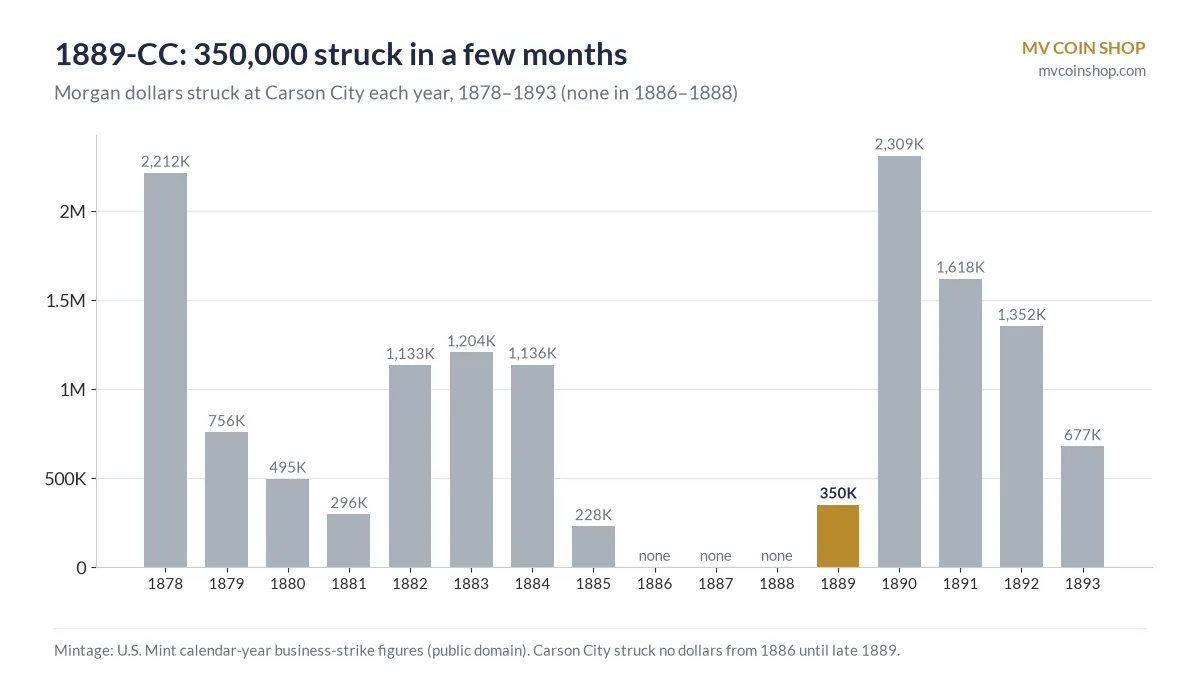
The 1889-CC is the rarest Carson City Morgan dollar and one of the series’ great keys. Only 350,000 were struck. A genuine coin in Good to Very Good condition is worth about $600–$1,300, Fine to Very Fine about $1,300–$3,050, Extremely Fine about $4,300–$5,450, and About Uncirculated $8,450–$22,500. Uncirculated examples are five- and six-figure coins. Fakes with added CC mint marks are common, so authentication comes first.
1889-CC Morgan dollar value by grade
| Grade | 1889-CC |
|---|---|
| Good–Very Good | $600–$1,300 |
| Fine–Very Fine | $1,300–$3,050 |
| Extremely Fine | $4,300–$5,450 |
| About Uncirculated | $8,450–$22,500 |
| MS63 | about $50,000 |
| MS64 | about $125,000 |
| MS65 | about $375,000 |
| MS66 | about $750,000 |
1889 Morgan dollar value finder
Market notes (Nov 2026)
- Lowest price in our table: a worn 1889-CC at $600–$1,300 retail, 18.6× the $32.30 melt (silver $41.76, COMEX, Nov 24).
- Metal is under 6% of that price; a $5 silver move (about $3.87 a coin) is small next to the 1889-CC premium.
- Biggest single grade step: 1889-CC from About Uncirculated ($8,450–$22,500) to MS63 ($50,000), about ×3.6.
- Top of the table: 1889-CC in MS65 at $375,000; its silver is 0.0086% of that.
- Auction prices this year support our ranges: PCGS AU50 coins brought $8,100 (Stack’s Bowers, March) and $7,930 (Heritage, July), just under the low end of our About Uncirculated range, while PCGS MS62 coins sold for $47,500 (July 5) and a $27,500 hammer (Oct 18) at Gold Standard, a reminder of how much one MS62 can differ from another.
Sources: COMEX silver futures, 4:25 a.m. Central, Nov 24, 2026; Corgano 2026 silver price history; PCGS Auction Prices, Stack’s Bowers Mar 2026; PCGS Auction Prices, Heritage Jul 2026; CoinCrafters on the July 5, 2026 Gold Standard sale; Gold Standard, Oct 15–18, 2026 results.
Make sure it is real
- CC mint mark: two C’s under the wreath on the back. They should be evenly spaced, the same size, and part of the coin, not a separate piece. Under magnification an added mint mark often shows a seam, glue or a color difference.
- Date: a common 1889 (21.7 million minted) or 1889-O can have CC letters added; a CC dollar from another year can have its date altered. Look closely at the last 9.
- Weight and size: 26.73 g and 38.1 mm. Many cast fakes are light or slightly too thick.
- Certification: for a coin worth this much, PCGS or NGC certification is how buyers and sellers agree it is genuine.
Cleaned or damaged 1889-CC dollars
Like the 1893-S, the 1889-CC is valuable enough that problem coins still sell well. A cleaned or scratched genuine 1889-CC typically brings a large discount from a problem-free coin, but it is still worth hundreds to thousands of dollars. Do not polish or “restore” one.
Found one in a family collection?
Carson City dollars were treasured in Nevada and the West, and many Bay Area estates include a few. Most are later dates from the 1880s. If you see CC on an 1889, put it aside by itself and have it authenticated before anything else. Handling a whole estate? Our guide for heirs and first steps with inherited coins cover the rest.
Why so few: Carson City in 1889
The Carson City Mint was the smallest of the silver-dollar mints, and it was often short of silver. The Director of the Mint’s report for fiscal year 1889 (ended June 30, 1889) says that during the whole year the Carson mint worked only as an assay office. It took in gold and silver deposits and paid for them, but it struck no coins. Silver for dollar coinage was being bought and coined only at Philadelphia and New Orleans.
Coinage at Carson resumed only in the second half of calendar 1889, so the entire 1889-CC mintage was squeezed into a few months. The Mint’s correspondence shows Carson gearing up again at year’s end. On December 19, 1889, the Director of the Mint returned to Philadelphia a bill for making five pairs of double eagle dies and ten pairs of standard silver dollar dies for “the U.S. Mint at Carson,” and asked for it to be corrected.
The low mintage is only half the story. Unlike several earlier Carson City dates, very few 1889-CC dollars were left in Treasury vaults for the government’s 1970s sales of Carson City dollars. Survivors had to come from circulation and old collections, which is why most known examples are worn.
Not sure which one you have? Text a photo to (415) 952-6467 or bring it to our office in Mountain View, by appointment, for a free look. Book a time.
Frequently asked questions
How much is an 1889-CC Morgan dollar worth?
A genuine 1889-CC is worth about $600–$1,300 in Good to Very Good, $1,300–$3,050 in Fine to Very Fine, and $8,450–$22,500 in About Uncirculated. Uncirculated coins sell for five and six figures.
How many 1889-CC Morgan dollars were made?
350,000. That is not the lowest Carson City mintage (the 1885-CC, at 228,000, and the 1881-CC, at 296,000, are lower), but far fewer 1889-CC dollars survive, which is why it is the rarest.
Why is the 1889-CC so rare?
Carson City struck no coins during fiscal 1889 and only resumed late in calendar 1889, so mintage was small. Few were saved in Treasury hoards, so most survivors are worn.
How do I know if my 1889-CC is real?
Check that the CC is part of the coin (no seam or glue), that the date has not been altered, and that the weight is 26.73 g. Professional certification is strongly recommended.
Related pages
- 1887 Morgan dollar value
- 1890 Morgan dollar value
- 1893-S Morgan dollar value
- Morgan dollar values (all dates)
Sources
- Values: APMEX coin-value pages and CoinsWorth auction estimates, checked Nov 24, 2026, rounded by us.
- Mintage: Morgan dollar mintage table (Wikipedia, citing Red Book/CoinFacts).
- History: Annual Report of the Director of the Mint, fiscal year ended June 30, 1889; Director of the Mint to Philadelphia superintendent, December 19, 1889 (NARA RG 104 via Newman Numismatic Portal).
By David, owner of Mountain View US and Foreign Coins, ANA member and PCGS and NGC submitter.