
Quick answer
First, check which 1921 silver dollar you have. If the back shows an eagle with spread wings, it is a Morgan (this page). If it shows an eagle perched on a rock with the word PEACE, it is a 1921 Peace dollar, worth $150 and up (see that page). Most 1921 Morgan dollars are common. A worn one is worth roughly its silver, about $32 at today’s price, and dealers and collectors usually pay somewhere between that and about $75. Uncirculated examples run from about $80 to $180 for the Philadelphia coin in grades MS63 to MS65. The 1921-D and especially the 1921-S jump much higher in top grades: a gem MS65 1921-S has been selling for around $800. Check the letter under the wreath on the back, then check for wear.
Which 1921 silver dollar do you have?
| 1921 Morgan dollar | 1921 Peace dollar | |
|---|---|---|
| Front | Liberty facing left, wearing a cap with wheat and cotton, LIBERTY on the headband | Liberty with flowing hair and a crown of rays, LIBERTY above |
| Back | Eagle with spread wings inside a wreath | Eagle perched on a rock, the word PEACE at the bottom |
| Mint marks | none (Philadelphia), D or S, under the wreath | none; all were struck at Philadelphia |
| How many made | about 86.7 million | 1,006,473 |
| Worn value | about melt to $75 | about $150–$210 |
People search for a “1921 silver dollar” without knowing there are two, and the difference in value is large. Everything below is about the Morgan. For the Peace dollar, go to our 1921 Peace dollar value page.
1921 Morgan dollar value by grade
The ranges below cover the main grades people actually own. Each range spans the public references we checked this month. Retail ranges are always higher than what a dealer pays.
| Grade | 1921 (no mint mark) | 1921-D | 1921-S |
|---|---|---|---|
| Worn (Good to Extremely Fine) | melt to $75 | melt to $75 | melt to $80 |
| About Uncirculated (AU55–58) | $50–$75 | $50–$65 | $50–$80 |
| MS63 | $80–$110 | about $140 | about $125 |
| MS64 | $95–$125 | about $300 | about $205 |
| MS65 | $160–$180 | about $450 | about $800 |
| MS66 | $650–$700 | about $1,150 | about $3,750 |
1921 Morgan dollar value finder
Market notes (Nov 2026)
- Worn 1921: $32–$75 (melt is $32.30 at $41.76 silver, COMEX, Nov 24).
- Silver is down about 39% in 2026 (Corgano), so worn 1921 prices fell with it.
- Biggest single grade step: 1921-S from MS65 ($800) to MS66 ($3,750), about ×4.7.
- Top of the table: 1921-S in MS65 at $800; its silver is 4% of that.
Sources: COMEX silver futures, 4:25 a.m. Central, Nov 24, 2026; Corgano 2026 silver price history.
1921 Philadelphia Morgan dollar (no mint mark)
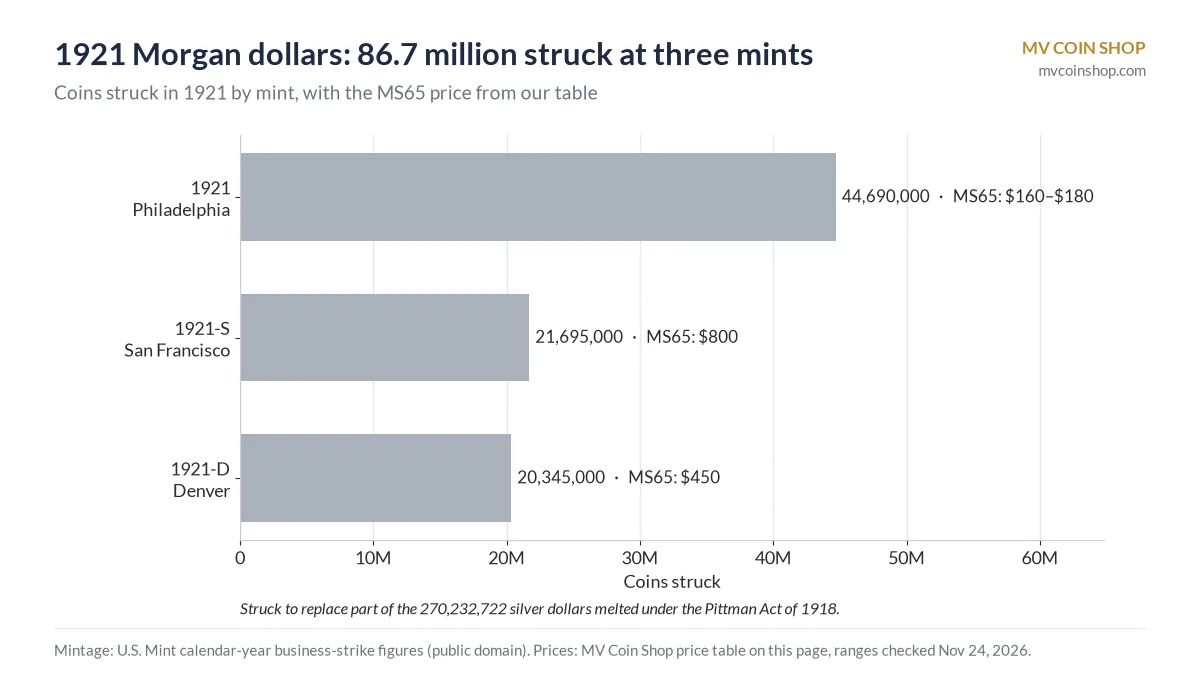
With no letter under the wreath, your coin was struck in Philadelphia, which made 44,690,000 of them, more than the other two mints combined. This is the most common 1921 Morgan. In worn condition it is valued close to its silver. Uncirculated pieces in MS63 to MS65 typically sell for $80 to $180, and a 1921 with no mint mark starts to get expensive only at MS66 and above.
1921-S (San Francisco)
San Francisco struck 21,695,000. Circulated 1921-S dollars trade close to the others, but in gem condition they are the scarcest of the three, because many were weakly struck. This is also the mint that produced the Thorn Head variety.
1921-D (Denver)
Denver struck 20,345,000, its first-ever Morgan dollars — and its first silver dollars of any type. 1921 was Denver’s only Morgan dollar year. When the mint began coining on February 1, 1906, it struck gold coins ($5, $10, and $20 pieces) and Barber dimes, quarters, and halves, but not silver dollars. Worn coins trade at about the same price as a Philadelphia coin. In MS64 and above they bring roughly two to three times as much.
Two things stand out. First, below MS63 the three mints are worth about the same, because the silver sets the floor. Second, above MS64 the branch mints pull away. The Denver and San Francisco coins were struck fast and often show weak centers, so fully struck gems are scarce. That is why a 1921-S in MS66 can be worth five times a Philadelphia coin in the same grade.
How to tell which 1921 Morgan you have
- Mint mark: turn the coin over. Just above the letters “DO” in DOLLAR, under the wreath, you will see a small D (Denver), an S (San Francisco), or nothing (Philadelphia). 1921 is the only year of the original Morgan series (1878–1921) with Denver coins.
- Morgan or Peace? Both designs are dated 1921. The Morgan shows Liberty facing left with a cap and the eagle with spread wings. The Peace dollar shows a crowned Liberty and an eagle perched on a rock with the word PEACE. A 1921 Peace dollar is a different, more valuable coin (see 1921 Peace dollar value).
- 1921 details: the 1921 dies were re-cut from scratch, so the design is slightly shallower than earlier Morgans and the eagle’s breast feathers look flatter. That flatter look is normal for 1921 and is not wear.
- Varieties: collectors chase a few die varieties listed by VAM number, most famously the 1921-S Thorn Head. Proof-like (PL) and deep mirror proof-like (DMPL) 1921 coins also exist and carry premiums. If your coin has mirror-like fields, set it aside for a closer look.
The 1921-S “Thorn Head” (VAM-1B)
The best-known 1921 Morgan variety is a 1921-S struck from one damaged obverse die. Something gouged the die, and the gouges show on every coin it struck as raised lines. The key marker, present on every Thorn Head, is a raised line running from the upper-left leaf in Liberty’s headdress across to her cap. You can see it without a magnifier. On the original “thorn” state, a spike-like line also sticks out into the field above the cap. That gave the variety its name.
- It was discovered by collector Martin Field in October 1978 and catalogued as VAM-1B by Morgan-dollar specialist Leroy Van Allen.
- The San Francisco Mint kept using the die after the damage. Workers polished some gouges away while new ones appeared, so collectors now recognize about ten distinct die states (1B1 through 1B7, plus sub-states). The most common is the one with only the cap gouge.
- PCGS will attribute the Thorn Head on its holder. That matters, because an unattributed coin usually sells as an ordinary 1921-S.
- Value: a premium over a regular 1921-S in the same grade. How much depends on the die state and grade, so ask us for a current figure.
If you have a pile of 1921-S dollars, check each one under a lamp for the line between leaf and cap. It takes a few seconds per coin.
1921 Morgan dollar VAM varieties: the full identifier
The Thorn Head is only one of the 1921 die varieties that bring a premium. Our 1921 Morgan dollar VAM identifier covers 69 listed dies across all three mints, with a step-by-step check, a flowchart, a VAM finder, original close-up diagrams and values from PCGS-graded sales. Each major variety also has its own guide:
- 1921-S Thorn Head (VAM-1B): the leaf-to-cap gouge and its die states 1B1 to 1B7
- 1921-D TRU_T (VAM-1A2): the S of TRUST missing
- 1921-D Capped R (VAM-1B1): a die chip on top of the R in AMERICA
- 1921-D Unicorn (VAM-1N3): a retained cud at TED of UNITED
- 1921-S BU Die Gouge (VAM-6A and 6B): a gouge joining B and U, with or without the S
- 1921 Pitted Reverse (VAM-41A and Hot 50 dies): raised rust dots around the wreath bow
- 1921 Wide Reed: 157 edge reeds instead of 189
- 1921 Wing Die Gouge (VAM-3F): a long gouge across the lower wing
- 1921 Zerbe and Chapman proofs: how to tell the two special issues apart
Cleaned, scratched or damaged: what it does to value
Most 1921 Morgans that come through our door from family collections have been handled, carried, or “shined up” at some point. Here is how problems change value in practice:
- Cleaned or polished: on a common worn 1921, cleaning rarely matters much, because the coin was already trading near its silver value. On an uncirculated coin it matters a lot: a cleaned MS-quality coin usually sells for a fraction of an original one and gets a “details” grade instead of a number.
- Rim dings, scratches, holes: treat these as silver-value coins.
- Natural toning: even, attractive toning can add value. Do not try to remove it.
- Rule of thumb: never clean a coin before showing it to someone. There is no cleaning method that adds value.
If you inherited a bag or box of 1921 dollars
This is the most common situation we see. 1921 was the last year of the Morgan dollar and the government struck more than 86 million of them, so they turn up in almost every family hoard. Here is how to approach a pile without being an expert:
- Count them and sort by mint mark (none, D, S). Write the count down.
- Pull out any that look bright and unworn, with frosty luster when you tilt them under a lamp. Those are the coins where grade matters, so keep them separate and handle them only by the edges.
- For the rest, a fair price is close to silver value: about $32 each at today’s price, or about $646 for a roll of 20. Some dealers pay a little over melt for nice circulated Morgans because collectors like them.
- Get the offer in writing and itemized, so you can see what the buyer thought was special. For more help, read our guide to handling an inherited coin collection.
Handling an estate?
If these came from a parent or grandparent, our step-by-step guide for heirs covers sorting, date-of-death values for taxes, and how to sell fairly. Or bring everything in for a free, no-obligation look. Still sorting things out? Start with what to do with inherited coins, or see how we buy Morgan dollars.
Why there are so many 1921 Morgan dollars: the story in the Mint’s own records
The 1921 Morgan exists because of a wartime law. Under the Pittman Act of April 23, 1918, the Treasury melted silver dollars and sold the silver, much of it to Britain for shipment to India. According to the Director of the Mint’s report for fiscal year 1921, the final count of dollars melted under the act was 270,232,722. The last 111,168 of them were melted at the Denver Mint early in that fiscal year to make smaller silver coins. The same law required the Treasury to buy American silver to replace every one of those dollars and coin it back into dollars.
The paperwork shows how that played out. On January 2, 1921, the Director of the Mint wrote to the Philadelphia superintendent that Assistant Secretary Gilbert wanted “preliminary preparations” for coining dollars from the Pittman silver on hand. Preparations were to be limited to making ingots and dies, and actual striking was to wait for further word. The superintendent was asked how soon striking could start and how many coins the Mint could make without extra help. Coinage began in February 1921, and by June 30 the Mint had delivered $19,043,000 in new dollars.
The government paid a premium for the silver. The Pittman Act fixed the price at $1.00 per ounce for silver that was both mined and refined in the United States. Producers had to file sworn affidavits from the miner, smelter and refiner to prove where it came from. The same Mint report notes that silver ineligible for the Pittman repurchase averaged $0.72898 an ounce in fiscal year 1921 (about 73 cents) and that the New York price fell to 53¼ cents on March 5, 1921. In other words, every 1921 Morgan was struck from silver the Treasury bought at well above market. When the bullion firm Handy & Harman asked in spring 1921 whether the Mint would take other silver, the answer was that the Department was not in the market for anything but Pittman silver at $1.00 an ounce.
The dies tell the rest. On April 26, 1921, the Director noted that the Denver superintendent had asked for 30 pairs of dollar dies, the first Morgan dollar dies Denver ever used. On May 23, 1921, the Director asked Philadelphia to prepare and ship twenty pairs of standard dollar dies to the Mint at San Francisco. From August through December 1921, telegrams to the San Francisco superintendent approved Pittman silver purchases from the Bunker Hill & Sullivan company of Idaho, typically in lots of about 40,000 to 65,000 ounces. Much of the silver in a 1921-S Morgan likely came from Idaho’s Silver Valley, refined and coined on the West Coast.
By spring the Treasury was confident enough to release the new coins to the public. A letter from the Director’s office said that “in view of the increased coinage of 1921 standard silver dollars,” the Mint was now prepared to pay out 1921 dollars in exchange for other forms of money. That is how so many reached banks and, eventually, family drawers. The San Francisco Mint struck 21,695,000 of them that year. Later in 1921 the Morgan design gave way to the new Peace dollar.
A local note
Our shop is about 40 miles down the Peninsula from the old San Francisco Mint building. Because of that, Bay Area families tend to hold more S-mint dollars than collections elsewhere, often bought at face value at local banks decades ago. If your 1921s came from a San Francisco relative, check for the S first. In top condition it is the most valuable of the three.
Not sure which one you have? Text a photo to (415) 952-6467 or bring it to our office in Mountain View, by appointment, for a free look. Book a time. If you want to sell, we buy 1921 Morgan dollars.
Frequently asked questions
Is a 1921 silver dollar rare?
Not usually. More than 86 million 1921 Morgan dollars were struck at Philadelphia, Denver and San Francisco, so worn examples trade close to their silver value. High-grade uncirculated coins, especially from Denver and San Francisco, are scarce and worth much more.
How much silver is in a 1921 Morgan dollar?
About 0.7734 troy ounce of pure silver (26.73 grams at 90% silver). At $41.76 per ounce that is about $32.30 of silver.
Where is the mint mark on a 1921 Morgan dollar?
On the back, under the wreath and just above the letters DO in DOLLAR. D means Denver, S means San Francisco, and no letter means Philadelphia.
How much is a 1921 Philadelphia Morgan dollar worth?
A 1921 Morgan dollar with no mint mark (Philadelphia) is worth about its silver, around $32, up to about $75 in worn condition, and roughly $80 to $180 in MS63 to MS65. A 1921 Peace dollar never has a mint mark and is worth $150 or more.
What is a 1921 Thorn Head Morgan dollar?
A 1921-S Morgan struck from a gouged obverse die (VAM-1B). It shows a raised line from the leaf to Liberty’s cap, and in one state a thorn-like spike above the cap. It sells for a premium over a normal 1921-S.
Is a 1921-D Morgan dollar worth more?
In worn condition, not much. In MS65 and higher it is worth roughly two to three times the Philadelphia coin, because well-struck Denver coins are hard to find.
Should I clean my 1921 Morgan dollar?
No. Cleaning leaves fine scratches that collectors and grading services can see, and it can cut the value of an uncirculated coin dramatically. Leave it as it is.
What is the difference between a 1921 Morgan and a 1921 Peace dollar?
They are different designs from the same year. The Peace dollar, with a crowned Liberty and the word PEACE on the back, was first struck at the very end of 1921 in high relief and is worth far more in every grade.
Related pages
- 1901 Morgan dollar value
- 1893-S Morgan dollar value
- 1898 Morgan dollar value
- 1921 Peace dollar value
- Morgan dollar values (all dates)
- 1921 Morgan dollar VAM varieties and finder
Sources
- Melt value: 0.77344 troy oz × silver price ($41.76, COMEX silver futures, 4:25 a.m. Central on Nov 24, 2026).
- Values: APMEX coin-value pages and CoinsWorth auction estimates, checked Nov 24, 2026, rounded by us.
- Mintages: Morgan dollar mintage table (Wikipedia, citing Red Book/CoinFacts).
- Thorn Head: paraphrased from Leroy Van Allen’s VAM attributions as documented on VAMWorld.
- History: Annual Report of the Director of the Mint, fiscal year ended June 30, 1921 (also on Internet Archive); “Letters Sent to Philadelphia & San Francisco Mints,” 1921 (National Archives RG 104, via the Newman Numismatic Portal on Internet Archive); Treasury statement by Secretary Mellon, April 1, 1921; Treasury regulations on Pittman Act silver sales, August 30, 1920.
By David, owner of Mountain View US and Foreign Coins, ANA member and PCGS and NGC submitter.