
I’m David. Silver half dollars are one of the most common things people bring me: a coffee can of Kennedys, a few rolls of Franklins, or a folder of Walking Liberty halves started by a grandparent. I’m a member of the American Numismatic Association and a submitter to PCGS and NGC, and I evaluate silver coins by appointment from our office in Mountain View.
Half dollars are easy to sell well once they are sorted. The date tells you how much silver each coin holds, and a short list of dates and conditions tells you which coins deserve a closer look. This page covers both. For dimes, quarters, and mixed lots, see sell silver coins; for Morgan and Peace dollars, see sell Morgan silver dollars.
Next step: contact David about your half dollars. Call or text (415) 952-6467, email hi@mvcoins.org, or use our contact form. Every item is evaluated individually.
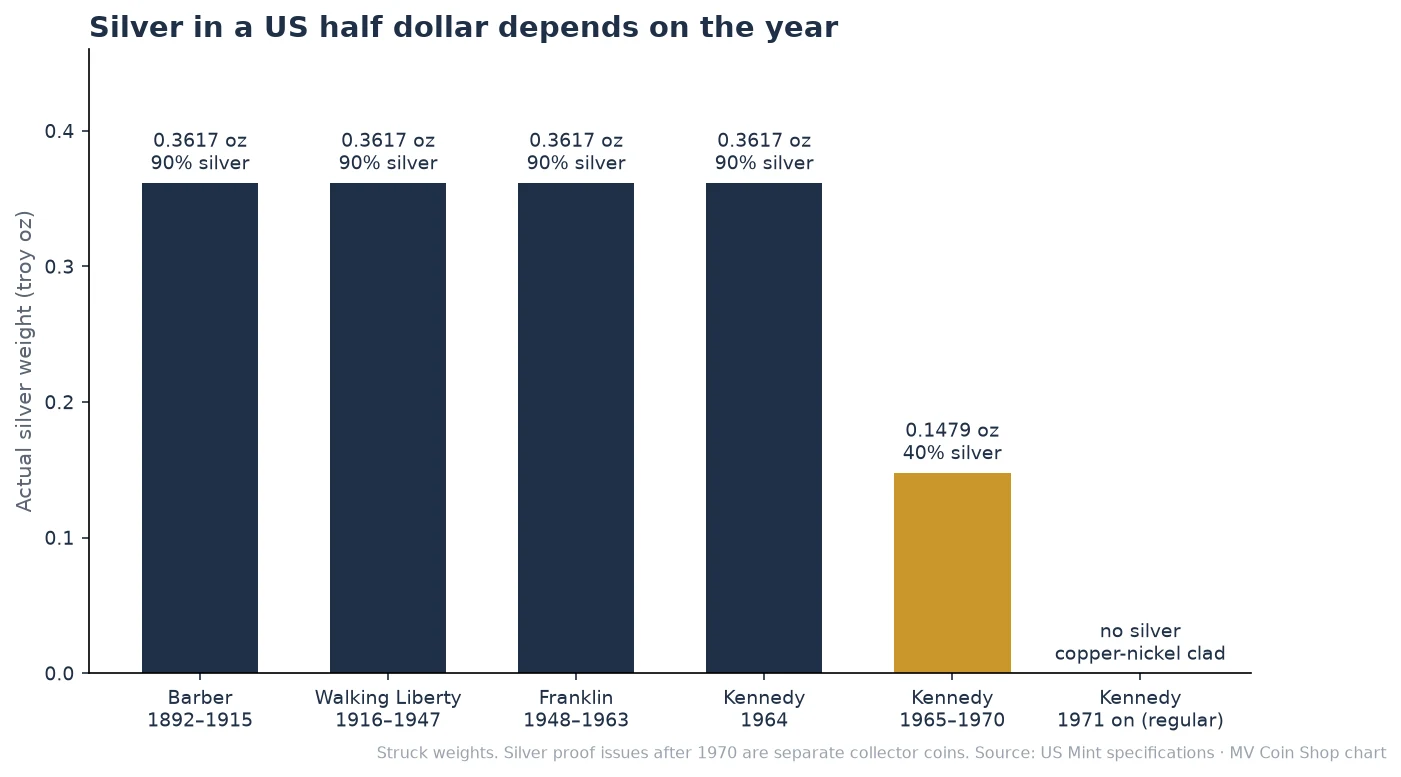
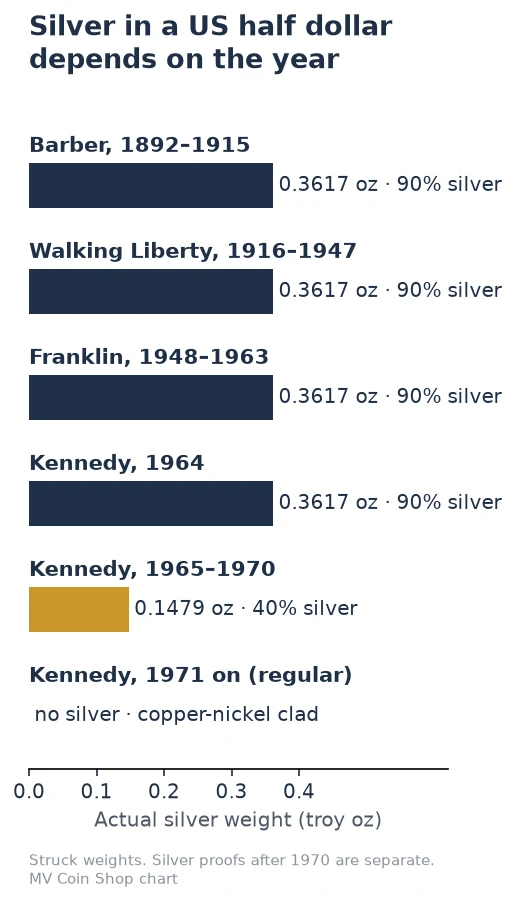
How much silver is in each type of half dollar
Four designs were struck in 90% silver. In 1965 the Mint switched the half dollar to a 40% silver composition, and in 1971 it dropped silver from regular issues altogether.
Swipe to see more
| Type | Years | Composition | Weight | Silver (oz) |
|---|---|---|---|---|
| Barber | 1892–1915 | 90% silver | 12.50 g | 0.3617 |
| Walking Liberty | 1916–1947 | 90% silver | 12.50 g | 0.3617 |
| Franklin | 1948–1963 | 90% silver | 12.50 g | 0.3617 |
| Kennedy | 1964 | 90% silver | 12.50 g | 0.3617 |
| Kennedy | 1965–1970 | 40% silver (silver-clad) | 11.50 g | 0.1479 |
| Kennedy | 1971 on, regular issues | Copper-nickel clad | 11.34 g | None |
Mint mark location, if you need it while sorting:
- Barber: on the back, below the eagle.
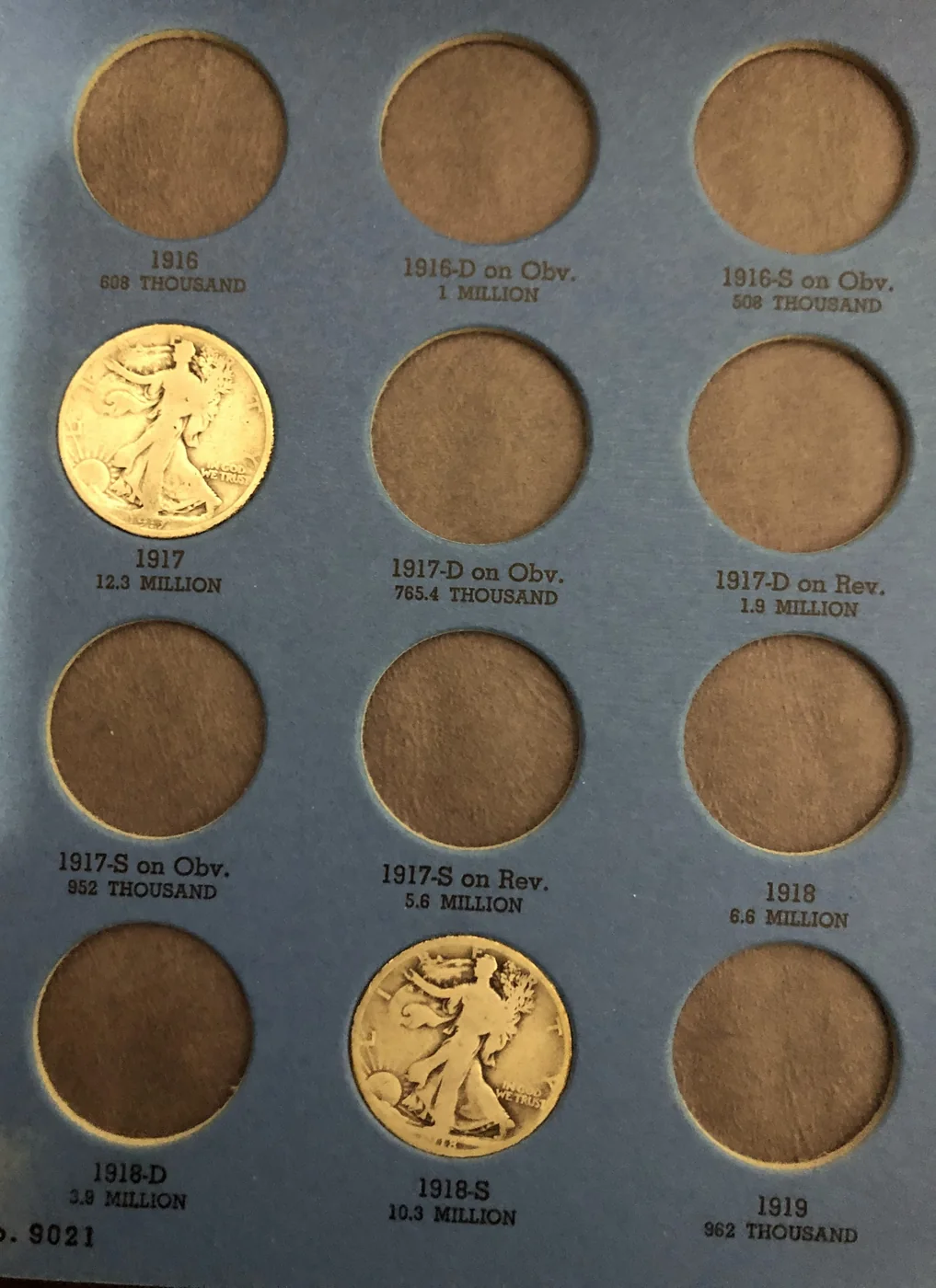
- Walking Liberty: on the front, below the motto, for 1916 and part of 1917; on the back, lower left near the rim, after that. Both the 1917-D and the 1917-S exist with the mint mark on the front and also with it on the back.
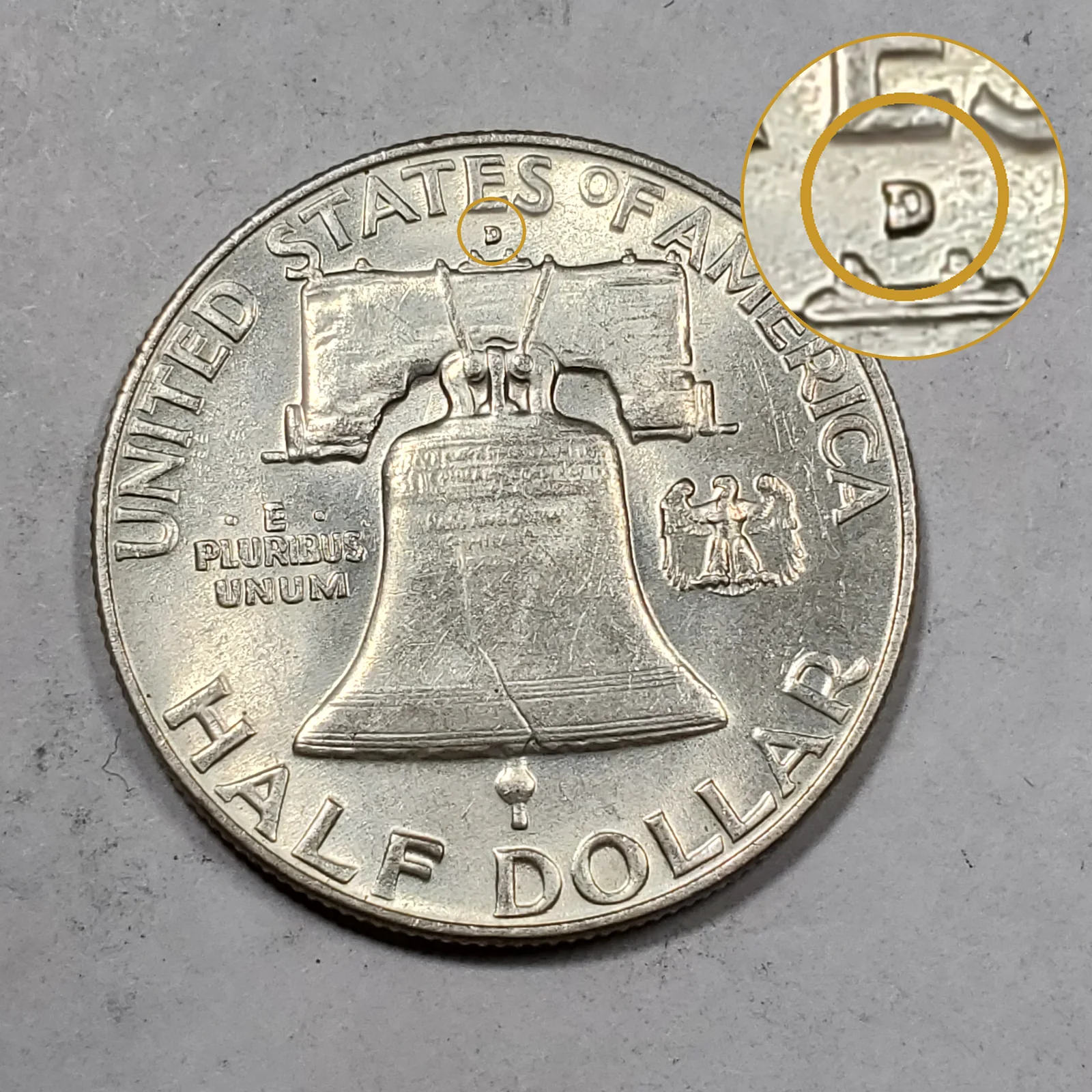
- Franklin: on the back, above the bell’s beam.
- Kennedy, 1964: on the back, left of the eagle near the olive branch.
- Kennedy, 1965–1967: these years carry no letter.
- Kennedy, 1968 and later: on the front, below the portrait and just above the date.
Sorting a mixed group: date, weight, and edge
When halves arrive loose, the date is the first sort. If dates are worn or you want to double-check, weight and the edge settle it quickly.
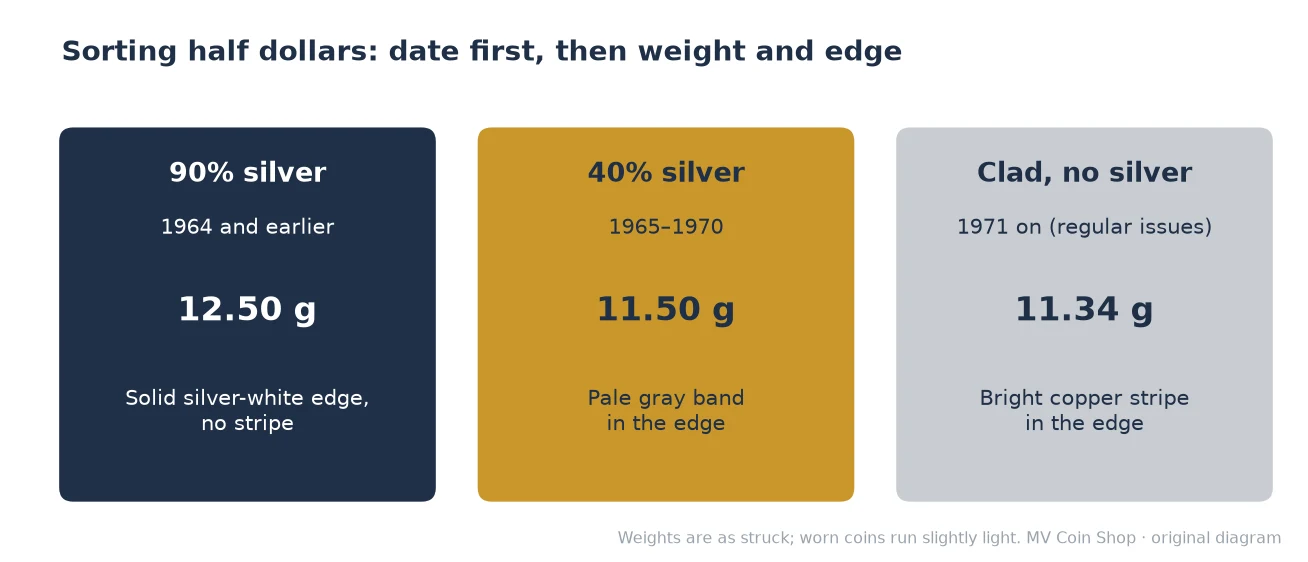
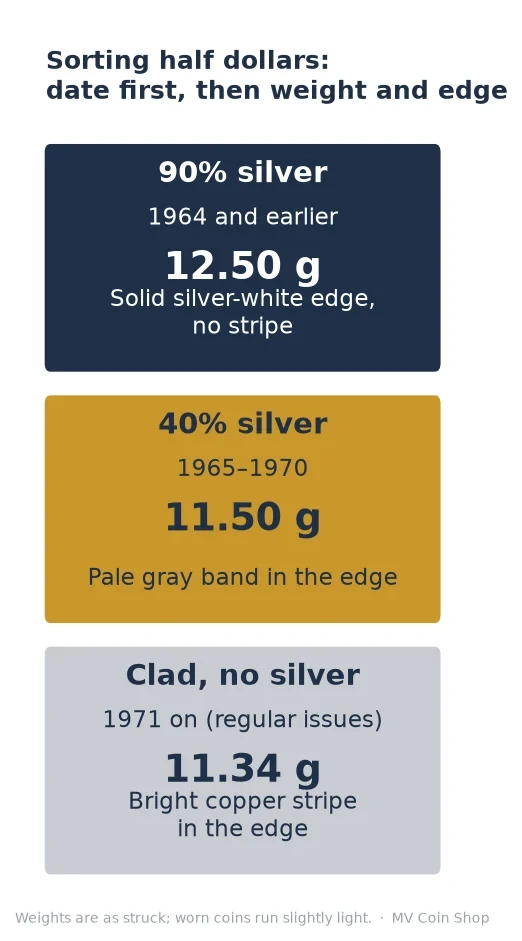
- 90% silver halves show a solid, silver-white edge with no visible layers.
- 40% Kennedys have silver-rich outer layers bonded to a lower-silver core, so the edge shows a faint gray band rather than a copper stripe.
- Clad Kennedys show a bright copper stripe through the middle of the edge and contain no silver.
- A kitchen scale that reads to 0.01 gram separates the three groups: about 12.5, 11.5, and 11.3 grams. Heavily worn silver coins can weigh a little less.
Please do not clean, polish, or dip any of them while sorting. It does nothing for silver content and removes collector value from the coins that have it.
A short list before you contact David:
- Sort by date first, then use weight and the edge if a date is worn.
- Keep 90% halves, 40% Kennedys, and clad coins in three groups, and note a rough count of each.
- Set aside older or better-looking coins, original rolls, and anything you are unsure about.
- Leave the coins uncleaned, and contact David for an individual evaluation.
Have questions about your half dollars? Contact David at (415) 952-6467 (call or text), hi@mvcoins.org, or our contact form for an individual evaluation.
Half dollars that deserve a closer look
Most circulated halves are valued for their silver. These are the exceptions I check for in every lot:
- Barber halves in any grade above heavy wear, plus low-mintage Philadelphia dates such as 1913, 1914, and 1915, and branch-mint coins such as 1896-S, 1897-O, and 1897-S.
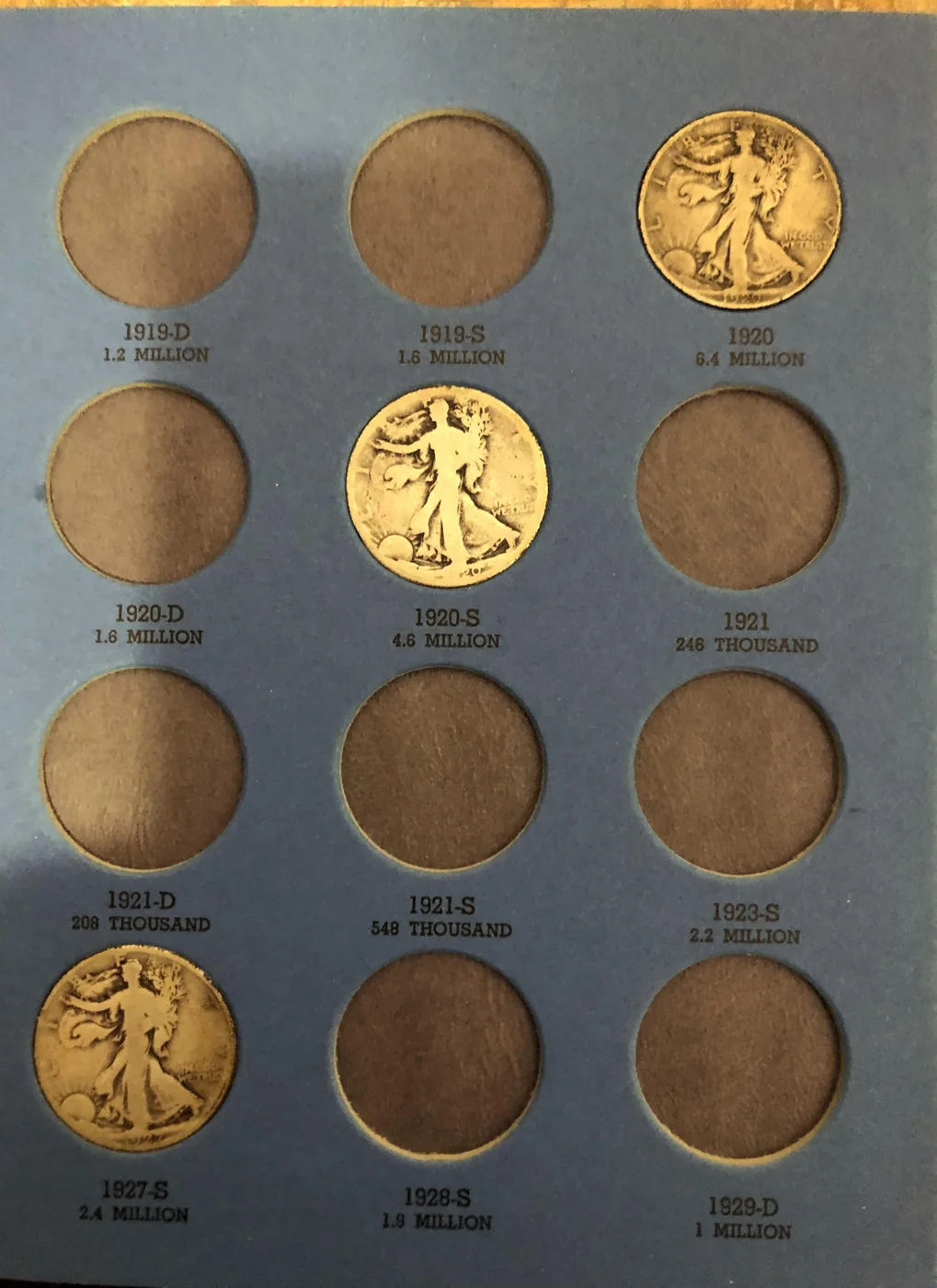
- Walking Liberty halves from 1916 through 1921, especially 1916-S, the 1917-D and 1917-S with the mint mark on the front (both were also struck with it on the back), 1919-D, and all three 1921 issues, along with the 1938-D. Sharp, original examples of later dates in mint state also draw collector interest.
- Franklin halves in mint state with fully struck lines across the bottom of the Liberty Bell, which graders designate Full Bell Lines. Dates such as 1949-S, 1953, and 1955 are scarcer than the rest.
- 1964 Kennedy halves in high certified grades, and the 1964 proof with the Accented Hair variety, identified by extra hair lines above the ear.
- The 1970-D Kennedy, the last 40% silver half for general use, issued only in mint sets.
- Original rolls and mint-sealed bags, which should stay unopened until they are evaluated.
If you are not sure whether something belongs on this list, set it aside. Separating those coins from the silver-value coins is part of every evaluation.
Dates not to sell by weight: a checklist
Use this as a sorting sheet. If a half dollar matches a line, set it aside before the rest are counted.
Swipe to see more
| Coin | Where the mint mark is | Set aside |
|---|---|---|
| Walking Liberty, 1916 and part of 1917 | Obverse, below IN GOD WE TRUST | 1916-S; 1917-D and 1917-S with the mark on the front (both dates also exist with it on the back) |
| Walking Liberty, rest of 1917 to 1947 | Reverse, lower left near the rim | 1919-D, 1919-S, all three 1921 coins (1921, 1921-D, 1921-S), 1938-D |
| Franklin, 1948 to 1963 | Reverse, above the bell | Any uncirculated coin, especially with full lines across the bottom of the bell |
| Kennedy, 1964 | Reverse, left of the eagle near the olive branch | High-grade coins and proofs, including the Accented Hair proof |
| Kennedy, 1968 and later | Obverse, below the portrait and just above the date | The 1970-D, always: it was issued only in mint sets |
| Any date | Any | Uncirculated coins, original rolls, and sealed bags |
Not sure whether to send a coin to PCGS or NGC? See the grade-or-raw decision chart; the same questions apply to silver.
Have questions about which halves to set aside? Contact David at (415) 952-6467 (call or text), hi@mvcoins.org, or our contact form for an individual evaluation.
Silver content and melt reference
This table shows silver content and melt value at a dated reference spot price. Melt value is not an offer or a quote and does not indicate what we pay; every lot is evaluated individually.
Swipe to see more
| Coin | Silver content (troy oz) | Melt at reference spot |
|---|---|---|
| 90% half dollar (1964 and earlier), each (12.50 g as struck) | 0.3617 | $14.87 |
| 40% Kennedy half (1965–1970), each (11.50 g as struck) | 0.1479 | $6.08 |
| Roll of 20 90% halves (struck weight; worn rolls run lighter) | 7.2338 | $297.31 |
| Roll of 20 40% Kennedy halves (struck weight) | 2.9580 | $121.57 |
Melt reference for your half dollars
Type the reference spot from the table above, or another price, then enter a count. Melt value is not an offer or a quote and does not indicate what we pay. Every item is evaluated individually. Contact David at (415) 952-6467, hi@mvcoins.org, or our contact form to talk about yours.
How half dollars are quoted, and why 40% halves bid weaker
Most 90% halves are quoted per dollar of face, the same way as 90% dimes and quarters, since every dollar of denomination holds the same silver. Two halves make one dollar, so a seller can total a roll or a jar without weighing it.
The 1965 to 1970 Kennedy halves form their own category. Each coin holds much less silver, recovering it means refining a mostly copper coin, and fewer buyers want them. For those reasons bids on 40% halves tend to be weaker relative to their melt than bids on 90% coins. The exact figure moves with the market, so contact David for an individual evaluation.
What I check first, in order
- Date. It separates 90% silver halves (through 1964) from 40% halves (1965 through 1970) and flags the dates in the list below.
- Mint mark, in the right place. Walking Liberty halves moved the mint mark from the front to the back during 1917, so the 1917-D and 1917-S exist both ways. Franklin halves carry it above the bell. Kennedy halves carry it on the back in 1964, left of the eagle, and from 1968 on the front, below the portrait and just above the date.
- Condition. Original luster, sharp detail, and, on Franklins, the lines across the bottom of the bell.
- Problems. Cleaning, scratches, and holes matter for the set-aside coins.
- Then weight. Only after that do the remaining coins get counted as silver.
Have questions about your half dollars? Contact David at (415) 952-6467 (call or text), hi@mvcoins.org, or our contact form for an individual evaluation.
How an evaluation works
1. Contact David. Call or text (415) 952-6467, email hi@mvcoins.org, or use our contact form. A rough count of 90% and 40% halves is enough to start, plus photos of any older or better-looking coins. Our photo guide shows how.
2. Sorting and review. I confirm the silver content, pull out coins with collector interest, and check anything certified. Every lot is evaluated individually.
3. Your decision. We go through what affects the value of the group, and you decide what to sell and what to keep.
4. Meeting and payment. Payment methods are agreed before any sale. We meet at our office in Mountain View, at a bank, at your home in the Bay Area, or work by insured mail-in if you are farther away.
If the halves came from an estate, our inherited coin collection guide explains how to handle the rest of the collection.
Questions about selling half dollars
What do you pay for silver half dollars?
We do not quote prices on the website. A 90% half holds 0.3617 troy ounce of silver and a 40% Kennedy holds 0.1479, and scarce dates or high-grade coins can carry collector value beyond that. Contact David at (415) 952-6467, hi@mvcoins.org, or the contact form for an individual evaluation.
Which half dollars contain silver?
Every regular-issue half dollar dated 1964 or earlier is 90% silver. Kennedy halves dated 1965 through 1970 are 40% silver. Regular Kennedy halves from 1971 on are copper-nickel clad with no silver, apart from special silver proof and collector issues.
What is the melt value of a 40% Kennedy half dollar?
A 1965 to 1970 Kennedy half contains 0.1479 troy ounce of silver, so its melt value is that weight multiplied by the silver spot price. The reference table on this page shows the figure at a dated spot price. Melt value is not an offer.
How much silver is in a roll of half dollars?
A standard roll holds 20 halves. A roll of 90% halves contains about 7.23 troy ounces of silver as struck, and a roll of 40% Kennedys about 2.96 ounces. Worn coins run slightly lighter.
Is a 1964 Kennedy half dollar rare?
No. Hundreds of millions were struck and most are valued for their silver. Exceptions include high-grade certified examples, the scarce Accented Hair proof variety, and special strikes, which are worth having evaluated individually.
Why is the 1970-D Kennedy half different?
The 1970-D was the last 40% silver Kennedy made for general use, but it was issued only in that year’s mint sets rather than released to banks. Fewer survive, so it carries collector interest that the 1965 to 1969 dates do not.
How do I sell half dollars to you?
Contact David by phone or text at (415) 952-6467, by email at hi@mvcoins.org, or through the contact form. A rough count of 90% and 40% halves, and photos of any older or better-looking coins, help. Every lot is evaluated individually, and payment methods are agreed before any sale.
Contact David about your half dollars
Ready to talk about your half dollars? Contact David: call or text (415) 952-6467, email hi@mvcoins.org, or send photos through our contact form. We look at every piece individually and explain what affects its value.
Related pages: sell silver coins for dimes, quarters, and mixed lots, sell bullion for bars and rounds, and sell proof sets for collector sets.