
I’m David. For more than 14 years I’ve bought US gold coins struck before 1933 — the $2.50, $5, $10, and $20 pieces that turn up in safe deposit boxes, estates, and old collections. I’m a member of the American Numismatic Association and a submitter to PCGS and NGC, and I work by appointment from our office in Mountain View.
These coins sit in two markets at once. Every one of them contains a fixed amount of gold, so it always has a melt value. Many also have collector value beyond their gold. Knowing which market your coins belong to is the key to selling them well, and it is what this page walks through. For modern bullion coins and world gold, see sell gold coins.
Next step: contact David about your pre-1933 gold. Call or text (415) 952-6467, email hi@mvcoins.org, or use our contact form. Every item is evaluated individually.
The eight pre-1933 US gold types we see most
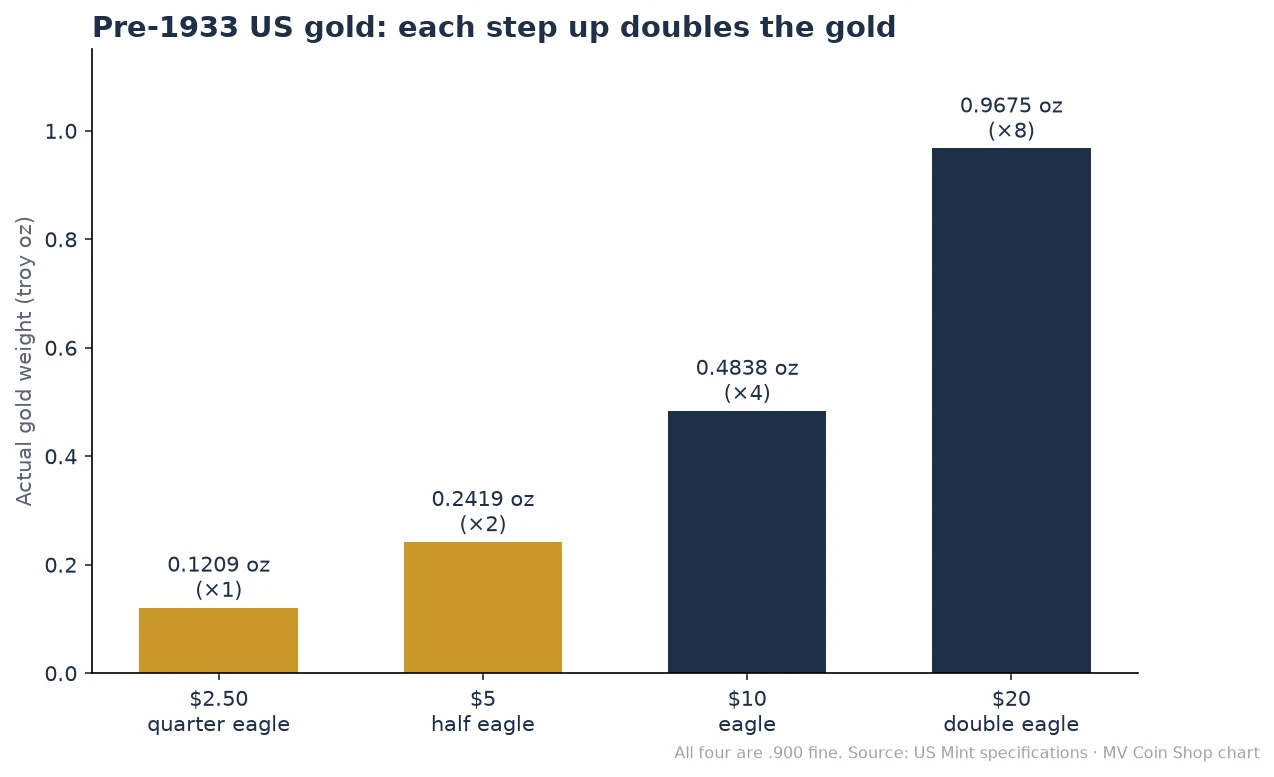
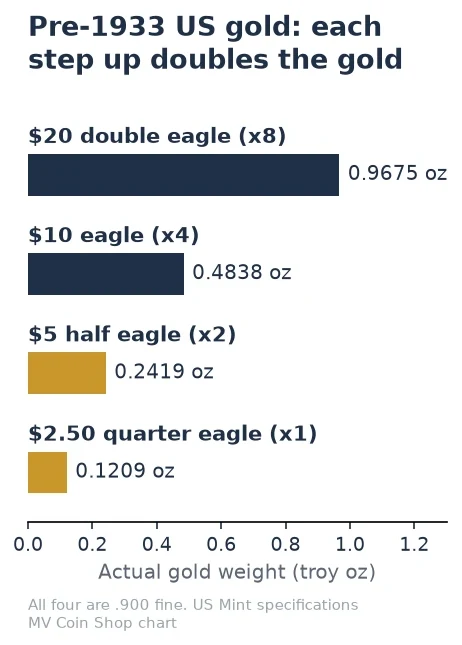
From 1838 to 1933 the US Mint struck gold in four main denominations, each in a Liberty Head design and then a 20th-century design. Gold content is the same within a denomination, no matter the type or year.
Swipe to see more
| Denomination | Type | Years struck | Gold content (troy oz) |
|---|---|---|---|
| $2.50 quarter eagle | Liberty Head | 1840–1907 | 0.1209 |
| $2.50 quarter eagle | Indian Head (incuse) | 1908–1929 | 0.1209 |
| $5 half eagle | Liberty Head | 1839–1908 | 0.2419 |
| $5 half eagle | Indian Head (incuse) | 1908–1929 | 0.2419 |
| $10 eagle | Liberty Head | 1838–1907 | 0.4838 |
| $10 eagle | Indian Head | 1907–1933 | 0.4838 |
| $20 double eagle | Liberty Head | 1850–1907 | 0.9675 |
| $20 double eagle | Saint-Gaudens | 1907–1933 | 0.9675 |
A few details that matter when you sort them:
- The Indian Head $2.50 and $5 have an incuse design — the portrait and lettering are sunk into the surface rather than raised. Wear and cleaning show up first on the high points around the headdress and the eagle’s shoulder.
- Saint-Gaudens double eagles are dated in Arabic numerals except for the high-relief 1907 pieces with a Roman-numeral date, which are a separate, much more valuable coin.
- Mint marks affect value. Philadelphia coins carry no letter at all. Look for CC (Carson City), O (New Orleans), S (San Francisco), D (Denver after 1906, Dahlonega before 1862), and C (Charlotte). Carson City and the old Southern branch mints usually carry the largest premiums.
- Where to look: on Liberty Head gold the mint mark is on the reverse below the eagle; on the Saint-Gaudens $20 it is on the obverse above the date; on Indian Head $2.50 and $5 pieces it is on the reverse to the left of the arrowheads; on the Indian $10 it is on the reverse next to the eagle’s talons.
For the $20 pieces in detail, including the three Liberty types, the scarce dates and mints, and how counterfeits are caught, see our guide to selling $20 gold coins.
Melt value vs numismatic premium
Melt is simple: gold content times the spot price. A $20 double eagle holds 0.9675 ounce of gold, so its melt is a little under the spot price of one ounce. The numismatic premium is the collector value above melt, and it depends on date, mint, grade, eye appeal, and whether the coin is certified. Neither figure is an offer; every coin is evaluated individually.
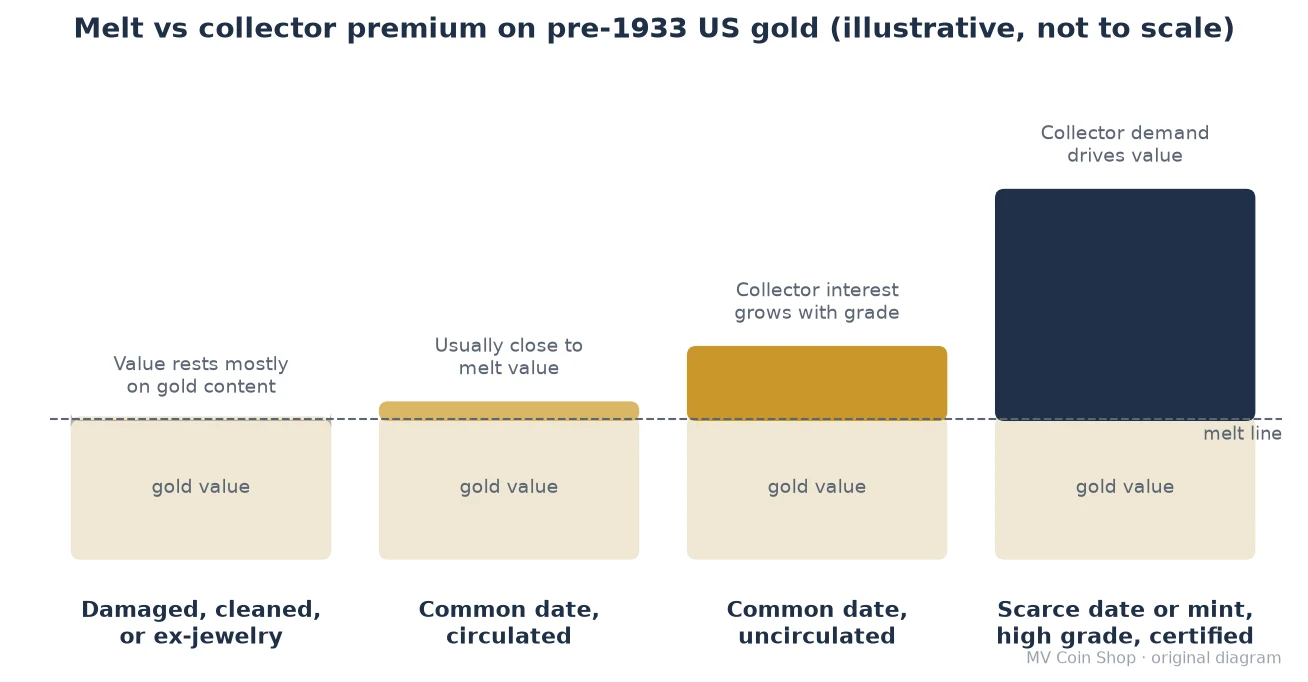
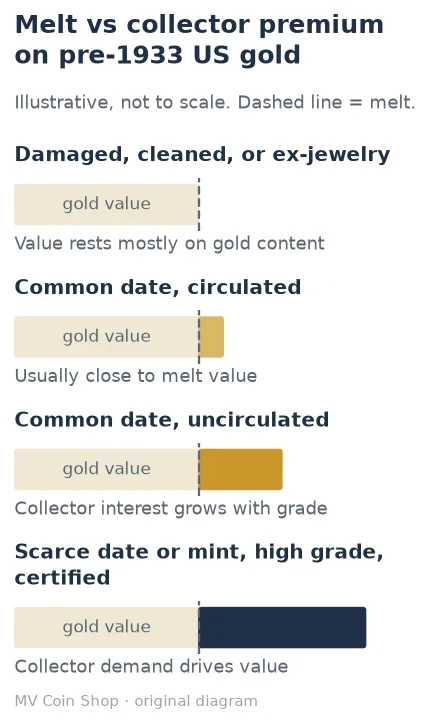
- Damaged, cleaned, or ex-jewelry coins are valued mainly for their gold content. Bezel marks, solder, holes, and harsh cleaning remove most collector interest.
- Common dates in circulated grades — think 1904 Liberty $20s or 1920s Saint-Gaudens pieces with wear — generally trade close to melt in the market. Original, problem-free coins can attract more collector interest.
- Common dates in mint state draw collector interest that grows with each grade step, especially in certified holders.
- Scarce dates and mints, and top grades, are valued from collector demand. For those coins, gold content is only part of the picture.
In practice, an inherited group of pre-1933 gold is usually a mix. A careful evaluation separates the coins valued mainly for gold from the ones with collector interest, rather than treating the whole lot the same way.
Have questions about your pre-1933 gold? Contact David at (415) 952-6467 (call or text), hi@mvcoins.org, or our contact form for an individual evaluation.
Certified vs raw pre-1933 gold
A coin in a PCGS or NGC holder comes with an independent grade and authentication, so buyers can evaluate it quickly and with confidence. That certainty matters most for mint-state coins and scarce dates, where one grade point can change the value a great deal.
Raw coins (not in a holder) are evaluated on our own grading and authentication. For common circulated dates that is normal and costs you nothing. For a raw coin that could be scarce or high grade, it can make sense to grade before selling — see what coin grading costs and selling graded coins. I’ll tell you plainly if I think grading would pay for itself and when it would not.
One caution: do not crack coins out of old holders to “clean them up,” and keep holders unbroken. A damaged holder or a cleaned coin rarely regains its value.
Grade it or sell it raw?
A PCGS or NGC holder does two jobs: it settles authenticity, and it puts a grade on the coin that any later buyer can read. Grading has a cost and takes time, so it only makes sense when the answer could change how the coin is valued. As an ANA member who submits coins to PCGS and NGC, these are the questions I go through with a seller before anyone pays a fee.
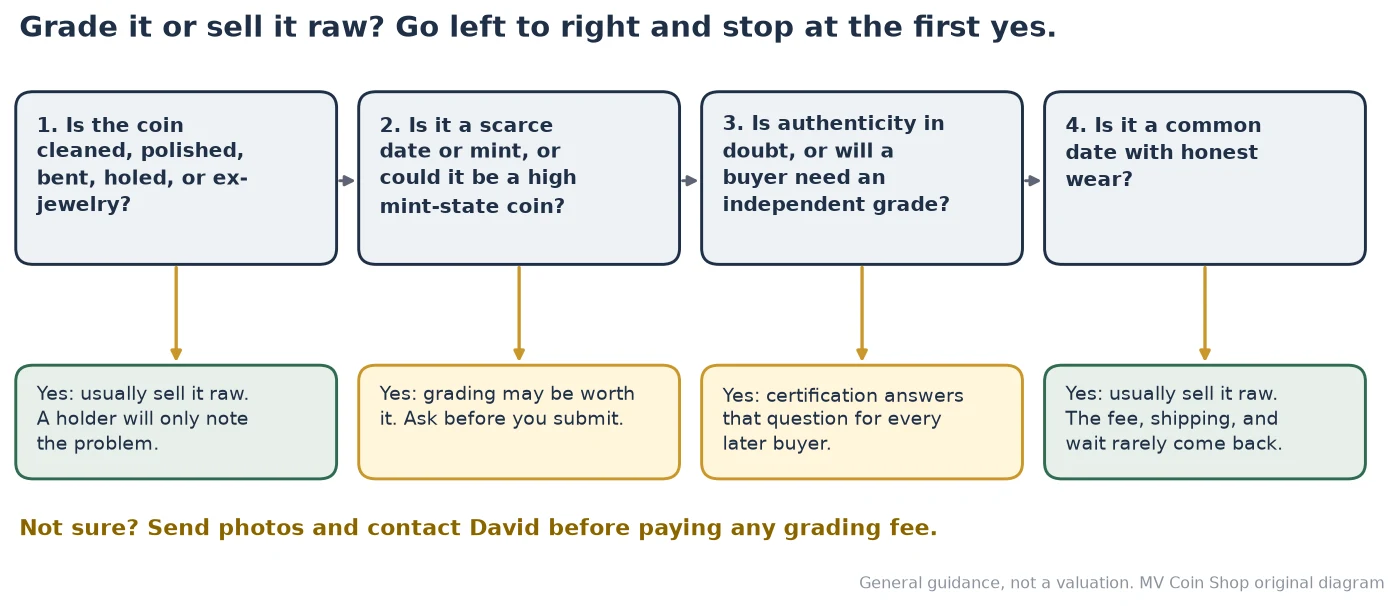
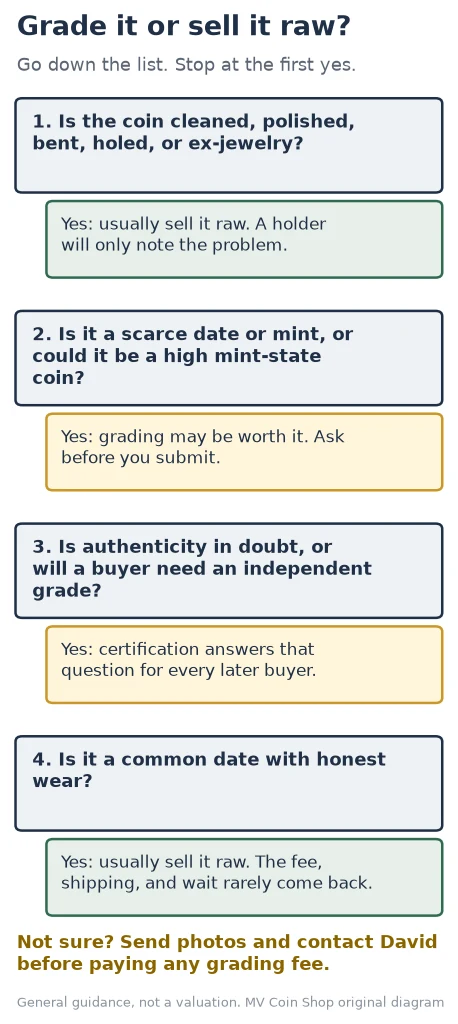
- Cleaned, polished, bent, holed, or ex-jewelry? The holder will usually just record the problem, so selling the coin raw is normally the sensible route.
- A scarcer date or mint, or a coin that may be a high mint-state piece? This is where a grade can make a real difference. Ask before you submit, because the date, the surfaces, and the strike all decide whether it is worth it.
- Is authenticity the open question? Certification answers it once, for every buyer who handles the coin after you.
- A common date with honest wear? The fee, the shipping, and the wait rarely come back, so most of these coins are best sold as they are.
Have questions about whether to grade a coin? Contact David at (415) 952-6467 (call or text), hi@mvcoins.org, or our contact form for an individual evaluation.
Gold content and melt reference for US gold
This table shows the gold content of each denomination and its melt value at a dated reference spot price. Melt value is not an offer or a quote and does not indicate what we pay; every coin is evaluated individually. The melt figure is recalculated monthly; gold content never changes.
Swipe to see more
| Coin | Gross weight | Fineness | Gold content (troy oz) | Melt at reference spot |
|---|---|---|---|---|
| US $20 Liberty or Saint-Gaudens | 33.436 g | .900 | 0.9675 | $3,454 |
| US $10 Liberty or Indian | 16.718 g | .900 | 0.4838 | $1,727 |
| US $5 Liberty or Indian | 8.359 g | .900 | 0.2419 | $864 |
| US $2.50 Liberty or Indian | 4.180 g | .900 | 0.1209 | $432 |
Melt reference for pre-1933 US gold
Type the reference spot from the table above, or another price, then enter a count. Melt value is not an offer or a quote and does not indicate what we pay. Every item is evaluated individually. Contact David at (415) 952-6467, hi@mvcoins.org, or our contact form to talk about yours.
A short list before you contact David:
- Sort by denomination first ($2.50, $5, $10, or $20), then by design (Liberty, Indian, or Saint-Gaudens).
- Note the date and mint mark; set aside Carson City, New Orleans, and any coin whose date you do not recognize as common.
- Do not clean or polish the coins, and leave certified pieces in their holders.
- Send photos of both sides, or bring them in, and contact David for an individual evaluation.
Price guide figures vs. what a dealer can offer
Printed guides and online price lists usually describe a retail level, or what a coin has brought at auction in a stated grade. A dealer buying a coin is working from a different number: what the coin can be resold for, after the time it takes to sell it, the cost of checking it, and the risk of a grade or authenticity problem. Those two figures are not supposed to match, and comparing a guide’s retail figure with a buy offer mixes two different things.
Three points help when you read any guide. First, check which grade the figure refers to: a guide lists many grades, and an honest worn coin sits near the bottom of that range. Second, notice whether the figure is for a certified coin; raw coins are generally valued with more caution because the grade has not been settled. Third, check the date on the guide, since metal prices and collector demand move. I explain which grade and which factors I see in your coins when we talk, and every coin is evaluated individually.
Have questions about how your coins are valued? Contact David at (415) 952-6467 (call or text), hi@mvcoins.org, or our contact form for an individual evaluation.
How an evaluation works
1. Contact David. Call or text (415) 952-6467, email hi@mvcoins.org, or use our contact form. Clear photos of both sides of each coin, plus the front of any holder, help — our photo guide shows how. A rough count by denomination is useful too.
2. Coin-by-coin review. I separate the coins valued mainly for gold from the ones with collector interest, check authenticity, and grade the raw coins. Every coin is evaluated individually.
3. Next steps, your choice. We talk through what affects the value of each coin. You decide what, if anything, to sell, and you can keep the coins that matter to your family.
4. Meeting and payment. Payment methods (cash, check, or bank transfer) are agreed before any sale. We meet at our office in Mountain View, at a bank, with a house call in the Bay Area, or work by insured mail-in if you are farther away.
If your gold is part of a larger estate, our inherited coin collection guide covers the rest of the collection, and our coin appraisal page explains written appraisals.
Gold coins in bezels, pendants, and rings
US gold coins have been worn as jewelry for a long time, most often a $20, $10, or $5 in a pendant bezel or a small coin set into a ring or bracelet. These pieces are common in inherited collections and are worth a careful look before anything is taken apart.
- Leave the coin in the mount. Prying it out can scratch the rim or the fields. A bezel can be checked with the coin still inside.
- Look at the rim and edge. Solder spots, a filed or flattened edge, or a loop attached to the coin all leave marks. Certified coins with this history usually receive a details grade, with terms such as mount removed or damaged on the label.
- Check for holes. A hole removes gold, so it lowers even the metal value, not only the collector value.
- Mount and coin are separate items. A bezel is often a lower karat than the coin. The coin and the mount are valued separately.
Most ex-jewelry coins end up valued for their gold, but the date still matters, so I read it before deciding. Coins with clear jewelry damage are usually not good candidates for grading.
Have questions about a gold coin in jewelry? Contact David at (415) 952-6467 (call or text), hi@mvcoins.org, or our contact form for an individual evaluation.
What lowers the value of old gold coins
- Cleaning or polishing, including “just a little” with a cloth. Gold scratches easily and buyers can see it.
- Jewelry use: bezels, loops, solder, or a hole.
- Rim damage and heavy bag marks on the larger coins.
- Doubt about authenticity. Counterfeit $20s made to pass as bullion and small coins with added mint marks are both common. A careful buyer checks weight, diameter, and design details. A correct weight is not proof on its own: some copies are made with real gold to the correct weight, and a real coin can have a mint mark added or altered to look like a scarcer one. Diameter, thickness, the edge, and fine design details all have to agree.
Questions about selling pre-1933 gold
How much will you pay for a $20 gold coin?
We do not quote prices on the website. Every $20 Liberty or Saint-Gaudens double eagle holds 0.9675 troy ounce of gold, and its value also depends on date, mint, grade, condition, and certification. Contact David at (415) 952-6467, hi@mvcoins.org, or the contact form for an individual evaluation.
How much gold is in pre-1933 US gold coins?
All regular-issue US gold from the $2.50 to the $20 is 90% gold. A $2.50 holds 0.1209 troy ounce, a $5 holds 0.2419, a $10 holds 0.4838, and a $20 holds 0.9675. Each denomination carries exactly twice the gold of the one below it.
Is pre-1933 gold valued at spot?
Gold content and spot are only part of the picture. The value of damaged or ex-jewelry pieces rests mostly on their gold, while original coins with collector demand can be worth more than melt. That is why every coin is evaluated individually instead of weighing the group.
Should I get my coins graded before I sell them?
Usually not for common circulated dates, where the grading fee can eat most of any gain. Grading tends to pay off for scarce dates and mints and for coins that may grade mint state. We are a PCGS and NGC submitter and can tell you which pieces, if any, are worth sending.
Are cleaned or jewelry-mounted gold coins still worth buying?
Yes, for their gold. A cleaned coin, or one with a bezel mark, solder, or a hole, loses most of its collector premium, so its value normally rests on gold content. Please do not try to remove a mount or polish a coin before you sell it.
How do I sell pre-1933 gold to you?
Contact David by phone or text at (415) 952-6467, by email at hi@mvcoins.org, or through the contact form, ideally with photos. Each coin is evaluated individually. Payment methods (cash, check, or bank transfer) are agreed before any sale, and meetings can be at our office in Mountain View, at a bank, at your home in the Bay Area, or by insured mail-in.
Which pre-1933 gold coins are most often counterfeited?
Fakes of common-date $20 Liberty and Saint-Gaudens pieces are made to pass as bullion, and smaller coins such as the 1911-D $2.50 Indian are faked or altered by adding a mint mark. A careful buyer checks weight, diameter, and design details, and certified coins are checked against the holder.
Contact David about your pre-1933 gold
Ready to talk about your pre-1933 gold? Contact David: call or text (415) 952-6467, email hi@mvcoins.org, or send photos through our contact form. We look at every piece individually and explain what affects its value.
For bullion coins and world gold, see sell gold coins; for bars, see sell bullion.