
I’m David. The $20 double eagle is the US gold coin I handle most often, whether it arrives as a single piece from a safe deposit box or as a roll that a grandparent put away decades ago. I’m a member of the American Numismatic Association and a submitter to PCGS and NGC, and I evaluate these coins by appointment from our office in Mountain View.
Every double eagle holds just under one ounce of gold, so all of them have a solid floor of metal value. What separates one from the next is design type, date, mint, and condition. This page explains how to sort your coins into those groups before you talk to anyone about selling them. For the smaller denominations, see pre-1933 US gold; for modern bullion such as Gold Eagles and Krugerrands, see sell gold coins.
Next step: contact David about your $20 gold coins. Call or text (415) 952-6467, email hi@mvcoins.org, or use our contact form. Every item is evaluated individually.
Liberty Head or Saint-Gaudens: identify the design first
The US Mint struck $20 gold pieces from 1850 to 1933 in two designs. Both weigh 33.436 grams, both are 90% gold, and both contain 0.9675 troy ounce of pure gold. They look nothing alike.
Swipe to see more
| Design | Years | Front | Edge |
|---|---|---|---|
| Liberty Head, Type 1 | 1850–1866 | Coronet head, 13 stars | Reeded |
| Liberty Head, Type 2 | 1866–1876 | Same; motto added on the back, denomination reads TWENTY D. | Reeded |
| Liberty Head, Type 3 | 1877–1907 | Same; denomination reads TWENTY DOLLARS | Reeded |
| Saint-Gaudens, no motto | 1907–1908 | Striding Liberty with torch, sunrise behind | Lettered E PLURIBUS UNUM |
| Saint-Gaudens, with motto | 1908–1933 | Same; IN GOD WE TRUST added on the back | Lettered E PLURIBUS UNUM |
Mint marks sit in a different place on each design:
- Liberty Head (all types): on the back, below the eagle.
- Saint-Gaudens: on the front, above the date.
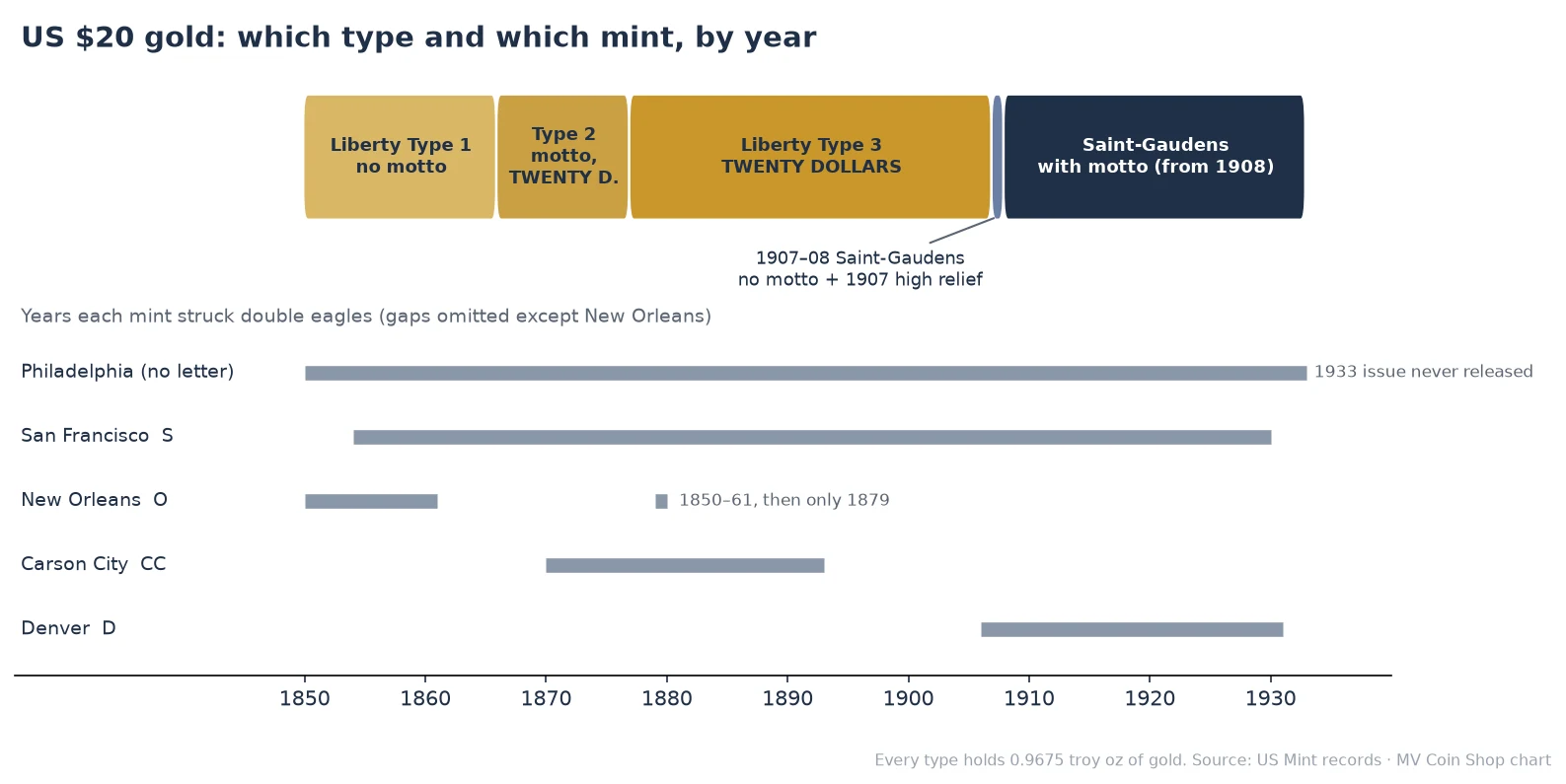
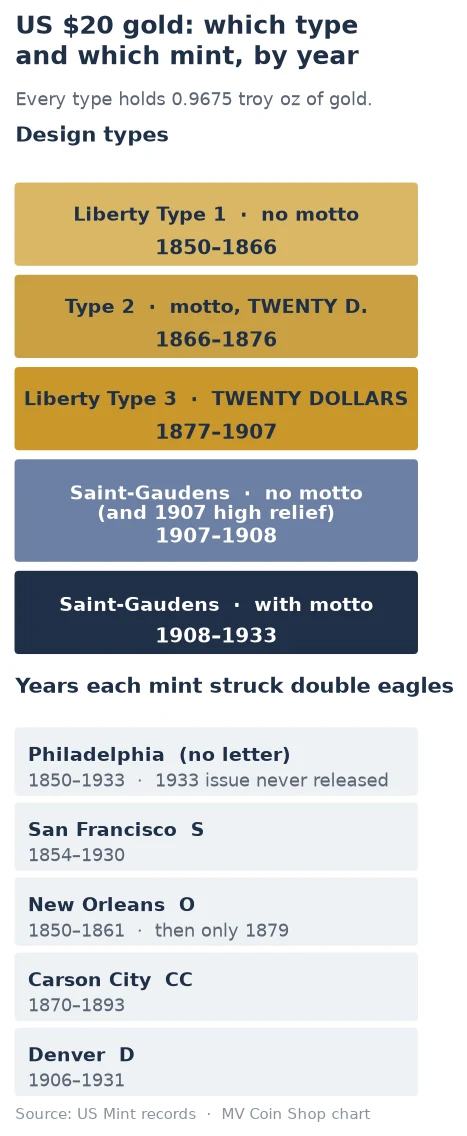
Two details catch people out. First, Saint-Gaudens coins struck from 1912 onward have 48 stars around the rim instead of 46, because Arizona and New Mexico joined the Union. Second, the 1907 high relief Saint-Gaudens, dated in Roman numerals (MCMVII), is a separate and far scarcer coin than the regular 1907 issue. If yours shows a Roman-numeral date and deep, sculpted relief, set it aside and mention it when you contact me.
Which double eagles carry collector premiums
Most of the double eagles that families own are common dates. That is not bad news: a common date still holds its gold. But a minority of coins carry real collector value beyond melt, and those are the ones a careful evaluation is designed to catch.
- Carson City (CC) Liberty coins, 1870–1893. The Nevada mint struck double eagles in modest numbers, and collectors chase every date. Even worn CC coins draw collector interest.
- New Orleans (O) Liberty coins. The mint struck double eagles only from 1850 to 1861 and again in 1879. The 1879-O and several 1850s dates, such as 1854-O and 1856-O, are major rarities, and the rest are scarce.
- Type 1 and Type 2 Liberty coins in general. Many were lost at sea, melted, or carried overseas, so fewer survive than the original mintages suggest.
- Low-mintage Philadelphia Liberty dates from the 1880s and 1890s, such as 1882, 1885, 1886, and 1891, which were struck in small numbers.
- Late-date Saint-Gaudens branch-mint coins. Many 1920s and early 1930s Denver and San Francisco issues were still in government vaults when gold was recalled in 1933, and most were melted. Dates such as 1920-S, 1921, 1924-D, 1924-S, 1926-D, 1927-D, 1929, 1930-S, 1931, and 1932 are scarce as a result.
- Any date in high mint state, particularly in PCGS or NGC holders, where each grade step can matter.
By contrast, the dates most often seen are 1904 Liberty and 1924, 1927, and 1928 Saint-Gaudens pieces. Large numbers of these were shipped to European banks before 1933 and came back to the US market decades later, which is why they are plentiful in lightly circulated and lower mint-state grades.
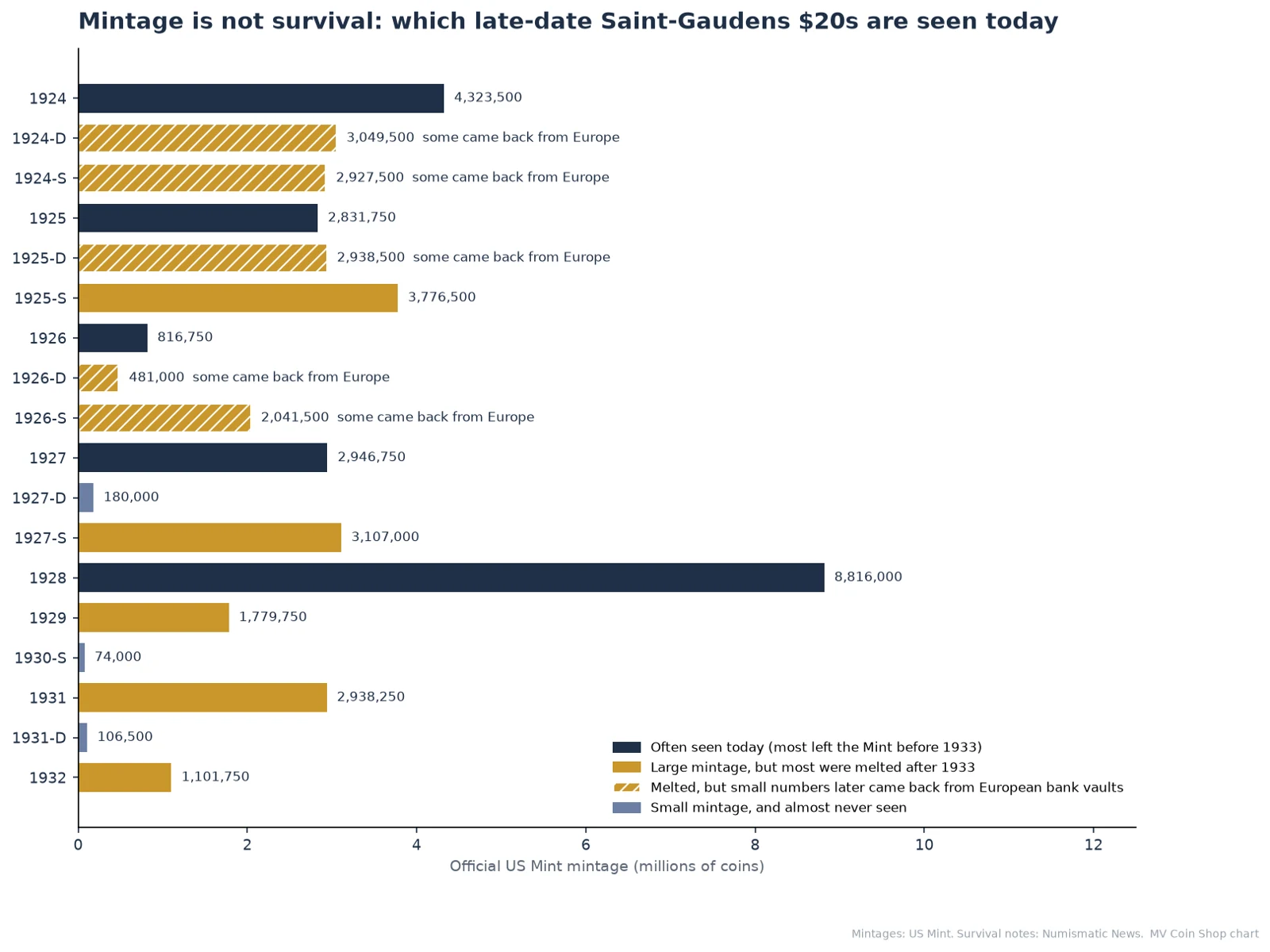
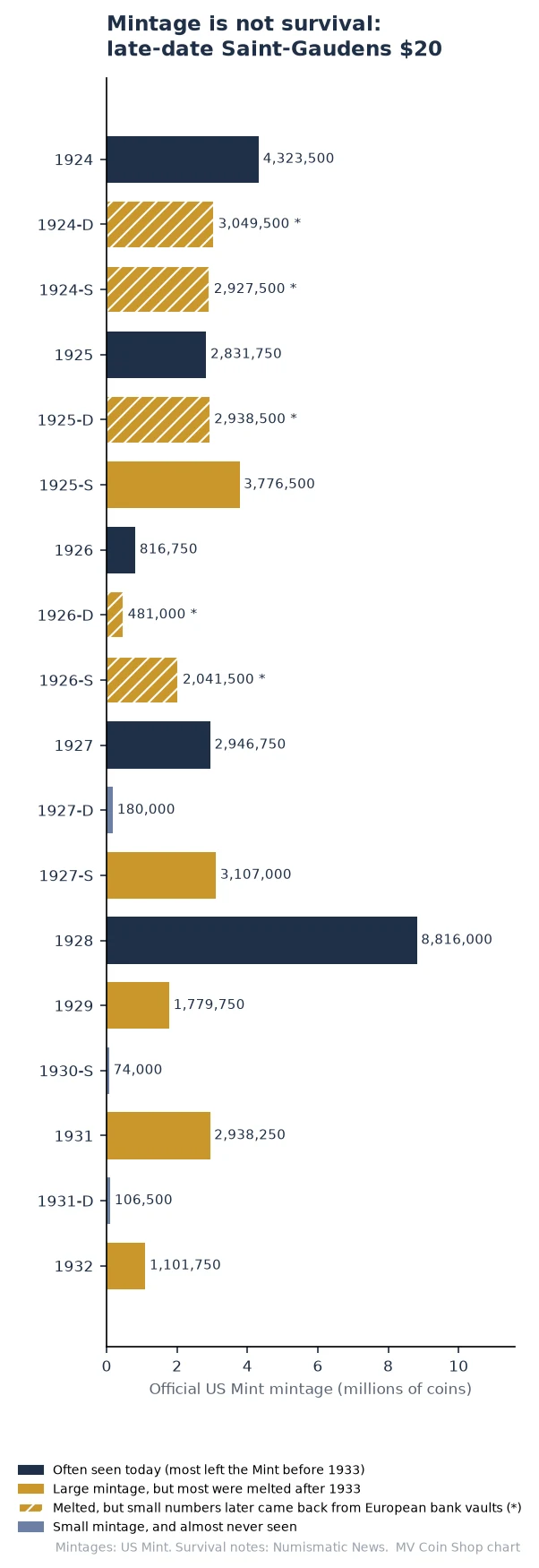
The chart uses official US Mint production figures, not estimates of how many coins survive. After gold was recalled in 1933, most late-date double eagles that were still in government vaults were melted. That is why a 1927-S, with more than 3 million coins struck, is seldom seen, while a 1928 Philadelphia coin is one of the dates people bring in most often. Mintage alone is not a guide to rarity. If you have a 1920-S, 1921, 1924-D, 1924-S, 1925-D, 1925-S, 1926-D, 1926-S, 1927-D, 1927-S, 1929, 1930-S, 1931, 1931-D, or 1932, set it aside and mention it when you contact me.
Have questions about your $20 gold coins? Contact David at (415) 952-6467 (call or text), hi@mvcoins.org, or our contact form for an individual evaluation.
Set this one aside
If one of these turns up, do not group it with the common coins. These are general reasons a double eagle gets a closer look, not values.
Swipe to see more
| Look for | Why it matters |
|---|---|
| CC mint mark (Carson City) | Small branch-mint output and strong collector demand in every grade. |
| O mint mark (New Orleans) | Struck in small numbers; the 1850s issues and the 1879-O are well known. |
| Philadelphia Liberty dates from the 1880s and early 1890s | Several of these had tiny business-strike mintages. |
| 1924-D, 1924-S, 1925-D, 1926-D, 1926-S | Most were melted. Small numbers came back later from European bank vaults, so they are scarce rather than unknown. |
| 1925-S, 1927-S, 1929, 1931, 1932 | Large mintages on paper, but most were melted after 1933, so few survive. |
| 1927-D, 1930-S, 1931-D | Small mintages and very few survivors. Any of these should be authenticated before anything else happens. |
| Any coin with original mint luster and few marks | Even a common date in high mint state is a different coin from a worn one. |
Why fake double eagles are common, and how they are spotted
A coin with nearly an ounce of gold is an attractive target for counterfeiters. Some fakes are gold-plated base metal; others are real gold of lower purity struck to pass as bullion, and some imitate scarce dates to capture a collector premium. A competent evaluation checks several things together rather than relying on one test:
- Weight and diameter. A genuine double eagle weighs 33.436 grams when new and measures about 34 millimeters across. Normal wear removes only a small fraction of a gram.
- Edge. Liberty coins are reeded; Saint-Gaudens coins carry raised lettering and stars. Mushy or uneven edge lettering is a warning sign.
- Design detail and surfaces. Fakes often show soft, grainy, or overly smooth fields, wrong letter shapes, and repeated identical marks shared across many pieces.
- Metal tests. A specific gravity check or a non-destructive XRF reading confirms the composition without harming the coin.
Certified coins add another check: the holder’s label, certification number, and coin should all agree. Counterfeit holders exist too, so I verify the certification number against PCGS or NGC records.
A double eagle that weighs right can still be a copy. Some copies are struck in real gold to the correct weight, and real coins have had mint marks added or altered to imitate scarcer dates. A careful check compares the weight, the diameter, the edge, and the fine detail together.
Gold content and melt reference for the $20
This is the metal value floor for any genuine double eagle at a dated reference spot price. Melt value is not an offer or a quote and does not indicate what we pay; every coin is evaluated individually.
Swipe to see more
| Coin | Gross weight | Fineness | Gold content (troy oz) | Melt at reference spot |
|---|---|---|---|---|
| US $20 Liberty or Saint-Gaudens | 33.436 g | .900 | 0.9675 | $3,454 |
Melt reference for your $20 gold coins
Type the reference spot from the table above, or another price, then enter a count. Melt value is not an offer or a quote and does not indicate what we pay. Every item is evaluated individually. Contact David at (415) 952-6467, hi@mvcoins.org, or our contact form to talk about yours.
A short list before you contact David:
- Identify the design (Liberty or Saint-Gaudens) and, for Liberty coins, the type.
- Write down dates and mint marks, and set aside the scarcer dates listed above.
- Do not clean, polish, dip, or unmount anything, and leave certified coins in their holders.
- Send photos of both sides, or bring the coins in, and contact David for an individual evaluation.
Double eagles in bezels and pendants
US gold coins have been worn as jewelry for a long time, and the $20 is the coin most often set in a pendant bezel or a belt buckle. These pieces are common in inherited collections and are worth a careful look before anything is taken apart.
- Leave the coin in the mount. Prying it out can scratch the rim or the fields. A bezel can be checked with the coin still inside.
- Look at the rim and edge. Solder spots, a filed or flattened edge, or a loop attached to the coin all leave marks. Certified coins with this history usually receive a details grade, with terms such as mount removed or damaged on the label.
- Check for holes. A hole removes gold, so it lowers even the metal value, not only the collector value.
- Mount and coin are separate items. A bezel is often a lower karat than the coin. The coin and the mount are valued separately.
Most ex-jewelry coins end up valued for their gold, but the date still matters, so I read it before deciding. Coins with clear jewelry damage are usually not good candidates for grading.
Have questions about a double eagle in jewelry? Contact David at (415) 952-6467 (call or text), hi@mvcoins.org, or our contact form for an individual evaluation.
What lowers the value of a double eagle
- Cleaning, polishing, or dipping. Hairlines and an unnatural shine remove most collector interest.
- Jewelry use. Bezel marks, solder on the rim, loops, and holes leave a coin valued mainly for its gold.
- Heavy bag marks and rim dings. The double eagle’s size and weight made it prone to contact marks, and deep ones lower the grade.
- Breaking coins out of old holders. An older PCGS or NGC holder is part of the coin’s story; leave it intact.
What I check first, in order
- The design. Liberty Head (1850 to 1907) or Saint-Gaudens (1907 to 1933). For Liberty coins I also note the type, which changed with the reverse motto and the denomination lettering.
- Date and mint mark. On a Liberty $20 the mint mark is on the reverse, below the eagle. On a Saint-Gaudens it is on the obverse, above the date. This is where most scarce coins are found, and where altered coins show tool marks.
- Weight and diameter. A genuine double eagle weighs 33.436 grams and measures about 34 millimeters across. I check both against those figures.
- Detail and surfaces. Under a loupe: the lettering, the stars, the edge reeding, and the texture of the fields. Cleaning, polishing, and jewelry marks change how a coin is treated.
- Sort. Every coin goes into one of two groups, valued as gold or set aside as a possible collector coin, and the set-aside coins get the grading question below.
Have questions about your double eagles? Contact David at (415) 952-6467 (call or text), hi@mvcoins.org, or our contact form for an individual evaluation.
Grade it or sell it raw?
A PCGS or NGC holder does two jobs: it settles authenticity, and it puts a grade on the coin that any later buyer can read. Grading has a cost and takes time, so it only makes sense when the answer could change how the coin is valued. As an ANA member who submits coins to PCGS and NGC, these are the questions I go through with a seller before anyone pays a fee.
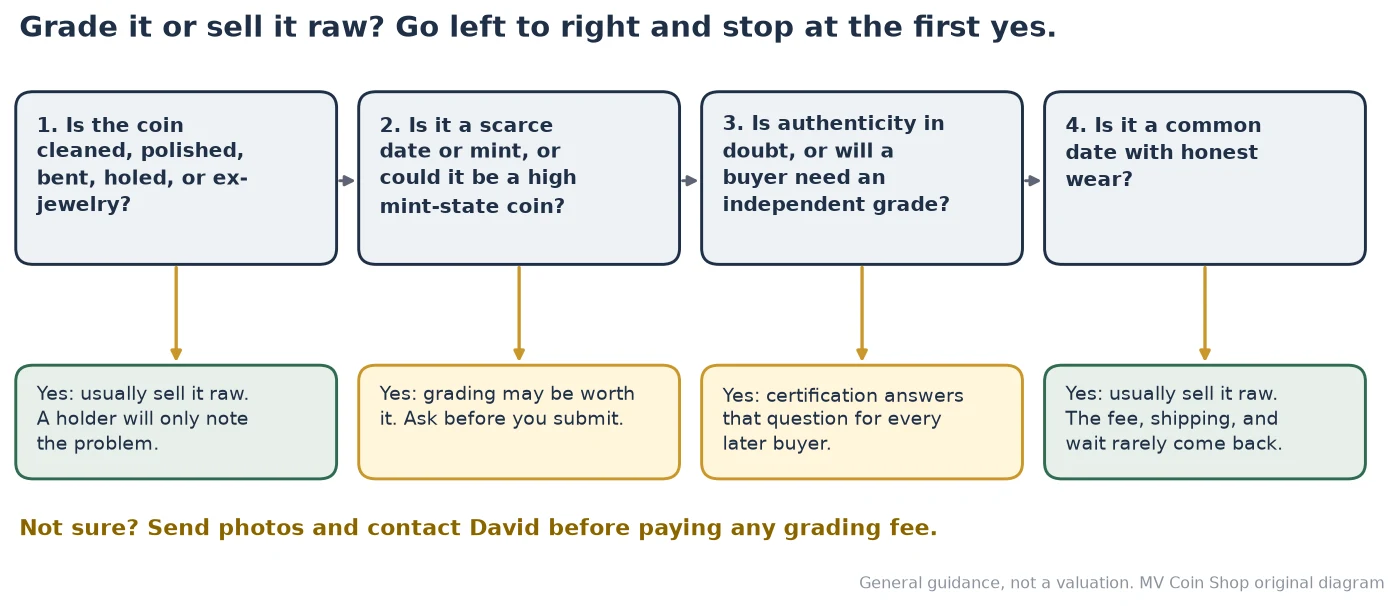
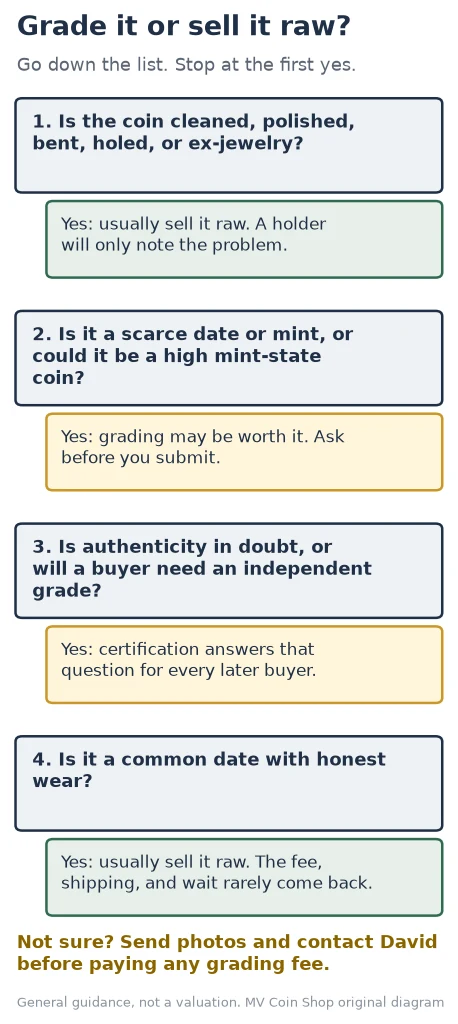
- Cleaned, polished, bent, holed, or ex-jewelry? The holder will usually just record the problem, so selling the coin raw is normally the sensible route.
- A scarcer date or mint, or a coin that may be a high mint-state piece? This is where a grade can make a real difference. Ask before you submit, because the date, the surfaces, and the strike all decide whether it is worth it.
- Is authenticity the open question? Certification answers it once, for every buyer who handles the coin after you.
- A common date with honest wear? The fee, the shipping, and the wait rarely come back, so most of these coins are best sold as they are.
Have questions about whether to grade a coin? Contact David at (415) 952-6467 (call or text), hi@mvcoins.org, or our contact form for an individual evaluation.
How an evaluation works
1. Contact David. Call or text (415) 952-6467, email hi@mvcoins.org, or use our contact form. Photos of both sides of each coin, and the label of any holder, let me flag scarce dates early. Our photo guide shows how.
2. Coin-by-coin review. I separate common dates from coins with collector interest, check authenticity, and grade the raw coins. Every coin is evaluated individually.
3. Your decision. We go through what affects the value of each coin. If a raw coin might be worth certifying first, I’ll tell you plainly, and you decide what to sell and what to keep.
4. Meeting and payment. Payment methods are agreed before any sale. We meet at our office in Mountain View, at a bank, at your home in the Bay Area, or work by insured mail-in if you are farther away.
If your double eagles are part of a larger estate, our inherited coin collection guide covers the rest of the collection, and our coin appraisal page explains written appraisals.
Questions about selling $20 gold coins
How much will you pay for my $20 gold coin?
We do not quote prices on the website. A double eagle always contains 0.9675 troy ounce of gold, and its date, mint, grade, surfaces, and any certification decide how much collector value it carries beyond that. Contact David at (415) 952-6467, hi@mvcoins.org, or the contact form for an individual evaluation.
How can I tell a Liberty $20 from a Saint-Gaudens $20?
The Liberty Head (1850 to 1907) shows a left-facing head wearing a coronet ringed by stars, with a heraldic eagle and shield on the back, and it has a reeded edge. The Saint-Gaudens (1907 to 1933) shows a full-length striding Liberty holding a torch, with a flying eagle on the back, and its edge carries the lettering E PLURIBUS UNUM between stars.
What is the difference between Type 1, Type 2, and Type 3 Liberty double eagles?
Type 1 coins (1850 to 1866) have no motto above the eagle. Type 2 coins (1866 to 1876) add IN GOD WE TRUST and still spell the denomination TWENTY D. Type 3 coins (1877 to 1907) spell it out as TWENTY DOLLARS. The types matter because the earlier ones survive in much smaller numbers.
I think I have a 1933 double eagle. Is it real?
Almost certainly not, and it should not be offered as one. The Mint struck 445,500 of them but never released them. Only one example has been ruled legal for private ownership, and it sold at auction in 2021. Pieces that turn up today are counterfeits or altered dates.
Are common-date double eagles valued only for their gold?
Not always. Common dates such as 1904 Liberty or 1924, 1927, and 1928 Saint-Gaudens pieces survive in large numbers, so in circulated grades they trade close to their gold content. Original mint-state examples, especially certified ones, can carry collector premiums, and the gap grows with grade.
Should I clean my double eagles before I bring them in?
No. Gold is soft and wiping, polishing, or dipping leaves hairlines that buyers see right away, and a cleaned coin loses most of its collector premium. Leave them exactly as they are, in the holders or flips they came in.
How do I sell double eagles to you?
Contact David by phone or text at (415) 952-6467, by email at hi@mvcoins.org, or through the contact form. Photos of both sides help, along with a count of how many Liberty and Saint-Gaudens pieces you have. Every coin is evaluated individually, and payment methods are agreed before any sale.
Contact David about your double eagles
Ready to talk about your $20 gold coins? Contact David: call or text (415) 952-6467, email hi@mvcoins.org, or send photos through our contact form. We look at every piece individually and explain what affects its value.
Related pages: pre-1933 US gold for $2.50, $5, and $10 pieces, sell gold coins for bullion and world gold, and selling graded coins for certified pieces.