
Quick answer
The Thorn Head is a 1921-S struck from a gouged front die. Every example shows a raised line from the top cotton leaf into Liberty’s cap, and early die states add more gouges off the cap. The common late state (1B6) sells for about $37–$165 circulated, $104–$282 in MS60 to MS63 and $288–$720 in MS64 and up, against $32–$80, $90–$130 and $205–$800 for a regular 1921-S. Rare early states can bring several times that.
Most 1921-S dollars are plain, softly struck coins worth a little over their silver. One front die stands apart. Early in its life something scraped across it, leaving deep gouges in the steel. Every coin that die struck shows the damage as raised metal, and the biggest gouge runs straight from a leaf in Liberty’s headdress into the rounded top of her cap.
Martin Field found the variety in October 1978. Collectors call it the Thorn Head because the earliest coins also show a sharp spike-like gouge beside the cap. Leroy Van Allen wrote it up as “An Amazing Dollar Die” in The Numismatist in June 2003, and it now sits on both the Hit List 40 and the WOW! list. The San Francisco Mint kept polishing and reusing it, so the Thorn Head comes in a run of die states rather than as one coin.
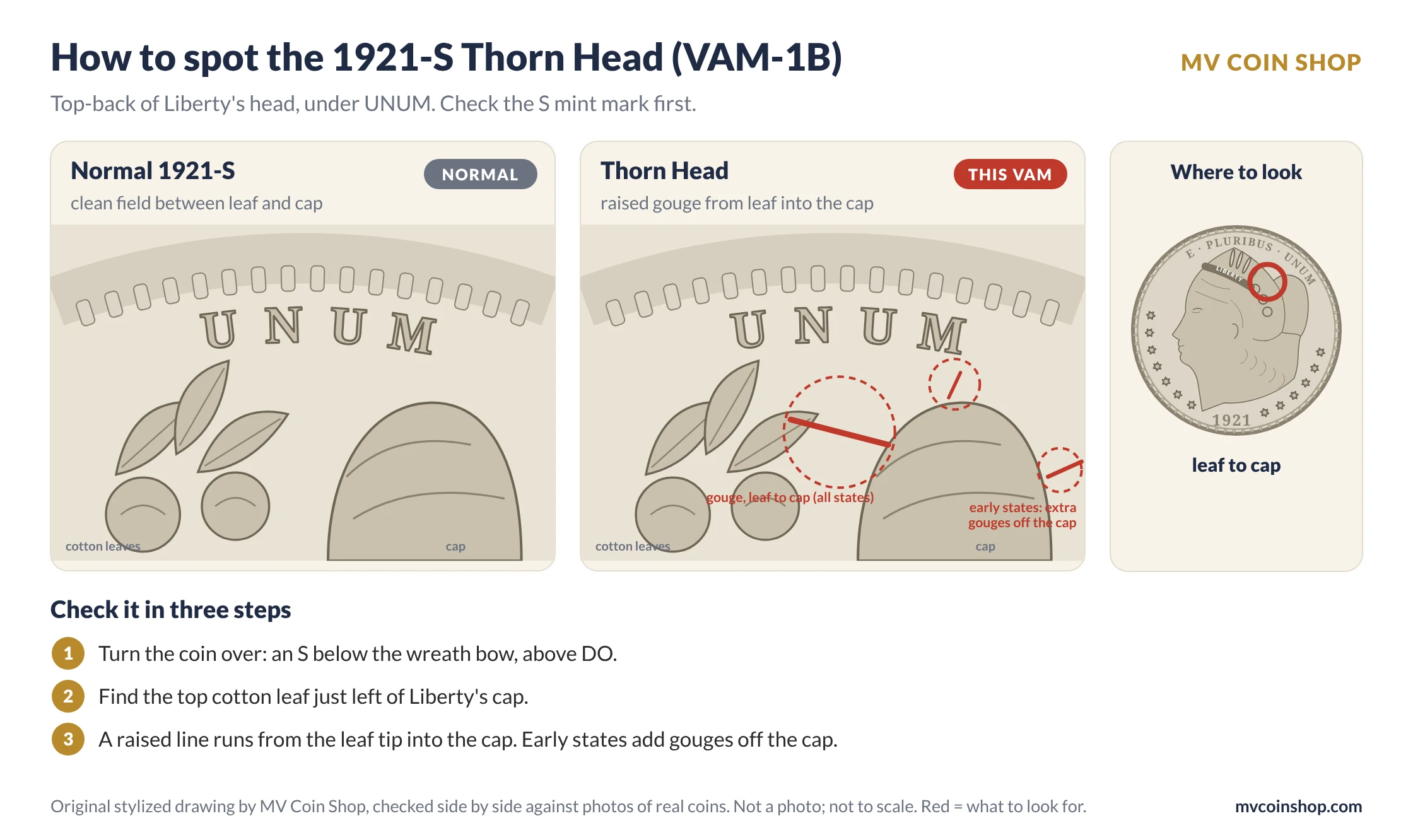
How to identify the 1921-S Thorn Head
- Check the back for the S mint mark between the wreath bow and DOLLAR. Only San Francisco used this die, so a coin with a D or no letter cannot be a Thorn Head.
- On the front, find the cotton leaves and blossoms in Liberty’s hair, just in front of her cap. Look at the uppermost leaf.
- Tilt the coin under a single lamp. A raised, straight line leaving the tip of that leaf and running into the left edge of the cap means you have one.
- Now look at the back of the cap and the field below UNUM. Extra gouges there, or a spike near the cap, point to an earlier and scarcer die state.
- Check the edge of the line with a 5x loupe. A true die gouge is raised and smooth-topped. A scratch on the coin itself is sunken and has sharp burrs.
Die markers to confirm it
- All states: raised gouge from the top cotton leaf to the cap fold.
- 1B1: a gouge out the back of the cap toward the rim and another in the field above the N of UNUM.
- 1B2: the field spike polished off, gouges inside the cap and in the rim teeth above N, heavy polish lines.
- 1B3: a gouge sticking up out of the top of the cap toward the right, the classic “thorn”.
- 1B4 and 1B5: the small wheat leaf gone, new gouges at IB, NU and above BU of PLURIBUS.
- 1B6: only the leaf-to-cap gouge remains. This is the state most collectors find.
- 1B7: an extra gouge at the Y of LIBERTY. Very few are known.
Die details summarized in our own words from the VAMWorld listings for these dies, which follow Leroy Van Allen’s attributions.
Thorn Head die states
The die was polished and reused, so the gouges changed over time. PCGS gives several states their own number. Populations and auction records below are as shown on PCGS CoinFacts on Nov 24, 2026.
| State | What to look for | PCGS # | PCGS population | PCGS auction record |
|---|---|---|---|---|
| 1B (generic) | PCGS label "Thorn Head", state not given | 134060 | 68 | $576 (AU55, 03/2014) |
| 1B1 | Gouges out the cap back and above N | 516350 | — | $648 (AU58, 12/2023) |
| 1B2 | Spike polished away, rim-tooth gouges | 418917 | 18 | $2,400 (MS62, 12/2023) |
| 1B3 | Gouge up out of the top of the cap | 413034 | 9 | $32 (AU50, 03/2019) |
| 1B4 | Leaf gone, gouges at IB and NU | 413037 | 46 | $1,680 (MS62, 12/2023) |
| 1B5 | Extra gouge above BU | 413040 | 38 | $600 (MS62, 02/2020) |
| 1B6 | Leaf-to-cap gouge only | 413043 | 140 | $1,350 (MS63+, 01/2019) |
| 1B7 | Gouge at the Y of LIBERTY | 509857 | — | $7,050 (AU53, 04/2017) |
What the 1921-S Thorn Head is worth
| Grade band | What it sells for | Regular coin, same band |
|---|---|---|
| Circulated (Good to AU) | $37–$165 | $32–$80 |
| MS60 to MS63 | $104–$282 | $90–$130 |
| MS64 and up | $288–$720 | $205–$800 |
| Date | Grade (PCGS) | Price | Venue |
|---|---|---|---|
| 12/2023 | MS64+ | $720 | Heritage |
| 12/2023 | AU53 | $94 | Heritage |
| 07/2023 | AU55 | $168 | Stack’s Bowers |
| 03/2023 | MS64 | $432 | Heritage |
| 09/2022 | MS62 | $159 | Heritage |
| 09/2022 | AU50 | $84 | Heritage |
| 08/2022 | AU58 | $101 | Heritage |
| 06/2022 | AU55 | $89 | Heritage |
Sales summary: PCGS-graded auction sales recorded by PCGS CoinFacts #413043 (2013–2023): XF45 $36–$60, AU50 $74–$84, AU53 $94, AU55 $37–$168, AU58 $69–$165, MS61 $153–$182, MS62 $104–$282, MS63 $89–$294, MS64 $288–$432, MS64+ $720. Scarcer states bring more.
How rare is the 1921-S Thorn Head?
Our rating runs from 1 (easy to find) to 5 (very rare). It is our judgment from the PCGS population, how often the variety appears at auction and how often we see it, not an official scale.
| Coin | PCGS # | Below 60 | 60 to 62 | 63 | 64 | 65 and up | Total |
|---|---|---|---|---|---|---|---|
| Thorn Head (generic) | 134060 | 55 | 3 | 6 | 4 | 0 | 68 |
| Thorn Head 1B2 | 418917 | 12 | 3 | 3 | 0 | 0 | 18 |
| Thorn Head 1B3 | 413034 | 7 | 0 | 2 | 0 | 0 | 9 |
| Thorn Head 1B4 | 413037 | 35 | 8 | 3 | 0 | 0 | 46 |
| Thorn Head 1B5 | 413040 | 29 | 4 | 4 | 1 | 0 | 38 |
| Thorn Head 1B6 | 413043 | 78 | 19 | 23 | 16 | 4 | 140 |
Look-alikes and common mistakes
The 1921-S VAM-15E uses the same front die before the damage, so it has none of the gouges. VAMWorld also lists a “pre-thornhead” state, 1B0, with no gouges yet; it carries no Thorn Head premium. Do not confuse the gouge with a hairline scratch: a scratch is cut into the coin and catches light along its edge, while the Thorn gouge stands up above the surface. Lots of 1921-S dollars also show light die polish lines in the same area, which are thin, parallel and run in groups.
What collectors say
The Thorn Head is unusual because the damage is large, visible without a loupe and changed as the die was reworked. VAMWorld counted about 400 attributed examples by 2016, and more than half were the late 1B6 state. Collectors who chase it tend to want one of each state, which is why the 1B2 and 1B4 have brought $1,680 to $2,400 in MS62 at Heritage while a 1B6 in the same grade sells for a fraction of that.
Think you have one? Send us clear photos or book a free look. We will tell you which die it is and what it would bring, with no obligation. If you decide to sell, we also buy Morgan dollars.
Frequently asked questions
How much is a 1921-S Thorn Head worth?
The common 1B6 state sells for about $37–$165 circulated and $104–$282 in MS60 to MS63, based on PCGS-graded sales. Early states sell for more: a 1B7 brought $7,050 in AU53.
How do I know if my 1921-S is a Thorn Head?
Look for a raised line from the top cotton leaf in Liberty's hair into the edge of her cap. It is visible without a magnifier on most coins.
Does PCGS label the Thorn Head?
Yes. PCGS attributes it as VAM-1B and also by die state (1B1 to 1B7) for several states, each with its own PCGS number.
Is there a Thorn Head on 1921 or 1921-D dollars?
No. The Thorn Head die was used only at San Francisco, so every genuine example has an S mint mark.
Other 1921 varieties and related pages
- 1921 Morgan dollar VAM varieties, with the VAM finder
- 1921 Morgan dollar value by mint and grade
- Morgan dollar values (all dates)
- 1921 Pitted Reverse Morgan Dollar (VAM-41A and Hot 50 Dies)
- 1921 Wide Reed Morgan Dollar (Infrequently Reeded Edge)
- 1921-D TRU_T Morgan Dollar (VAM-1A2)
- 1921-D Capped R Morgan Dollar (VAM-1B1)
- 1921 Wing Die Gouge Morgan Dollar (VAM-3F)
- 1921-D Unicorn Morgan Dollar (VAM-1N3)
- 1921-S BU Die Gouge Morgan Dollar (VAM-6A and 6B)
- 1921 Zerbe and Chapman Proof Morgan Dollars
- 1896 Morgan dollar VAM varieties
Sources
- Die descriptions: VAMWorld listing (checked Nov 24, 2026), summarized in our own words; Van Allen and Mallis, Comprehensive Catalog and Encyclopedia of Morgan and Peace Dollars.
- Price guide, population and auction records: PCGS CoinFacts #134060, PCGS CoinFacts #516350, PCGS CoinFacts #418917, PCGS CoinFacts #413034, PCGS CoinFacts #413037, PCGS CoinFacts #413040, PCGS CoinFacts #413043, PCGS CoinFacts #509857 and regular-coin #7300, checked Nov 24, 2026.
- Sales: PCGS CoinFacts sales and price guide (checked Nov 24, 2026) #134060, #413034–#413043, #418917, #509857; GreatCollections archive summary (via search, Nov 24, 2026).
By David, owner of MV Coin Shop, ANA member and PCGS and NGC submitter. Diagrams are original stylized drawings by MV Coin Shop, not photos. Updated November 24, 2026.