
I’m David. Stacks of 1950s and early-1960s proof sets are one of the things families most often find in a parent’s desk or safe, and I’ve been buying them for more than 14 years. This page explains what those sets contain, how much silver is in each one, and what affects the value of one set compared with another. I’m a member of the American Numismatic Association and a submitter to PCGS and NGC.
The US Mint resumed selling proof sets to collectors in 1950. Every set from 1950 through 1964 holds five coins struck twice on polished dies: a Lincoln cent, a Jefferson nickel, a Roosevelt dime, a Washington quarter, and a half dollar (Franklin through 1963, Kennedy in 1964). The dime, quarter, and half are 90% silver, which gives every one of these sets a silver content floor.
Next step: contact David about your proof sets. Call or text (415) 952-6467, email hi@mvcoins.org, or use our contact form. Every item is evaluated individually.
1950–1964 proof sets by year
Swipe to see more
| Year | Sets struck | Original packaging | Half dollar | Notes |
|---|---|---|---|---|
| 1950 | 51,386 | Box | Franklin | First proof set since 1942; lowest mintage of the era |
| 1951 | 57,500 | Box | Franklin | |
| 1952 | 81,980 | Box | Franklin | |
| 1953 | 128,800 | Box | Franklin | |
| 1954 | 233,300 | Box | Franklin | |
| 1955 | 378,200 | Box or flat pack | Franklin | Packaging changed partway through the year |
| 1956 | 669,384 | Flat pack | Franklin | |
| 1957 | 1,247,952 | Flat pack | Franklin | |
| 1958 | 875,652 | Flat pack | Franklin | |
| 1959 | 1,149,291 | Flat pack | Franklin | |
| 1960 | 1,691,602 | Flat pack | Franklin | Large Date and Small Date cent versions |
| 1961 | 3,028,244 | Flat pack | Franklin | |
| 1962 | 3,218,019 | Flat pack | Franklin | |
| 1963 | 3,075,645 | Flat pack | Franklin | Last Franklin half |
| 1964 | 3,950,762 | Flat pack | Kennedy | First Kennedy half; last 90% silver set |
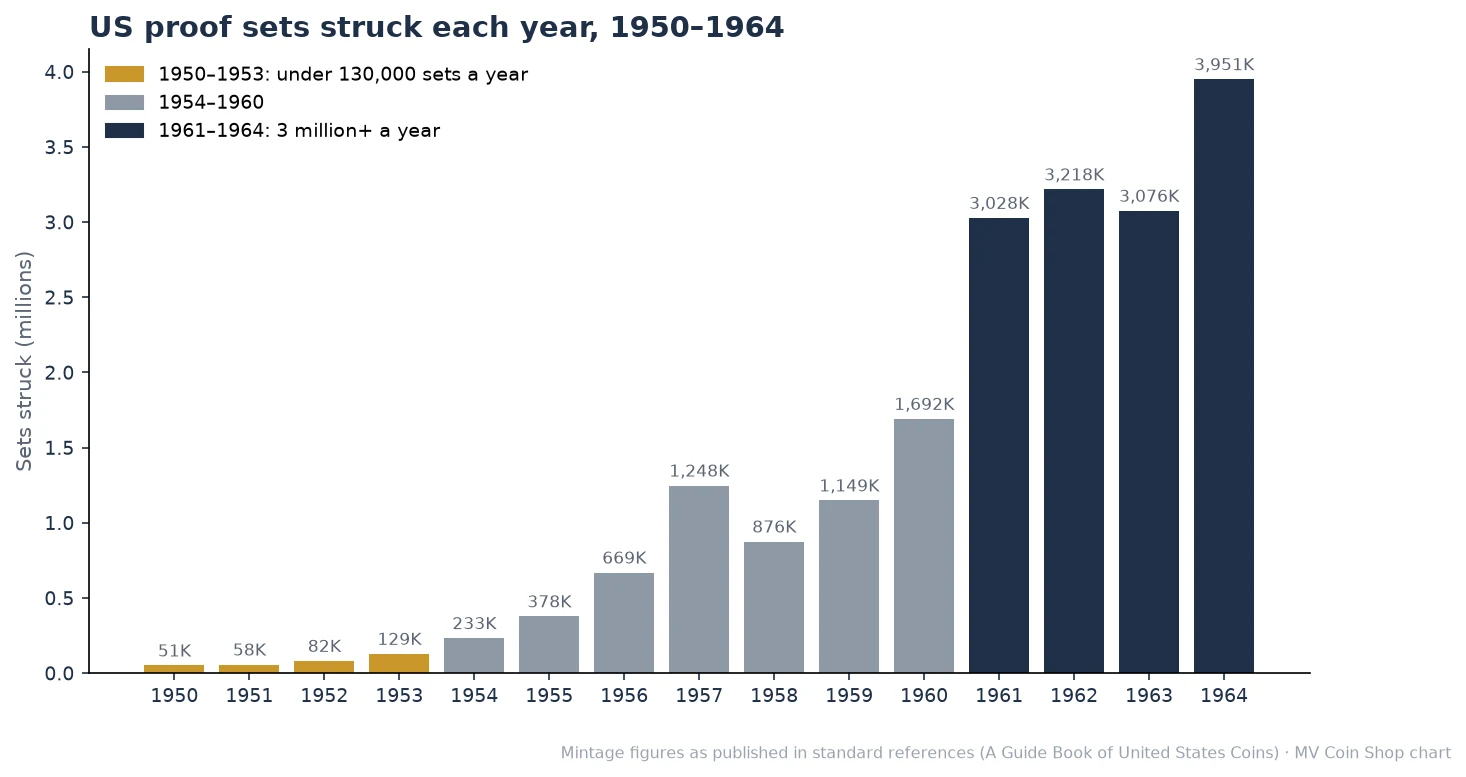
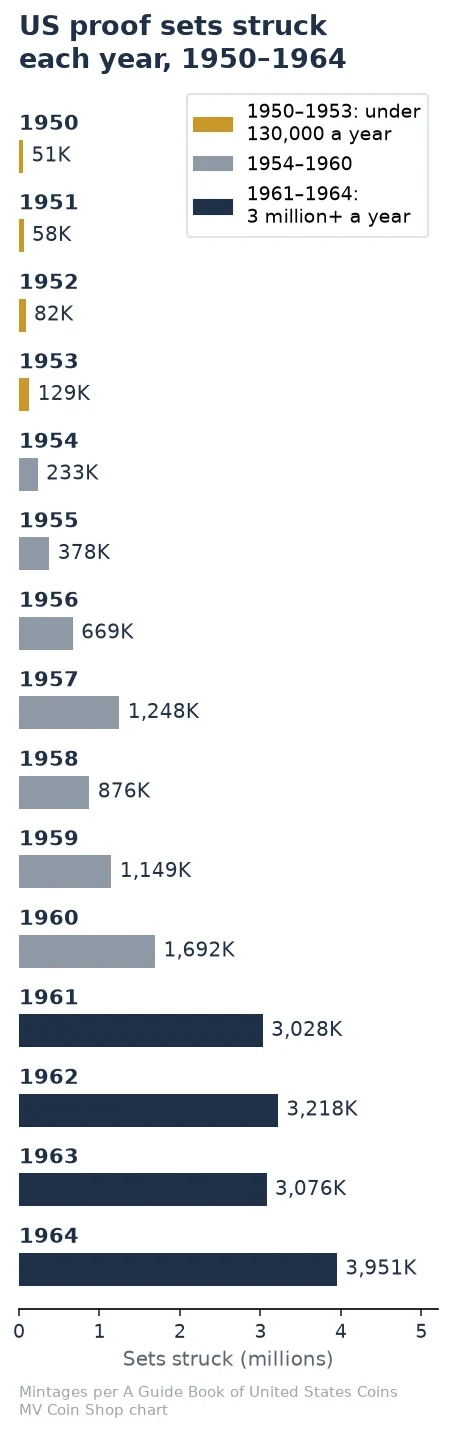
The chart tells most of the story. Collectors bought proof sets by the tens of thousands in the early 1950s and by the millions a decade later. For every 1950 set there are about 77 from 1964, and that scarcity is one of the things that affects value.
Silver content and the melt floor
The three silver coins in each set contain 0.6149 troy ounce of pure silver: 0.0723 in the dime, 0.1808 in the quarter, and 0.3617 in the half. Multiply 0.6149 by the silver spot price for the set’s melt value. Melt value is a metal-content fact, not an offer or a quote, and it does not indicate what we pay. Year, cameo contrast, packaging, and surfaces all affect value, so every set is evaluated individually.
Swipe to see more
| Coin | Silver content (troy oz) | Melt at reference spot |
|---|---|---|
| 1950–1964 proof set, per set (dime, quarter, half) | 0.6149 | $25.27 |
| Proof half dollar alone | 0.3617 | $14.87 |
| Proof quarter alone | 0.1808 | $7.43 |
| Proof dime alone | 0.0723 | $2.97 |
Melt reference for 1950–1964 silver proof sets
Type the reference spot from the table above, or another price, then enter a count. Melt value is not an offer or a quote and does not indicate what we pay. Every item is evaluated individually. Contact David at (415) 952-6467, hi@mvcoins.org, or our contact form to talk about yours.
Have questions about your proof sets? Contact David at (415) 952-6467 (call or text), hi@mvcoins.org, or our contact form for an individual evaluation.
What affects value beyond the silver
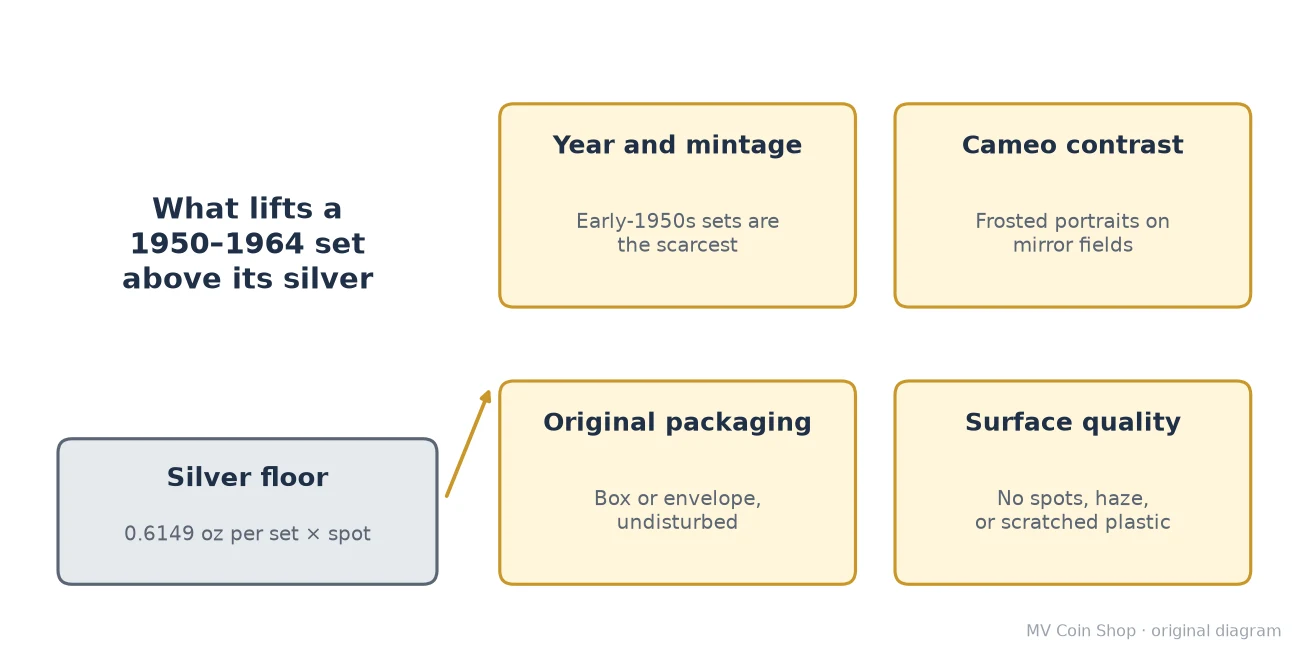
- Year and mintage. 1950 through 1953 are the scarce years; 1954 through 1957 are in the middle; 1961 through 1964 are the most plentiful.
- Cameo contrast. On some coins the raised portrait has a frosted white finish against mirror-like fields. Coins graded Cameo or Deep Cameo by PCGS or NGC are especially sought after by collectors, particularly from the early 1950s.
- Original packaging. Sets from 1950 to early 1955 came in small cardboard boxes with each coin in its own cellophane sleeve. From 1955 on they came flat, sealed in pliofilm inside an envelope. Original, undisturbed packaging is what buyers want to see.
- Surface quality. Milky spots, haze, dark toning that has turned blotchy, or scratched plastic all lower the value. Even, attractive toning on an original set can be a plus.
- Recognized varieties. The 1960 Small Date cent and the 1964 Accented Hair Kennedy half are two well-documented varieties found in proof sets that collectors look for.
How to check your sets before selling
- Sort by year and count how many of each you have. A short list like “three 1957, ten 1964” is a great start.
- Look through the plastic, not inside it. Tilt each set under a lamp and look for frosted portraits, spots, or haze.
- Keep boxes, envelopes, and inserts together. Do not move coins between sets or into new holders.
- Photograph the front of each set so the year and coins are readable. Our photo guide shows lighting that works through plastic.
Have questions about your proof sets? Contact David at (415) 952-6467 (call or text), hi@mvcoins.org, or our contact form for an individual evaluation.
Proof set checklist: varieties, cameo, and packaging
Use this list with the sets in hand and a good lamp. A loupe helps but is not required for most of it.
Swipe to see more
| Check | Where to look | What it tells you |
|---|---|---|
| 1956 Franklin half, Type 1 or Type 2 | Reverse: the eagle beside the bell. Count the feathers left of the perch: four on Type 1, three on Type 2 | Type 1 is the scarcer reverse in 1956 proof sets |
| 1960 cent, Small Date or Large Date | The date: Small Date digits are thick with a small round 0; Large Date digits are thinner with a larger 0 | Small Date proofs are the scarcer variety |
| 1961 Franklin half, doubled reverse | Strong doubling on the reverse lettering, clearest on E PLURIBUS UNUM | A recognized proof variety |
| 1964 Kennedy half, Accented Hair | Heavy hair lines above the ear; the I in LIBERTY lacks most of its lower left serif | A one-year proof variety |
| Cameo contrast | Tilt the set under a lamp: frosted portrait against mirror fields | Strong contrast is what PCGS and NGC designate Cameo or Deep Cameo |
| Packaging, 1950 to early 1955 | Small box with coins in cellophane sleeves | Original boxes are wanted; cellophane can leave hairlines or cloudy toning |
| Packaging, 1955 to 1964 | Flat pack: sealed pliofilm inside an envelope | Torn seals, writing, frayed edges, or discoloration lower the appeal |
| Swapped or reopened sets | Cut or resealed plastic, coins from different years | A set that has been opened is valued as loose coins |
Do not cut sets open to look closer; the varieties above can be checked through the plastic. If a set shows one of them, keep it separate and mention it when you get in touch.
Have questions about your proof sets? Contact David at (415) 952-6467 (call or text), hi@mvcoins.org, or our contact form for an individual evaluation.
Sets after 1964
From 1965 the Mint stopped using 90% silver in circulating dimes and quarters. Special Mint Sets from 1965 to 1967 and proof sets from 1968 to 1970 include a 40% silver half dollar, and most later sets are copper-nickel clad apart from separately sold silver editions. Those later sets are a different market from the 1950–1964 sets on this page; our proof set selling page covers how we handle them.
Grade it or sell it raw?
A PCGS or NGC holder does two jobs: it settles authenticity, and it puts a grade on the coin that any later buyer can read. Grading has a cost and takes time, so it only makes sense when the answer could change how the coin is valued. As an ANA member who submits coins to PCGS and NGC, these are the questions I go through with a seller before anyone pays a fee.
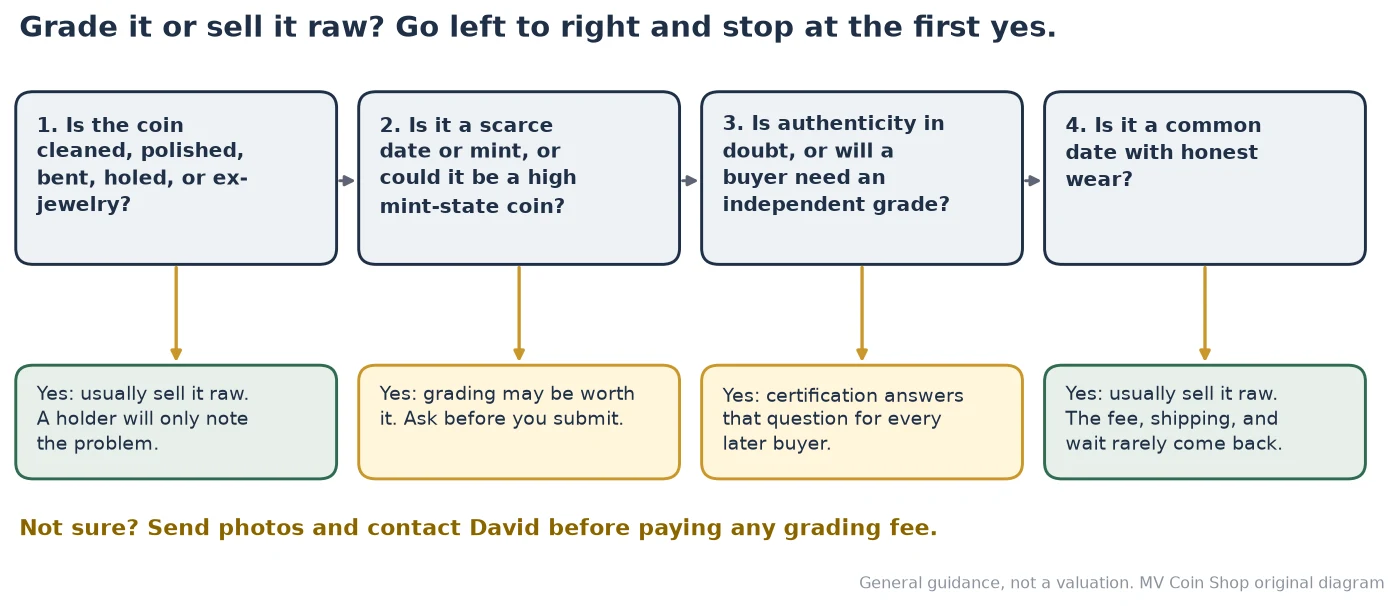
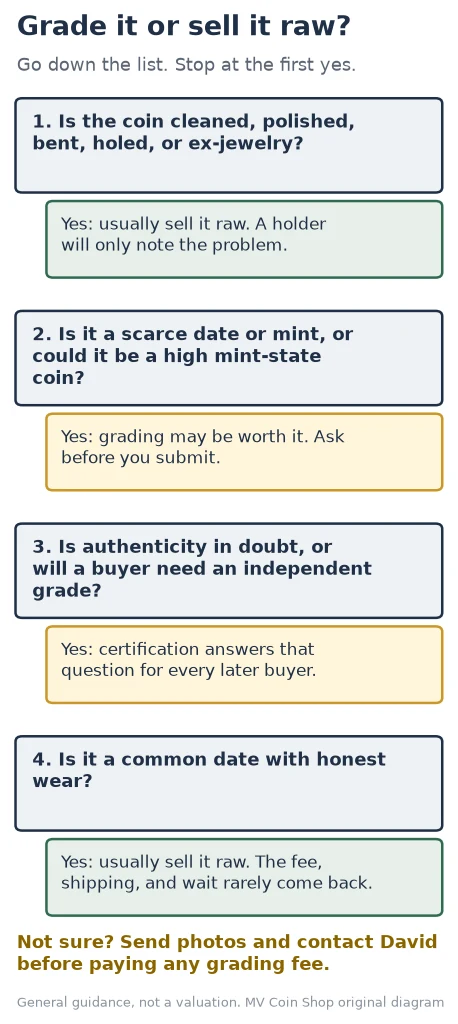
- Cleaned, polished, bent, holed, or ex-jewelry? The holder will usually just record the problem, so selling the coin raw is normally the sensible route.
- A scarcer date or mint, or a coin that may be a high mint-state piece? This is where a grade can make a real difference. Ask before you submit, because the date, the surfaces, and the strike all decide whether it is worth it.
- Is authenticity the open question? Certification answers it once, for every buyer who handles the coin after you.
- A common date with honest wear? The fee, the shipping, and the wait rarely come back, so most of these coins are best sold as they are.
For proof sets the question usually applies to a single coin, such as a strong cameo or one of the varieties above. Most sets are worth more left whole than broken up for grading, so ask before you open anything.
Have questions about whether to grade a coin? Contact David at (415) 952-6467 (call or text), hi@mvcoins.org, or our contact form for an individual evaluation.
Selling a stack of 1950–1964 proof sets
When a family brings in a run of these sets, I look at them by year and condition rather than as one lump, and I point out any set that deserves a closer look for cameo coins. Every set is evaluated individually, and you decide whether to sell all of them, some of them, or none.
We meet at our office in Mountain View by appointment, come to you in the Bay Area, or work by insured mail-in. Payment methods (cash, check, or bank transfer) are agreed before any sale. See sell proof sets for the process, and sell silver coins if the sets came with loose silver. If the sets are part of an estate, our inherited coin collection guide covers the rest. For other older US coins, start at coin values.
Questions about 1950–1964 proof set values
How much silver is in a 1964 proof set?
The dime, quarter, and half dollar in a 1964 set are 90% silver and together contain 0.6149 troy ounce of pure silver. The cent and nickel are not silver. Every US proof set from 1950 through 1964 has the same silver content.
How much will you pay for a 1964 proof set?
We do not quote prices on the website. A 1964 set contains 0.6149 troy ounce of silver, and it is the most common set of the era; strong cameo contrast or the Accented Hair Kennedy half can add collector value. Contact David at (415) 952-6467, hi@mvcoins.org, or the contact form for an individual evaluation.
Which 1950–1964 proof sets are the most valuable?
As a rule, the earliest. Fewer than 130,000 sets a year were made from 1950 through 1953, and the 1950 set has the lowest mintage of all. Within any year, sets with cameo coins and clean original packaging bring the most.
Should I take the coins out of the plastic to sell them separately?
No. Leave sets in their original packaging. Opening the cellophane or pliofilm exposes the coins to fingerprints and air, and undisturbed original sets are what collectors prefer. If a single coin deserves separate grading, we can tell you before anything is opened.
Do the 1950–1955 boxed sets differ in value from flat packs?
Original boxes from 1950 to 1955 add to collector appeal because many have been lost or replaced. What matters most is that the coins and packaging are original and the coins are clean. In 1955 both boxed and flat-pack sets were issued.
Do you buy proof sets by mail?
Often, yes. Contact David with photos of the front of each set and a count by year. Each set is evaluated individually, insured mail-in can be arranged, and payment methods (cash, check, or bank transfer) are agreed before any sale.
Contact David about your proof sets
Ready to talk about your proof sets? Contact David: call or text (415) 952-6467, email hi@mvcoins.org, or send photos through our contact form. We look at every piece individually and explain what affects its value.