
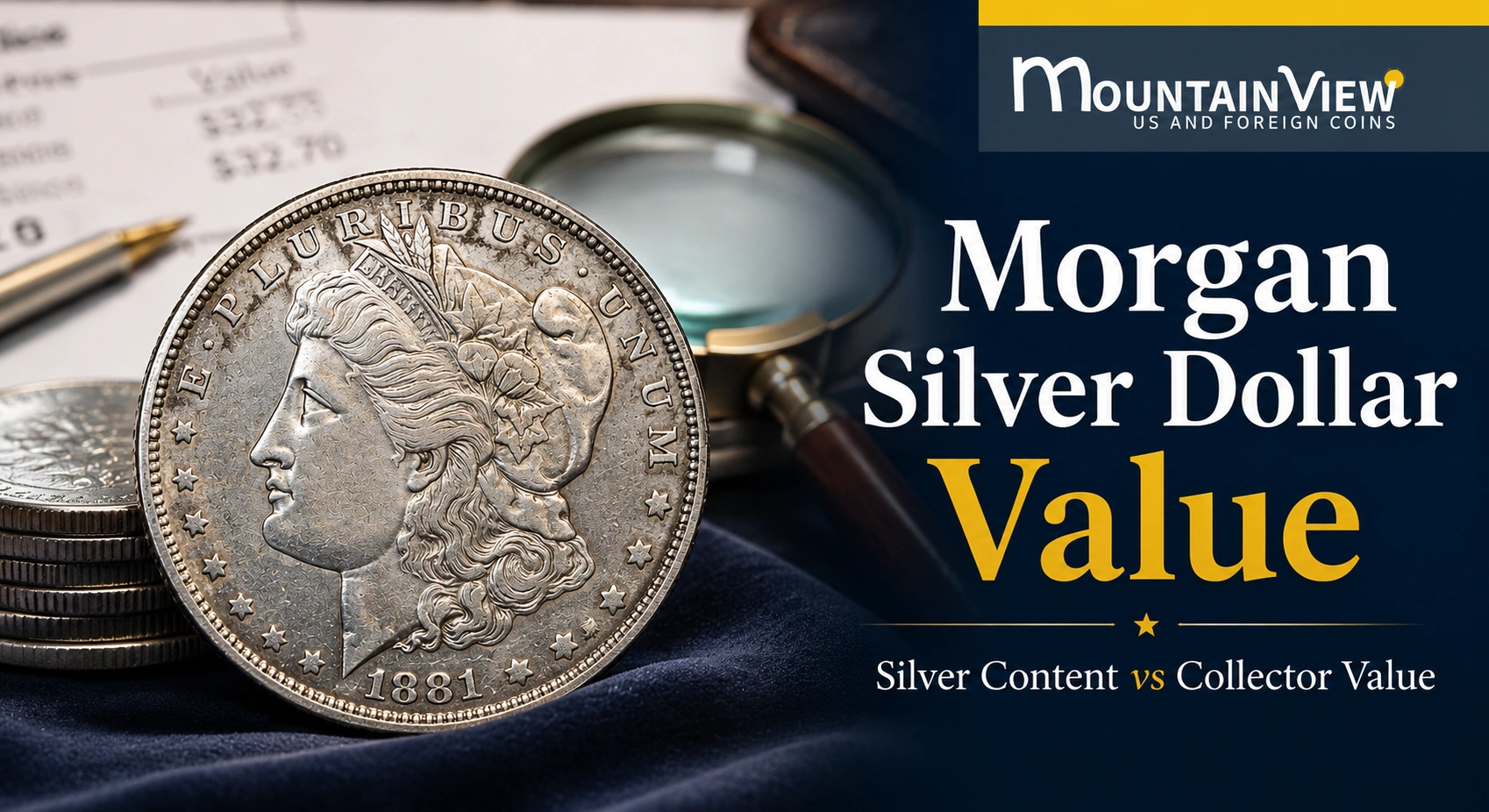
A Morgan Silver Dollar contains 0.7734 troy ounces of pure silver. The coin is struck in 90% silver and 10% copper. That silver content sets the absolute minimum price for every Morgan Dollar ever made, regardless of its date, condition, or mint mark.
Silver content is only where the value starts. For many Morgan Dollars, collector demand pushes the price far above what the metal alone is worth. Understanding both numbers is what separates an informed seller from one who undersells.
The Silver Composition of a Morgan Silver Dollar
Every original Morgan Silver Dollar minted between 1878 and 1904, and again in 1921, carries the same composition:
- Silver content: 90%
- Copper content: 10%
- Pure silver per coin: 0.7734 troy ounces
- Edge: Reeded
These specifications were set by the Bland-Allison Act of 1878 and remained unchanged across all five mints that struck Morgan Dollars: Philadelphia, Carson City, San Francisco, New Orleans, and Denver.
One common misconception is that a silver dollar contains a full troy ounce of silver. It does not. The 0.7734 figure is the actual silver content, derived from the 90% purity applied to the total coin weight.
The coin was designed by George T. Morgan, Assistant Engraver at the US Mint, and first struck in 1878. The obverse depicts Liberty facing left. The reverse shows an eagle clasping arrows and an olive branch. The same design was used across the full production run.
What Is the Melt Value of a Morgan Silver Dollar?
Melt value is the dollar amount of the pure silver in a coin calculated at the current spot price. For a Morgan Dollar, the formula is:
Melt Value = 0.7734 x current silver spot price per troy ounce
Silver spot price changes every trading day. The melt value of a Morgan Dollar moves with it. To find your coin’s current melt value, multiply 0.7734 by the live silver spot price at the time of calculation.
This melt value is the floor. No matter how worn or common a Morgan Dollar is, it is always worth at least this amount as silver metal. That guaranteed floor is why Morgan Dollars remain a consistent holding for collectors and precious metals buyers alike.
Why Silver Content Is Not the Only Number That Matters
Most Morgan Dollars are worth more than their melt value.
The reason is numismatic premium. Morgan Dollars are among the most widely collected coins in US history. Collector demand, combined with date, mint mark, and condition, creates value above and beyond what silver content alone justifies.
Common-date circulated Morgan Dollars regularly trade above melt value in the collector market. Morgan Dollars with rare mint marks, scarce dates, or high uncirculated grades can trade for many times their melt value.
How Mint Mark Affects Morgan Silver Dollar Value
Where a coin was struck matters significantly. The mint mark appears on the reverse, just below the bow of the wreath. Philadelphia coins carry no mint mark.
- Philadelphia (no mark): The most common production source for Morgan Dollars
- San Francisco (S): Known for generally strong strikes and good luster
- New Orleans (O): Often shows softer strikes than other mints
- Carson City (CC): The most sought-after mint mark among collectors
- Denver (D): Only struck Morgan Dollars in 1921, the final year of the original series
Carson City Morgans carry consistent premiums across nearly every date. Morgan Dollar production at the Carson City Mint ran from 1878 to 1893 with limited output throughout. Many CC Morgans were also melted under the Pittman Act of 1918, which reduced the number of surviving examples and made remaining coins more sought after in the collector market.
How Date and Key Dates Affect Morgan Silver Dollar Value
Not all years produced equal numbers of coins. Dates with low original mintages and low survival rates in collectible grades command the highest prices.
Key dates confirmed by PCGS CoinFacts include:
1893-S: The lowest-mintage business-strike Morgan Dollar. Very few survived in collectible grades. Considered the key date of the entire series.
1889-CC: Survival rates in uncirculated grades are extremely low despite a moderate original mintage. One of the rarest Carson City issues in Mint State condition.
1895 Philadelphia: No confirmed business strikes exist. Only proof specimens were struck. Known among collectors as “The King of Morgan Dollars.” It is the only date in the series where no circulated examples are believed to exist.
1893-CC and 1879-CC: Additional Carson City rarities with strong collector demand across all grades.
The 1921 Philadelphia issue, by contrast, was struck in very large numbers. Common-date 1921 Morgan Dollars in circulated condition typically trade close to melt value.
The practical lesson: two Morgan Dollars of identical weight and silver content can have vastly different values because of date and mint mark alone.
How Condition and Grade Affect Morgan Silver Dollar Value
Morgan Dollars are professionally graded on a scale from heavily worn to perfect uncirculated. Condition has a direct impact on value, particularly for scarcer dates.
A heavily worn Morgan Dollar and a fully uncirculated example contain exactly the same amount of silver. Their collector values are not the same.
Coins certified by PCGS or NGC carry a documented grade that buyers in the collector market trust. Uncertified Morgan Dollars in potentially high grades often sell at a discount because the buyer cannot independently verify the grade without professional examination.
For sellers, knowing the condition of a coin before selling, or having it evaluated by a qualified numismatist, directly affects what it is worth.
Original Morgan Dollars vs. Modern Morgan Dollars
The US Mint revived the Morgan Dollar design in 2021 as a collectible issue. These modern coins differ from the originals in composition:
- Original Morgan Dollars (1878 to 1921): 90% silver, 0.7734 troy ounces of pure silver
- Modern Morgan Dollars (2021 and later): 99.9% fine silver, one full troy ounce of pure silver
If you have a Morgan Dollar dated 2021 or later, it is a different product from the historical coins. It contains more silver by weight but carries a different value profile, produced as a collectible rather than as circulating currency.
Always check the date before calculating silver content or melt value on any coin described as a Morgan Dollar.
How Many Morgan Dollars Equal One Troy Ounce of Silver?
Each Morgan Dollar contains 0.7734 troy ounces of silver. That means a Morgan Dollar contains slightly less silver than a one-ounce bullion coin, and slightly more silver than the equivalent face value in pre-1965 quarters.
Morgan Dollars contain more silver per coin than any other common 90% silver denomination. At the same face value, a Morgan Dollar contains more silver than four pre-1965 Washington Quarters combined.
What a Coin Dealer Considers When Buying Morgan Silver Dollars
When a coin dealer buys a Morgan Dollar, the offer reflects two separate evaluations.
The first is melt value: the confirmed silver content multiplied by the current spot price. This is the floor every dealer starts from.
The second is numismatic premium: the additional value the collector market assigns based on date, mint mark, condition, and current demand. Reputable dealers reference current auction results and PCGS price data to determine where a specific coin trades above melt.
A dealer who quotes a single blanket price for all Morgan Dollars without examining individual dates and mint marks is pricing at melt. That is appropriate for bulk common silver but not for any coin with numismatic significance.
Individual evaluation of each coin by date, mint mark, and condition is the only way to know what a Morgan Dollar is actually worth. If you are ready to sell in the Bay Area, see how Mountain View US and Foreign Coins evaluates and buys Morgan Silver Dollars individually by date, mint mark, and grade.
Frequently Asked Questions
How much silver is in a Morgan Silver Dollar?
A Morgan Silver Dollar struck between 1878 and 1921 contains 0.7734 troy ounces of pure silver in a 90% silver and 10% copper composition.
How do I calculate the melt value of a Morgan Silver Dollar?
Multiply 0.7734 by the current silver spot price per troy ounce at the time of calculation. Silver spot price changes daily, so the melt value moves with it.
Are all Morgan Silver Dollars worth the same?
No. The silver content is fixed, so the melt value is the same across all original issues. Collector value varies significantly by date, mint mark, and condition. Common dates in circulated condition trade near melt value. Key dates and Carson City issues trade well above it.
What is the most valuable Morgan Silver Dollar?
The 1893-S is the most valuable business-strike Morgan Dollar due to its extremely low original mintage and very low survival rate in collectible grades. The 1895 Philadelphia is considered rarer among collectors because only proof specimens exist with no confirmed business strikes.
Should I sell my Morgan Silver Dollars for melt value?
Only if a qualified numismatic dealer has confirmed the specific coins carry no collector premium above melt. Many Morgan Dollars are worth meaningfully more than their silver content based on date, mint mark, and condition. A professional evaluation before selling ensures you know what you actually have.
What is the difference between original and modern Morgan Silver Dollars?
Original Morgan Dollars (1878 to 1921) contain 90% silver and 0.7734 troy ounces of pure silver. Modern Morgan Dollars issued by the US Mint from 2021 onward contain 99.9% fine silver and a full troy ounce of silver. They are different products with different compositions and different value profiles.
Free Morgan Silver Dollar Appraisals in Mountain View, San Jose, and the Bay Area
If you have Morgan Silver Dollars and want to know whether your coins are worth more than their silver content, Mountain View US and Foreign Coins provides free appraisals in person and by photo for sellers throughout Mountain View, San Jose, and the Bay Area.
Every coin is evaluated individually by date, mint mark, and condition against current market data.
Knowing the silver content of a Morgan Dollar tells you the floor. A qualified appraisal tells you the ceiling.